
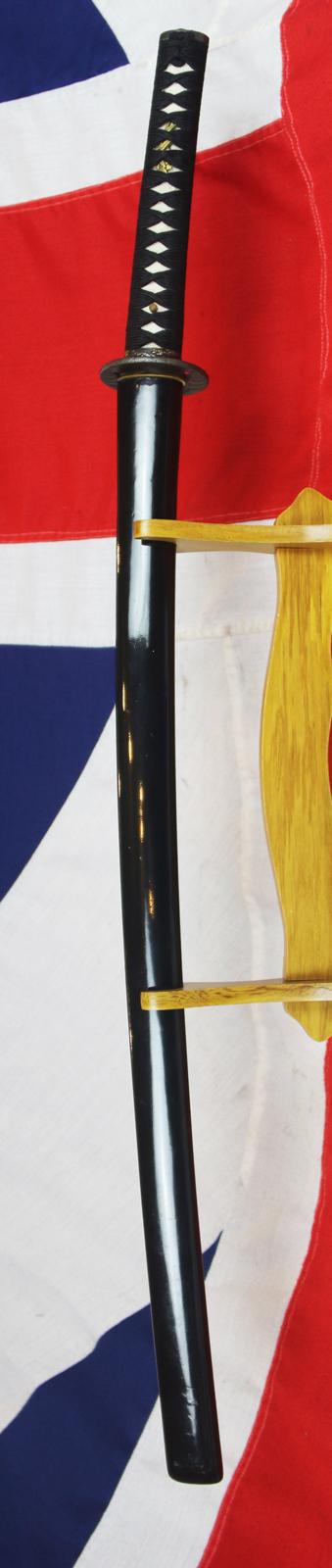

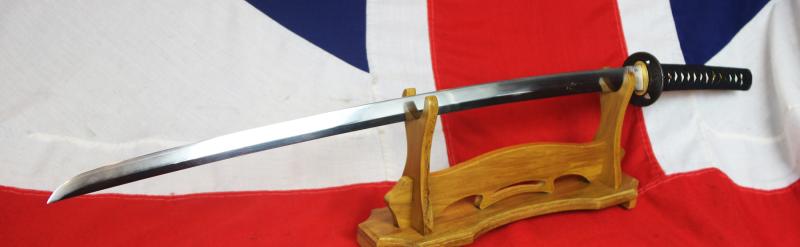
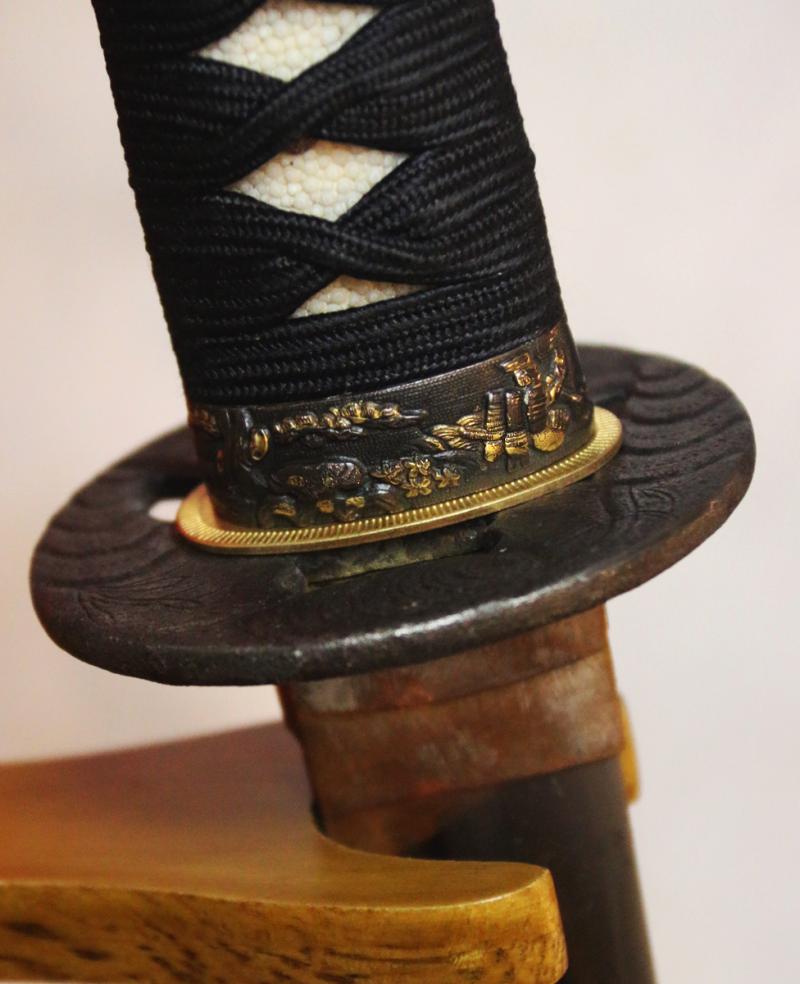
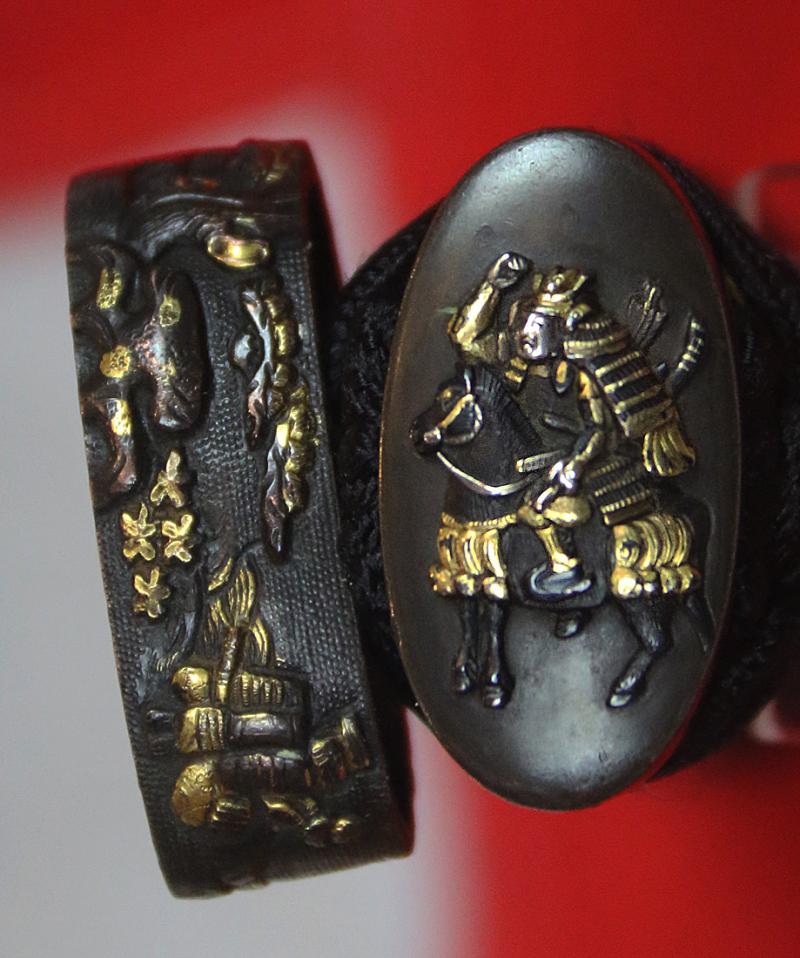
A Most Beautiful Signed Koto Katana, Circa1500's. All Original Edo Mounts of Onlaid Pure Gold, Silver & Shakudo Fuchi-Kashira of A Samurai Warrior In Armour On Horseback
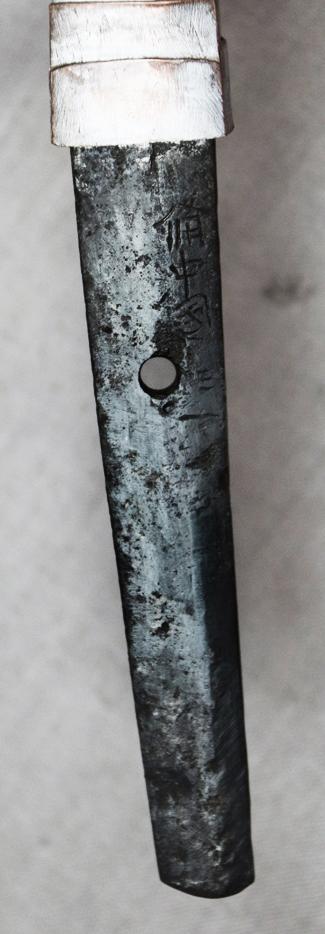
A circa 500 year old Koto period samurai katana blade, with a signed nakago, Bitchu ju Kuni... {the last part of the name can't be clearly read}.
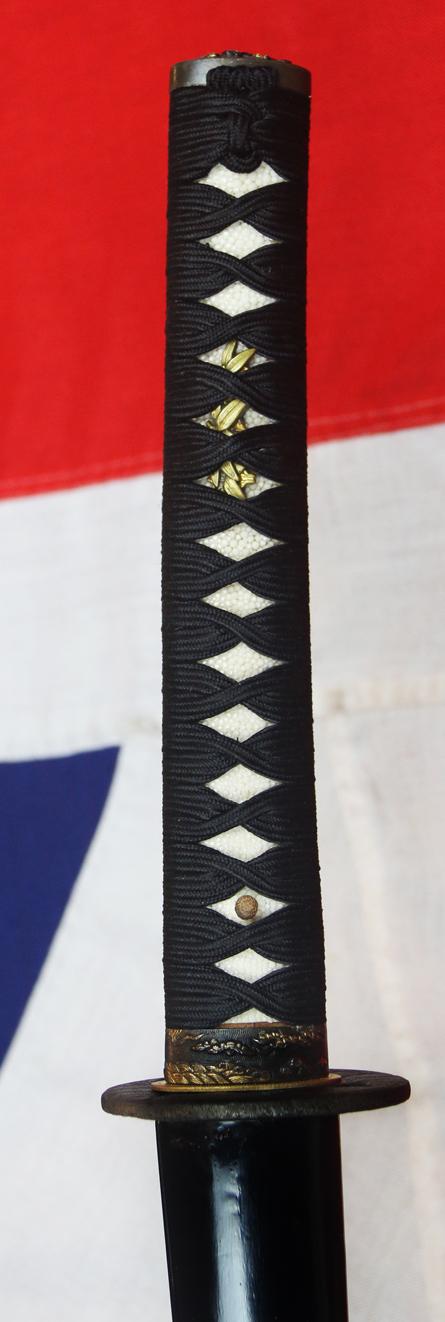
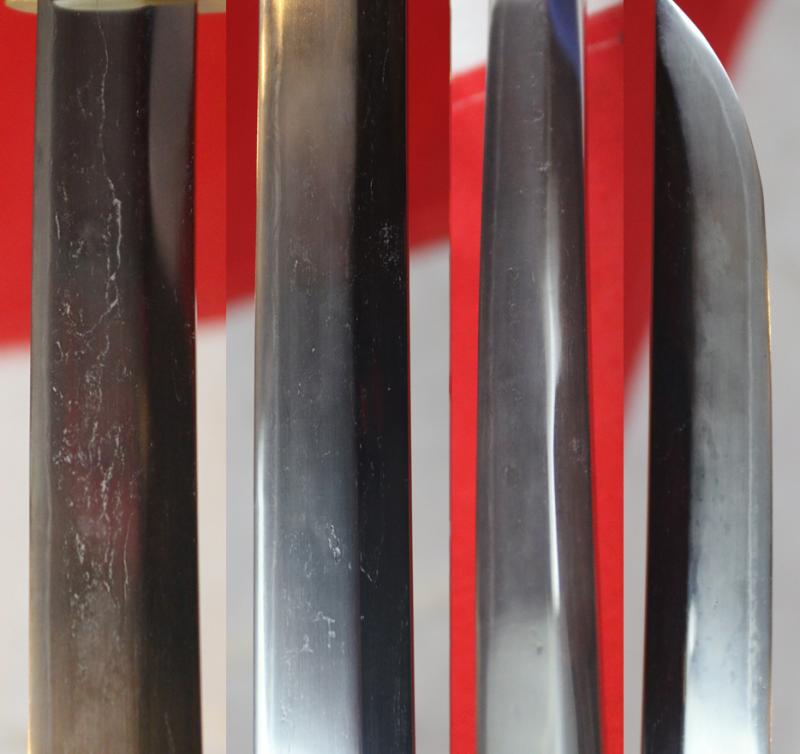
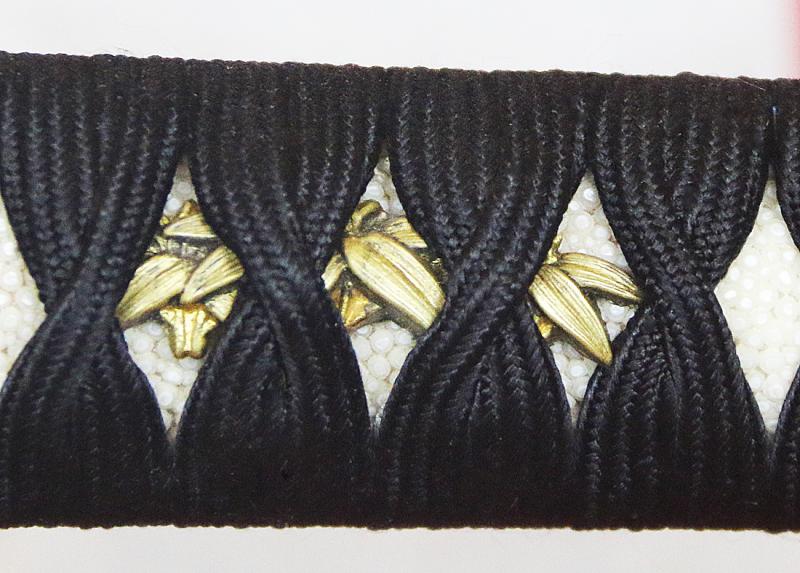
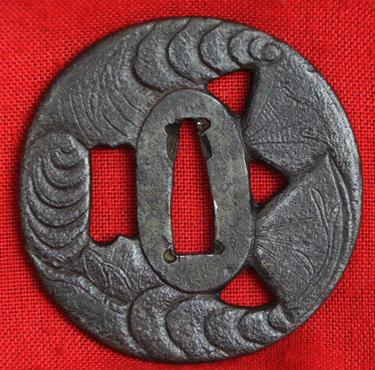
It has a very good suguha hamon, and a traditional silk bound over samegawa gint rayskin tsuka, with stunning shakudo fuchi-kashira with gold and silver decoration of a takebori samurai on horseback on the kashira, and a samurai by a shoreline with overhanging trees and wave,s on the fuchi, beautiful gold bamboo leaves menuki, circular iron tsuba chiselled with leaves, in its black urushi lacquered saya. Black tsuka-ito over gold bamboo leaves, on samegawa giant rayskin.
The motif of this iron tsuba’s takebori design seems to be numerous conch shells, known as “Horagai” (法螺貝). The conch shell originates from Hinduism and is closely linked to the teachings of Buddha. Historically, Yamabushi (mountain ascetics) used it to convey sermons. The conch was brought to Japan around 806 AD by monks like Kukai (空海) and Saicho (最澄), who returned from Tang China, with five of the eight bringing conch shells. Its sound represents the teachings of Buddha, making it a sacred instrument in Japanese esoteric Buddhism. The conch is one of the Eight Auspicious Symbols in Tibetan Buddhism, symbolizing purity and the dissemination of Buddhist teachings.
Shellfish have been eaten all over the world since ancient times. At the same time, they have been used in a wide variety of applications, such as coins, ornaments, daily necessities, and toys, due to the beauty and preservability of their shells. In Japan, there is also a folk belief that seashells with prominent projections are hung from the eaves to ward off evil spirits, and their names are said to ward off fire, such as the Suijigai (水字貝, 水 means water in Japanese). In addition, ascetic monks who trained in the mountains blew trumpet shells to exorcise evil spirits. During the Warring States period (戦国時代, 1467-1615), trumpet shells were used to signal the formation of battle lines and to boost the fighting spirit. It is only natural that this shell, which was used as a cue in battle and to raise the fighting spirit of soldiers, was incorporated into the decoration of armour, which is the uniform of fighting.
The samurai were roughly the equivalent of feudal knights. Employed by the shogun or daimyo, they were members of hereditary warrior class that followed a strict "code" that defined their clothes, armour and behaviour on the battlefield. But unlike most medieval knights, samurai warriors could read and they were well versed in Japanese art, literature and poetry.
Samurai endured for almost 700 years, from 1185 to 1867. Samurai families were considered the elite. They made up only about six percent of the population and included daimyo and the loyal soldiers who fought under them. Samurai means "one who serves."
Samurai have been describes as "the most strictly trained human instruments of war to have existed." They were expected to be proficient in the martial arts of aikido and kendo as well as swordsmanship and archery---the traditional methods of samurai warfare---which were viewed not so much as skills but as art forms that flowed from natural forces that harmonized with nature.
Some, it is said, warriors, didn't become a full-fledged samurai until he wandered around the countryside as begging pilgrim for a couple of years to learn humility. When this was completed they achieved samurai status and receives a salary from his daimyo paid from taxes (usually rice) raised from the local populace. Swords in Japan have long been symbols of power and honour and seen as works of art.
Shakudo {that can be used to make samurai sword mounts and fittings} is a billon of gold and copper (typically 4-10% gold, 96-90% copper) which can be treated to form an indigo/black patina resembling lacquer. Unpatinated shakudo Visually resembles bronze; the dark colour is induced by applying and heating rokusho, a special patination formula.
The Samurai sword, from all eras, in all its forms, has grown to be one of the most highly desired and iconic military antiques of all time.
There are many reasons why people enjoy collecting swords. Some people are drawn to the beauty and craftsmanship of swords, while others appreciate their historical and cultural significance. Swords can also be a symbol of power and strength, and some collectors find enjoyment in the challenge of acquiring rare or valuable swords.
One of the greatest joys of sword collecting is the opportunity to learn about the history and culture of different civilisations. Swords have been used by warriors for millennia, and each culture has developed its own unique sword designs and traditions. By studying swords, collectors can gain a deeper understanding of the people who made and used them.
Another joy of sword collecting is the sheer variety of swords that are available. There are swords in our gallery from all over the world and from every period of history. Collectors can choose to specialize in a particular type of sword, such as Japanese katanas or medieval longswords, or they can collect a variety of swords from different cultures and time periods. No matter what your reasons for collecting swords, it is a hobby that can provide many years of enjoyment. Swords are beautiful, fascinating, and historically significant objects.
** Authentic, currently, modern hand-made nihonto (Japanese sword blades) from top-tier, licensed swordsmiths in Japan today, typically start around $10,000–$25,000 for a katana, with prices often exceeding $60,000 for renowned masters or customized commissions. These, forged from tamahagane steel, require 12+ months to create due to strict legal limits on production, with some high-end, custom pieces from master smiths such as Yoshindo Yoshihara exceeding $10,000 for smaller tanto blades.
A brand new, katana blade from a reputable but lower ranked smith usually starts around $7,500–$10,000.
Master Smith Pricing, by high-ranking, famous, or award-winning smiths can range from $25,000 to over $60,000. With the added restriction that if the smith created a blade that was ranked high enough to be within the $ 60,000 range, it would be forbidden for it to leave Japan by law.
Japanese law limits smiths to producing roughly 24 long swords (katana/tachi) per year, significantly driving up demand and cost.
Every item is accompanied with our unique, Certificate of Authenticity. Of course any certificate of authenticity, given by even the best specialist dealers, in any field, all around the world, is simply a piece of paper,…however, ours is backed up with the fact we are the largest dealers of our kind in the world, with over 100 years and four generation’s of professional trading experience behind us.
Something else important to consider for potential collectors. Although it is fair to say that very fine, ancient, and available Japanese samurai swords are not the most inexpensive pieces to buy, compare them to the same equally highly ranked and available collectables in literally any other medium. The best available watercolour paintings will be priced from the hundreds of thousands to millions. The best available oil paintings will be from lower millions to tens of even hundreds of millions. The same for jewels, clocks, fine art, watches and certainly some rare vintage cars.
Of course, there are Japanese swords that can rank in value within the millions of pounds, in fact one of the most valuable works of art in the world, according to Forbes list, is a samurai sword, valued at 100 million dollars, and if a Masamune samurai sword ever appeared on the open market, it would certainly be priced at the ten’s of millions range. However, they simply are never available, but maybe, in theory, one 'might' appear on the open market but only every 50 to 100 years or so. However, the next level down within the world of collectable samurai swords, below the ‘very rarest’ of national treasure masterpieces, are available {and we have dozens of them} yet, they are still within the upper thousands to tens of thousand of pounds, which, by comparison, is utterly remarkable.
A wonderful Renoir, Cezanne, or any of best French Impressionist oil paintings are readily available though, in fact they appear for sale every month or so, in either London, Paris, New York or Tokyo, but, selling for tens or even the hundreds of millions of pounds range,and rare, early 1960's Ferraris can be also within that incredible range of value. So, where else can one find, within the collectable world of fine art, the finest ‘available’ collectable samurai sword, that can be less than one percent the cost of its equivalent competition. However, view a fabulous 500 year old samurai sword beautifully displayed and decorating a billionaire's home, and the uninformed will assume it will likely have cost millions of pounds, and it could certainly look as if it would have. But no, it will likely have been purchased for under £20,000.
Blade surface has areas of the usual age surface micro thinning seen in Koto blades
Blade 27.25 inches long tsuba to tip, overall sword length in saya 38 inches long
Code: 24182