
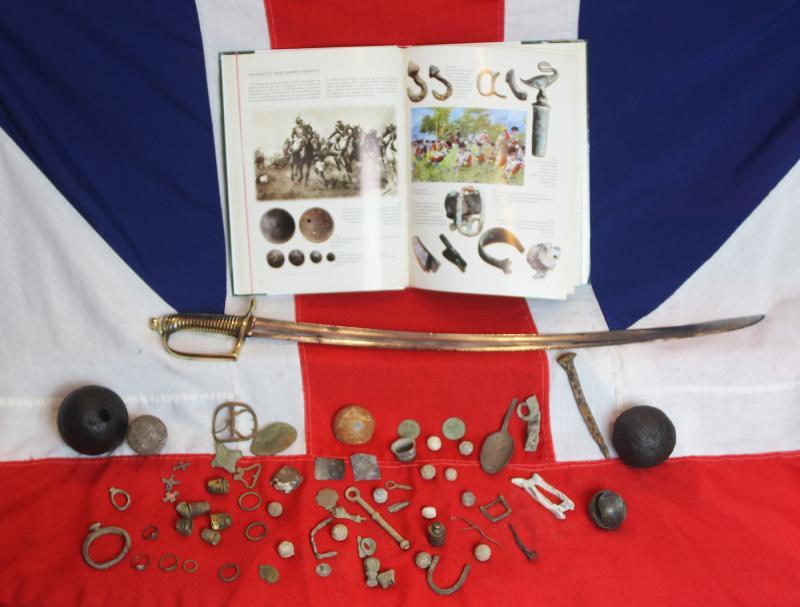
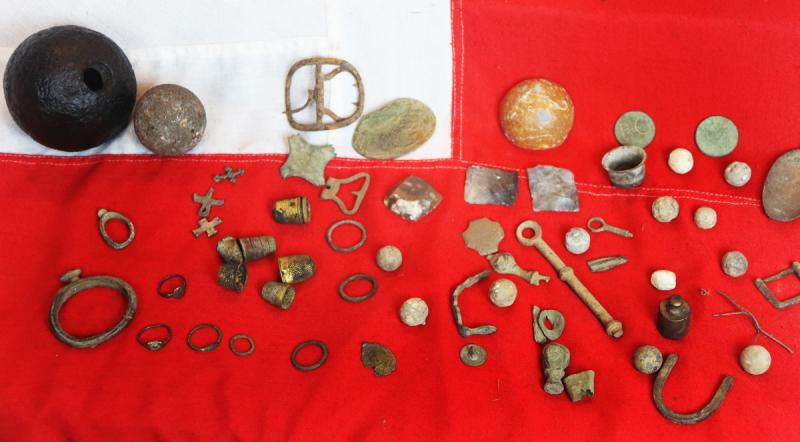
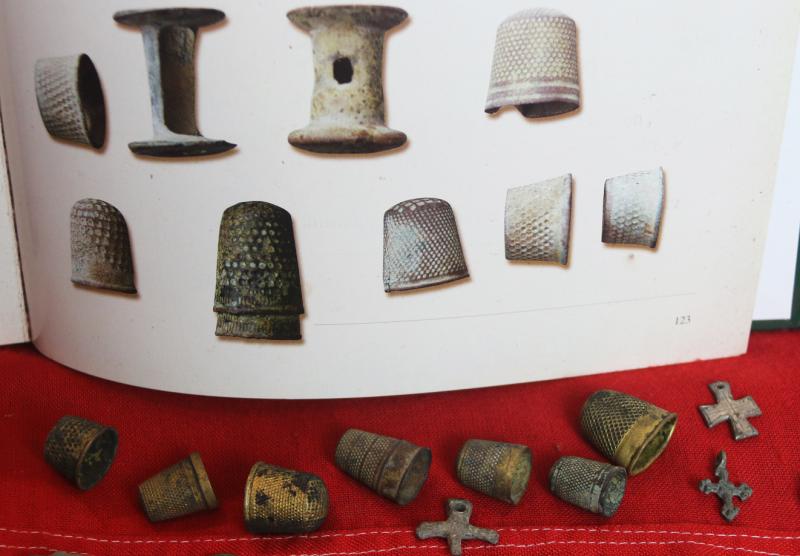
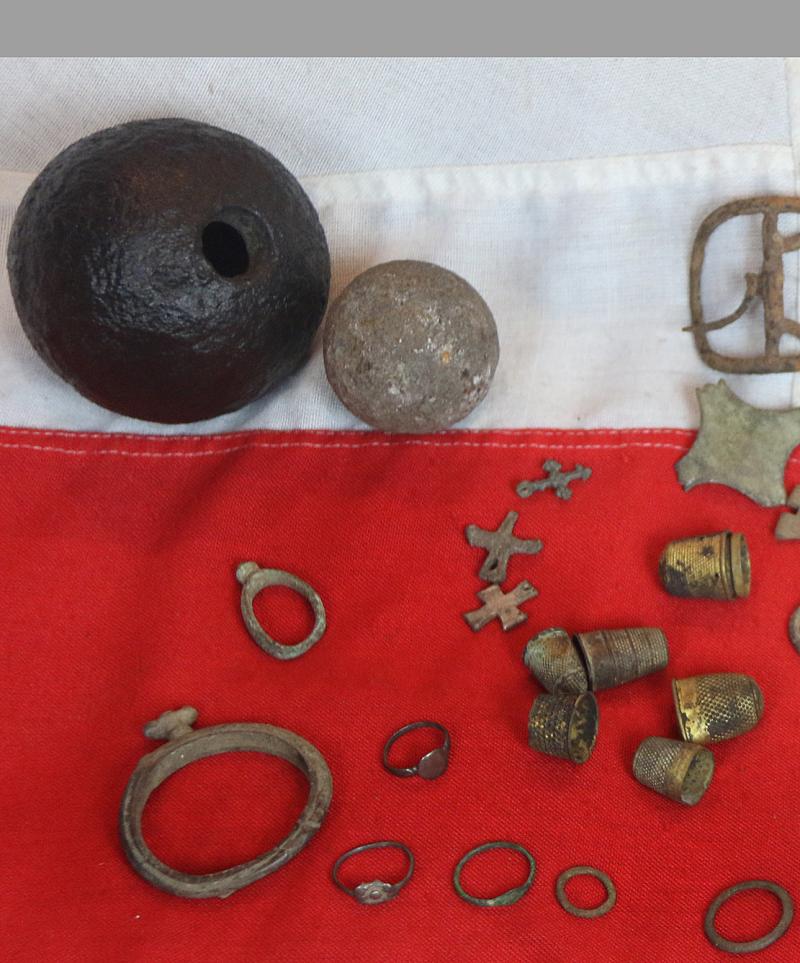
A Waterloo Soldiers Hussif or ‘Housewife’ Thimble. From Our Latest New Additions, Recovered from Waterloo. Whether We Find Private Collectors For our Pieces, or, For Public Museums Such As The Royal Armouries, Every Treasure Will Find A New Home
More photos of the thimble will be added on Saturday 27th. A British soldiers brass thimble from his ‘housewife’ pouch, recovered with a small collection, from the Waterloo battle site in the 1820’s by the Scottish, Hamilton family members {the 10th Duke of Hamilton} in their years long ‘Grand Tour’ of Europe and the Middle East. During the building of the huge monument, ‘The Lion Mound’, the local work force of hundreds of men were using the battle site excavation to supply thousands of tons of Waterloo battlefield soil. They subsidised their pay by selling to British ‘nobility tourists’ their precious finds, relics of the great battle. Our ‘housewife’ thimbles still show all thir excavation surface condition, completely untouched since then. We price are for each, a single, incredibly fascinating and intriguing thimble.
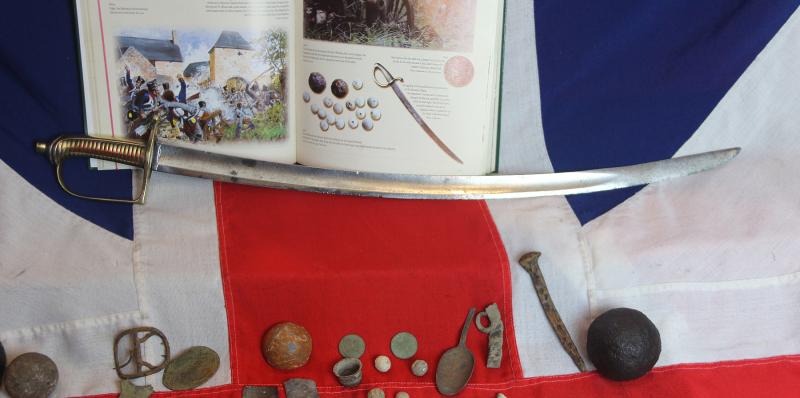
We are always thrilled to offer ‘re-discovered’ pieces from history, that can be found new owners to love and enjoy them, or museums that can display them for the enjoyment of all. A few years, for example we traced and acquired the second oldest known cannonball fired in combat in England. From the second battle of St Albans in the War of the Roses. That wonderful relic of history now resides in the St Albans museum, and was part of a public exhibition held from March 24, 2023 - June 28, See our re-discovered cannon ball, now on display in the St Albans museum, in the last photo in the gallery. All due thanks to SAHAAS President, Dr. John Morewood. A short while ago we furnished, for the Royal Armouries, Tower of London collection, a ‘Waterloo’ 1796 Heavy Cavalry Trooper’s sword, that was subsequently used in a fascinating documentary, filmed at the armouries, presented by Sean Bean
We have more from our Waterloo recovered souvenirs to add this coming week. Some very small, amazing yet most inexpensive pieces, and a few absolute beauties, shrapnel, cannon balls, some ‘housewife’ thimbles, rings etc, .
In the Napoleonic Wars every soldier was required to keep upon his person, a ‘housewife’, a small kit comprising needle, thread and a half or full thimble. Apparently they are no longer officially called a ‘housewife’ . See photo 7 in the gallery of part of Capt. Newton Chambers, 1st Foot Guards, of Waterloo, ‘houswiff’ {housewife}. Now in the National Army Museum collection in Chelsea, London. An essential museum to visit for amazing Waterloo artifacts.
A “housewife”, was a compact sewing kit that a soldier carried on campaign to mend his uniform. One famous example and survivor of the Napoleonic Wars was one owned by Captain Newton Chambers, who served with the 1st Regiment of Foot Guards. At the Battle of Waterloo he was aide-de-camp to General Sir Thomas Picton and was killed during the battle, as was Picton himself.
His housewife was made of silk pockets containing threads, five buttons and a small pincushion in a card tied with a pink ribbon. It would also have had a brass thimble.
The term housewife referring to a portable sewing kit was used in print for the first time in 1749. Such kits were also known as a “hussif”. In the 18th and 19th centuries it was common for mothers, wives and sweethearts to embroider personalised sewing kits for their menfolk to take to war. The one above is obviously a gift from a woman who was close to Captain Chambers. These sewing kits, or portions thereof are very popular with collectors today.
From the mid 19th century to the mid-20th century a more prosaic khaki roll-up pouch containing thread, buttons, scissors, needles and a thimble became standard army issue. Before the advent of safety pins the housewife was useful for mending uniforms and sewing on buttons, ranks, and awards. The needle could also be used for removing splinters, and on occasion, sewing up a wound. Some soldiers even took up recreational needlework. After the First World War (1914-18), embroidery became a popular therapeutic occupation for wounded soldiers.
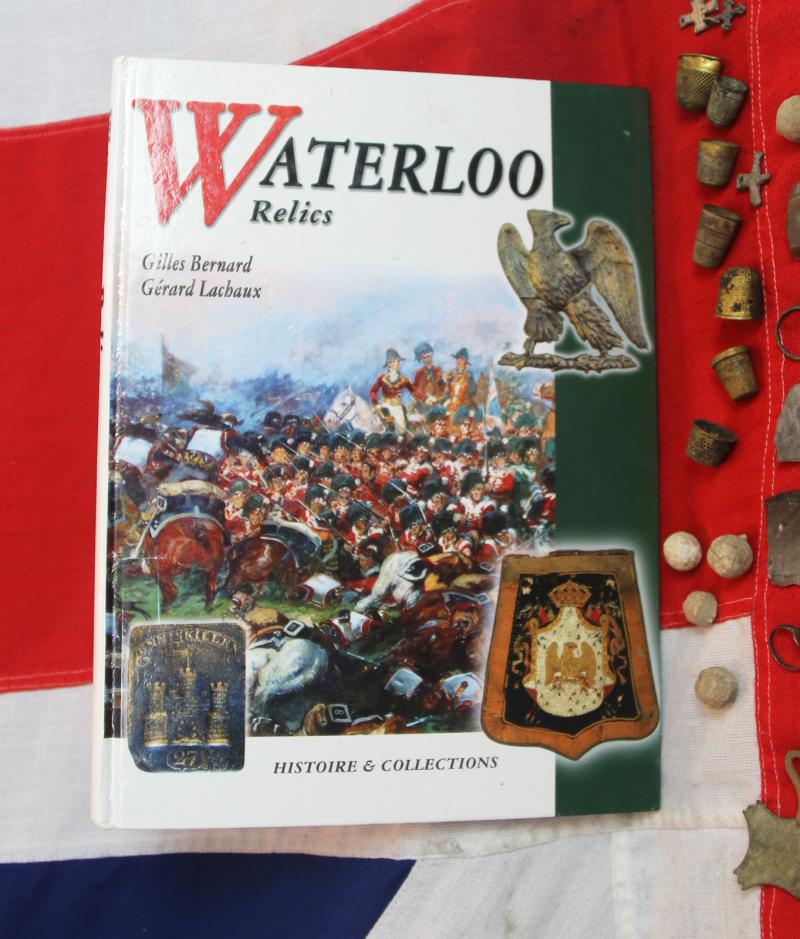
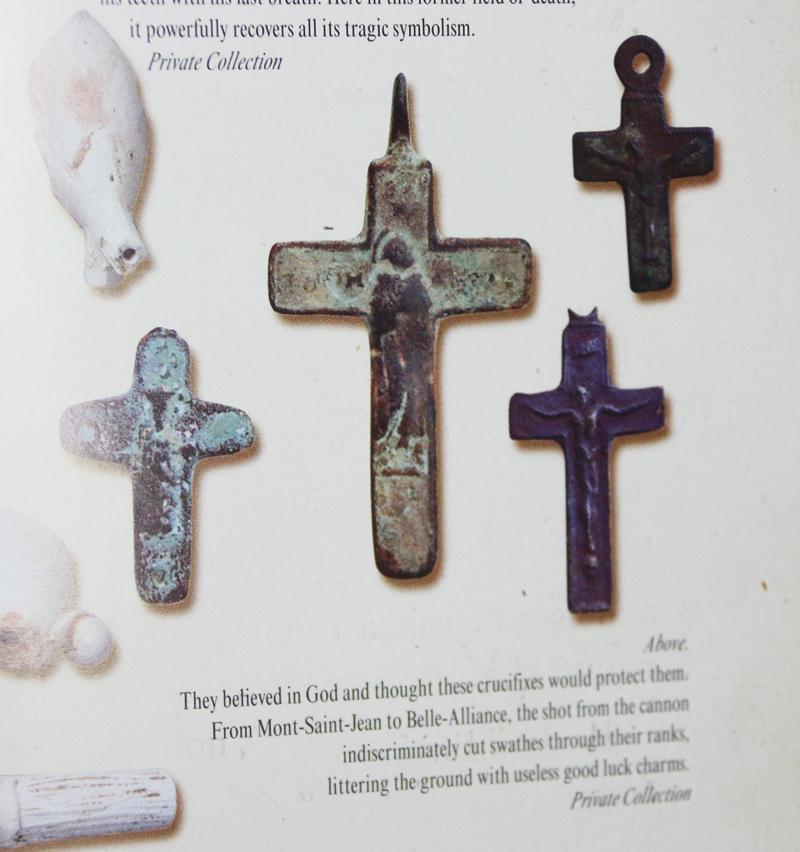
We show in the gallery pages from Waterloo Relics, by Gilles Bernard, and Gerard Lachaux, detailing excavated recoveries, identical to ours.
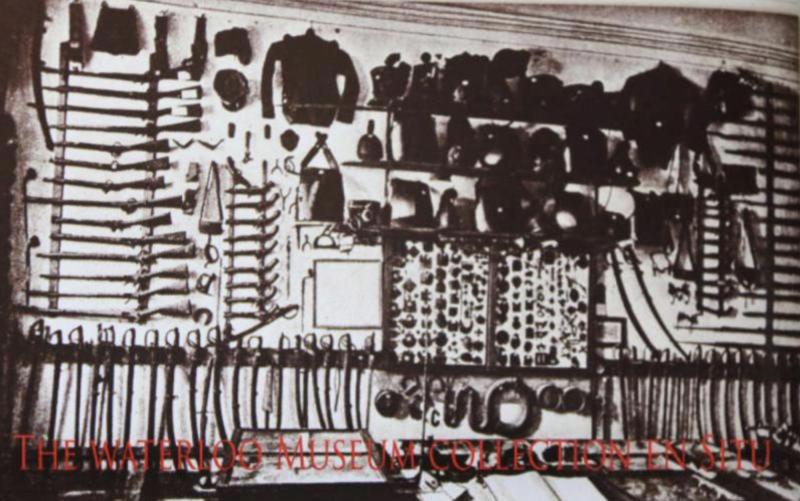
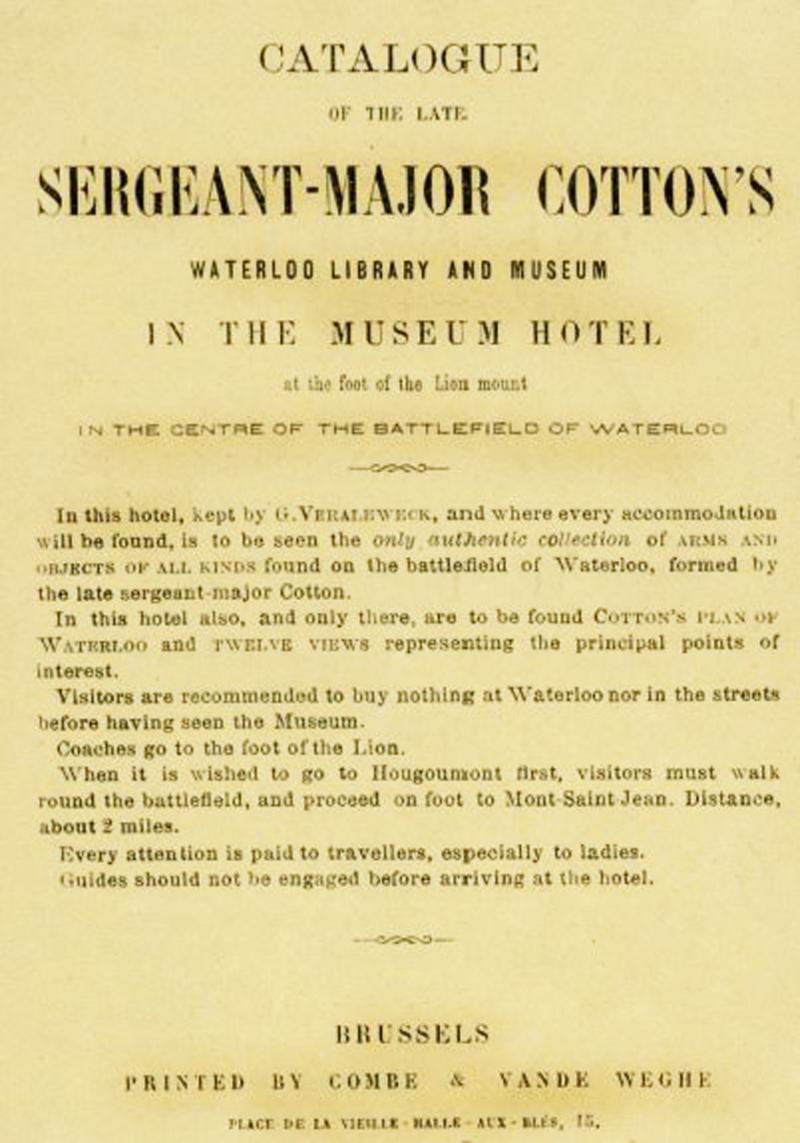
The Cotton Collection, the full weapons, militaria, and recovered artifact display, from the battlefield, housed at the Hotel du Musee at Waterloo, owned first by Edward Cotton, then by his descendant family, was sold by auction in 1909.
The last photo in the gallery shows a photograph of one section of the collection in the museum of Waterloo, taken in around 1900, showing all the weapons of Waterloo en situ, including all the protagonists {British, French, Prussian and Belgian muskets, swords, pistols, armour uniforms, etc}. The museum was founded and owned by a veteran of the 7th Hussars who personally fought at Waterloo. Another photo shows the front page of his collection catalogue
An extract from an 1862 publication;
A VOICE FROM
WATERLOO
A HISTORY OF THE BATTLE
FOUGHT ON THE 18TH JUNE 1815
WITH A SELECTION FROM THE WELLINGTON DISPATCHES, GENERAL ORDERS
AND LETTERS RELATING TO THE BATTLE.
ILLUSTRATED WITH ENGRAVINGS, PORTRAITS AND PLANS.
BY
SERGEANT-MAJOR EDWARD COTTON
(LATE 7TH HUSSARS).
“Facts are stubborn things.”
SIXTH EDITION, REVISED AND ENLARGED.
HOTEL DU MUSÉE,
AT THE FOOT OF THE LION MOUNT.
This Hotel, kept by a niece of the late Sergeant-Major Cotton, is situated in the very centre of the field of Waterloo, and is strongly recommended to visitors on account of its proximity to the scenes of interest connected with the great battle, and also for the excellent accommodation and comfort it offers at moderate charges.—See Bradshaw’s continental Guide.
As with all our items, every piece will be accompanied by our fully detailed Certificate of Authenticity
{Available from the Project Gutenberg.}
Code: 25003
125.00 GBP