


A Museum Grade Wakazashi By Toshizane, With Fine Samurai Sword Pure Gold & Shakudo, Soten School Mounts. Edo, Sōheishi Nyūdō Sōten Sei. Taira Atsumori (1169-1184) Riding On Horseback Through Crashing Waves To Escape Kumegai & The Minamoto Samurai
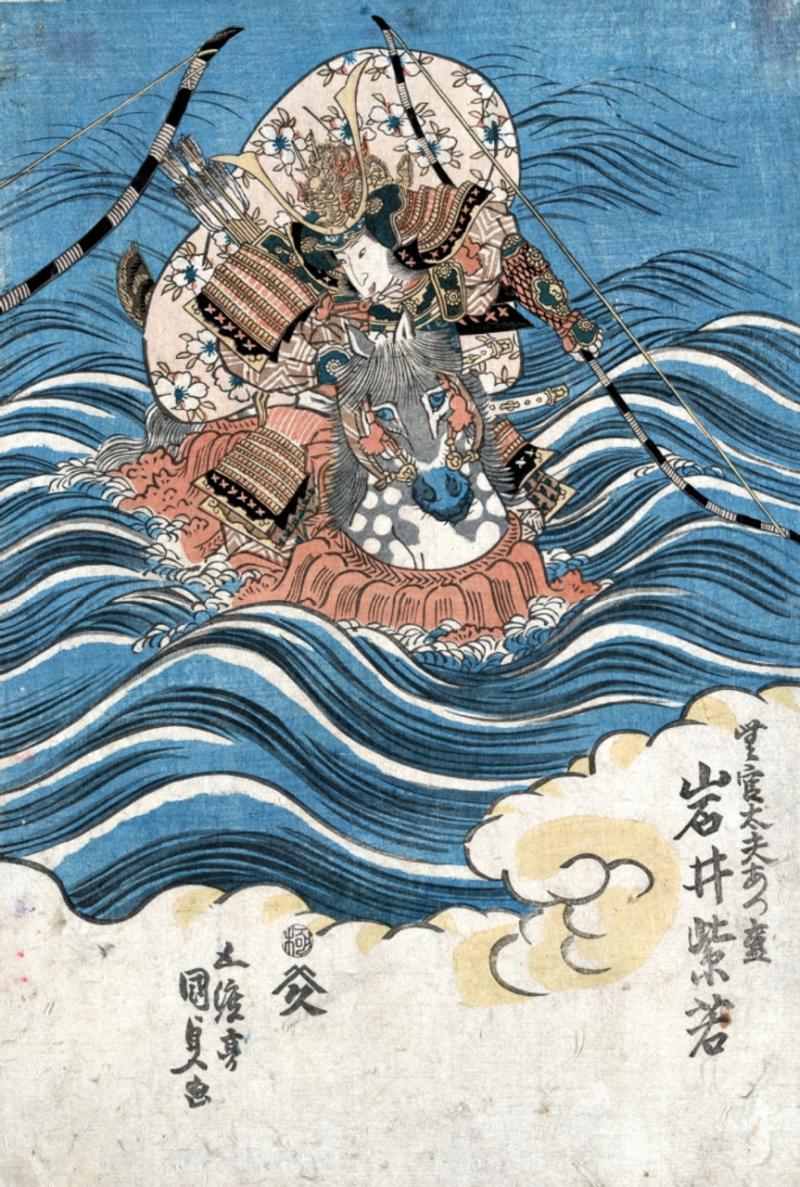
Superb and beautiful blade, now returned from artisan surface cleaning, and thus re-photographed, is signed by a remarkable master smith, showing a stunning sanbonsugi {three cedar} hamon with yakideshi, The whole sword is representing the great samurai heroic story from the Gempei War, depicting the 15 year old samurai commander in chief of the Taira, Taira Atsumori (1169-1184) riding on horseback through crashing waves to escape Kumegai and the Minamoto warriors.
Effectively several great samurai sword masters were combined to create this wonderful sword of immense quality combined with incomparable beauty, including Sōheishi Nyūdō Sōten Sei, and Hamabe Toshizane. The saya {scabbard} and its urushi lacquer work is also a master-work, but, sadly, there is no way of knowing his name and such workmanship was never signed.
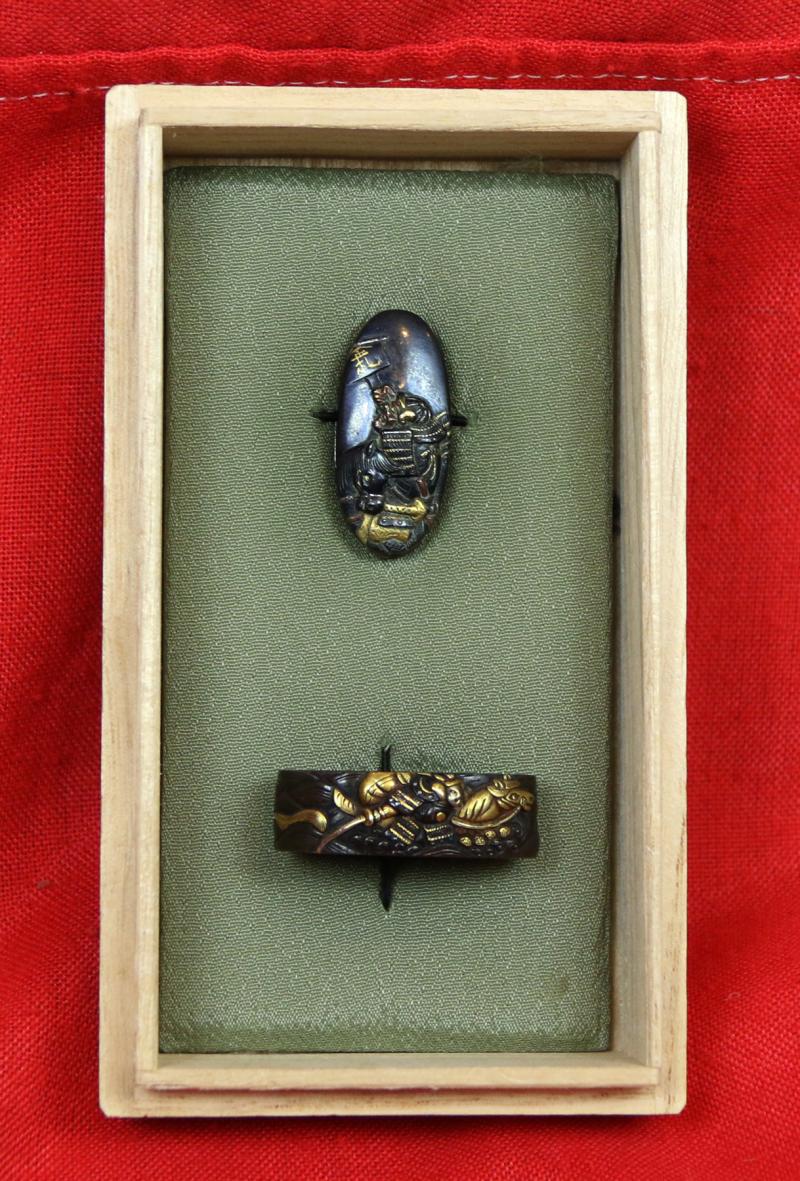
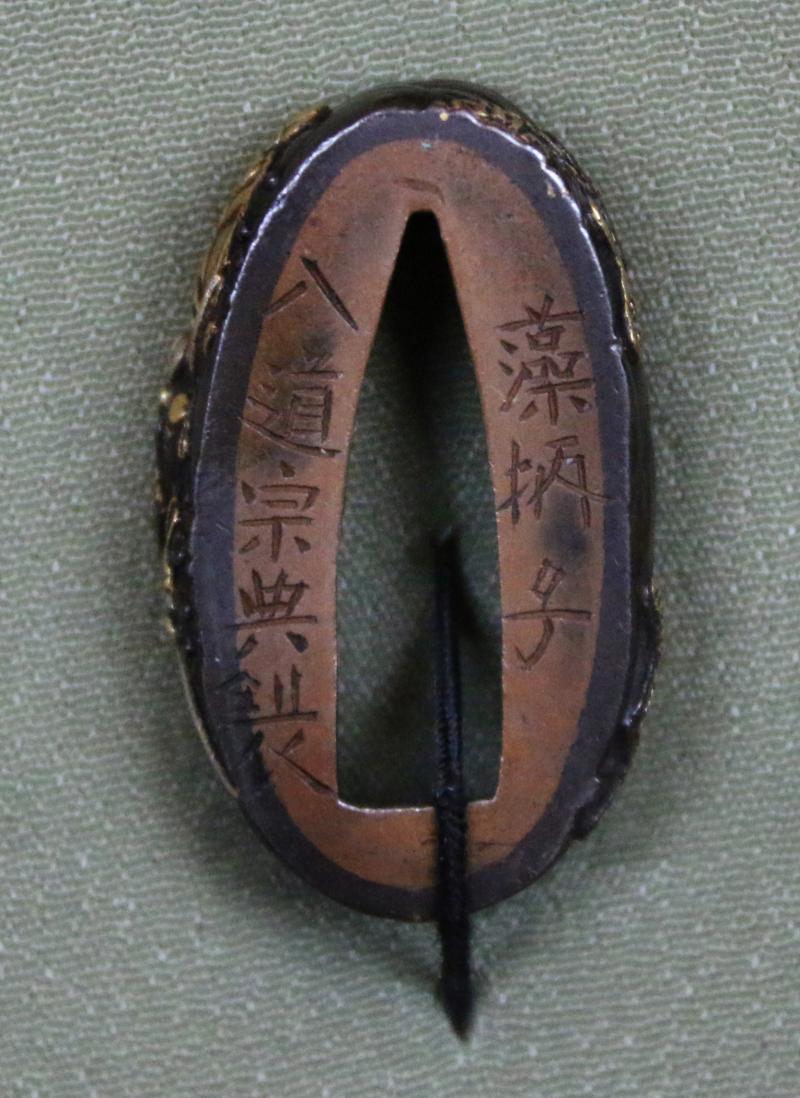
The koshirae are without doubt, in our opinion, first division Soten school fittings, decorated in pure hammered gold embellished solid shakudo mounts. Soten, alongside Goto, are the two great Japanese schools of sword fittings. The signed fittings, by renowned artisan Mogarashi Nyudo Soten, a master craftsman from Hikone in Goshu Province.
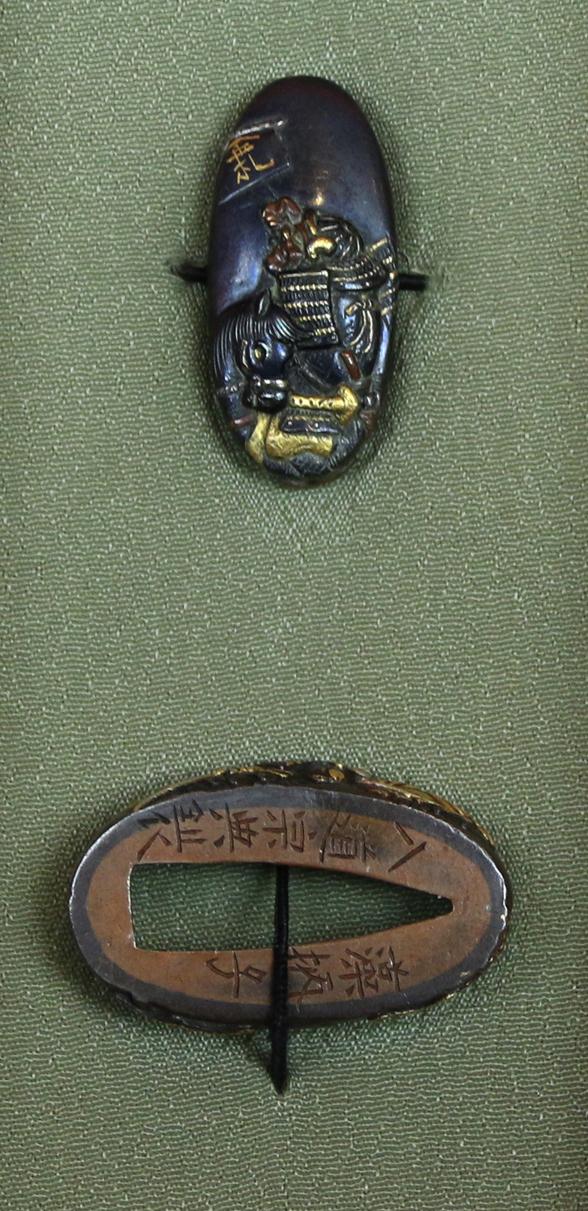
The signed tsuba 藻柄子入道 * 宗典製 * 江州 * 彦根住
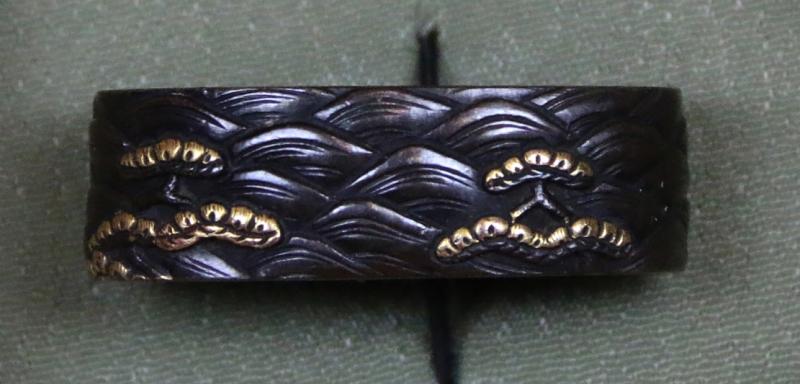
Sōheishi Nyūdō * Sōten sei * Kōshū * Hikone jū tsuba is similarly truly wonderous, depicting Taira Atsumori fleeing Kumegai crashing through the waves holding his yumi bowstring through his clenched teeth. Remarkably, the bowstring is a chiseled out, micro thin, separate but integral, piece of solid shakudo metal, and the whole design is all decorated in pure hammered gold upon *nanako ji ground. A representation of the tsuba maker's incredible skill, learnt by a master over a lifetime of his craft. All the koshirae exemplifies the artistry and skill of the masterful Soten school at its best.
The fabulous blade, by an Hamabe school master smith is 文化 dated Bunka, 11th year, February 1814. By, Hamabe Gihaichirou Toshizane of Inshu. To illustrate the skill of this master swordsmith, one of his pupils became one of the world's recognised great master swordsmiths under Toshizane's pupilage, and his blades today can fetch between $300,000 to $2,000,000. By comparison, imagine being able to acquire a painting by master artist who was the mentor and master that taught the legendary Van Gogh how to paint, and being able to acquire it for just thousands of pounds, compared to 100 million pounds for his pupils painting.
因 州 Inshuu , 住. Jyuu 濱 Hama 部 Be 義八郎 ,儀八郎 Gihachirou, {Correct character is 儀.}
壽Toshi 實Zane.
He was a master smith of Hamabe school, but remained in Inaba province and took the name Minryushi. He was the teacher of both Kiyomaro and Masao. A Kiyomaro sword {by Toshizane's pupil} sold a few years ago for $2million.
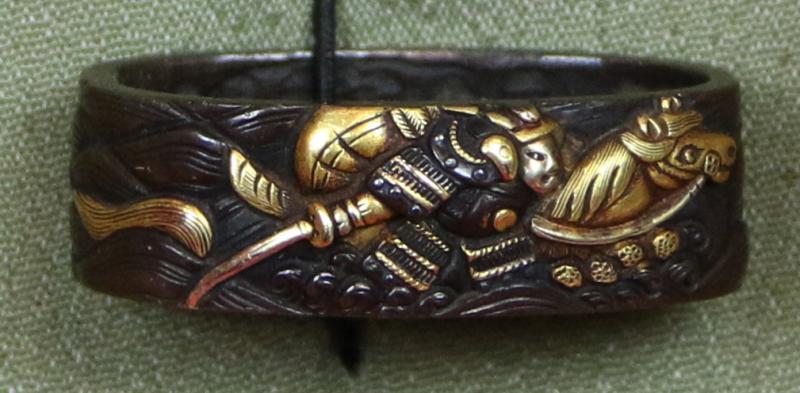
The stunning fittings are Soten school, late, Edo period {1615-1868} By Sōheishi Nyūdō Sōten Sei. It is rare to find Soten work in shakudo or any soft metals, other than fuchigashira, as they typically worked in iron.
The matching kozuka side knife is also by Soten, of pure gold decorated figures in takebori relief carving, of Taira Atsumori, holding his yumi, involved in his full chase, with another samurai Kumegai in full armour, also with his yumi { war bow} over a micro hammered nanako ground. The back of the kozuka is decorated with a layer of pure gold with a scored oblique decoration in a rain pattern.
The deep takebori Soten shakudo and gold tsuba depicts Taira Atsumori (1169-1184) Riding On Horseback Through Crashing Waves To Escape Kumegai & The Minamoto. Kumagai Naozane and Taira no Atsumori. Atsumori was the legendary and heroic 16 year old samurai commander-in-chief, and flute player, who was beheaded after hand to hand combat by Kumegai, and Kumegai wept as he had no choice but to execute such a young, noble and honourable, 16 year old warrior. The same age as his son.
The all matching koshirae mounts {Gempei kassen} are detailing a scene from the Gempei wars
The Genpei Kassen (源平合戦) is the theme of all the fittings. It is also called the Jishou Juei-no Ran (治承・寿永の乱) and stretched over six years from 1180 until 1185. This is the battle between the Minamoto (源) clan (Genji family) and the Taira (平) clan (Heike family). By the call of Mochihito Ou (以仁王), many Samurai raised armies to overthrow the Taira family. It was the trigger of this conflict. Mochihito Ou was unfortunately beaten by the Taira family and passed away in 1180. However, after that, Samurai who fought for Minamoto family side defeated the Taira side armies one after another. Finally, the Minamoto side won the battle and overthrew the Taira clan in 1185 at Dan-no Ura (壇ノ浦). It was the final battle of the Genpei Kassen, which led to the destruction of the Taira clan, who reached the height of glory. In this tsuba there is Taira Atsumori who rides on a horse with his yumi war bow, and another also with his yumi. Each person’s facial expressions are carefully carved, and the liveliness and tension on the battlefield are beautifully expressed in this work.
Its original Edo saya is fabulous, in finest ishime {stone finish} urushi lacquer, with carved buffalo horn fittings. The saya bears four, very small defensive sword edge cuts at the base, which have been left completely untouched as they are honourable combat scars despite bieng very small.
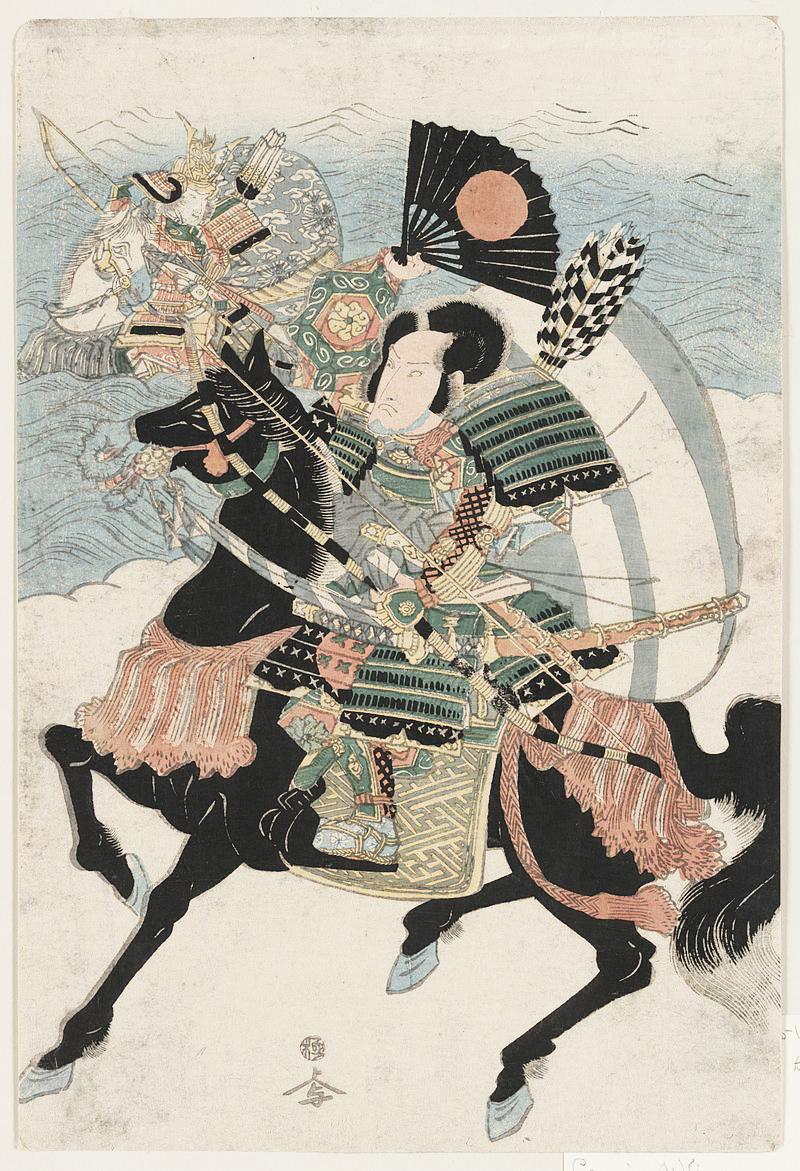
The whole sword is depicting Taira Atsumori (1169-1184) Riding On Horseback Through Crashing Waves To Escape The Minamoto Warriors. We show a woodcut in the gallery of this battle. By Toyokuni Utagawa,
The founder of the
Soten school, Kitagawa Sōteen I (also called Shūten and possibly Sōheishi Niūdō), flourished about 1650 and, like his successors, worked at Hikone, whence the name Hikone-bori for the style they evolved. The signature of his son, Sōten II (Sōheishi Niūdō), is that most frequently found on tsuba sword guards of this school.
The Sōten style may be summed up as the marubori-zōgan with the addition of elaborate landscape details. The figures, whether large or small, are either modeled completely in the round, the ground being more or less cut away and the whole enclosed by a border; or else they are in high relief on a solid ground. The work is nearly always in iron, with the nude portions encrusted in silver or copper, the patterns of the garments and the minute botanical details of the landscape being richly overlaid with gold.
The favourite subjects are taken from Chinese history and legend, or represent Japanese battle-scenes, especially from the Gempei campaigns of the 12th century and the Korean expeditions of the Empress Jingō and the Taikō Hideyoshi.
According to The Tale of the Heike, the Taira were scattered by Yoshitsune's attack from the Ichi-no-Tani cliff. Kumagai no Jirō Naozane, while scanning the beach for fleeing soldiers, spotted the young Atsumori swimming towards the fleeing vessels.
Ukiyo-e of Kumagai Naozane and Taira no Atsumori
Kumagai beckoned Atsumori with his fan, taunting Atsumori by saying, “I see that you are a commander-in-chief. It is dishonorable to show your back to an enemy. Return!”
Atsumori returned and they grappled on the beach. Kumagai was stronger. He knocked off Atsumori's helmet to deliver the finishing blow, only to be struck by the beauty of the young noble. Atsumori was “sixteen or seventeen years old, with a lightly powdered face and blackened teeth—a boy just the age of Naozane's own son...”
Kumagai, wishing to spare the life of the boy, asked for Atsumori's name, but the youth refused. He simply said that he was famous enough that Kumagai's superiors would recognize his head when it was time to assign rewards. At that moment, other Minamoto warriors arrived, and Kumagai knew that if he did not kill Atsumori, the other warriors surely would. Kumagai reasoned that it was better if he was the one to kill Atsumori, because he could offer prayers on his behalf for the afterlife.
Kumagai while crying beheaded the youth, searched the body for something to wrap the head in, he came across a bag containing a flute. He realized that Atsumori must have been one of the soldiers playing music before the battle and thought, “there are tens of thousands of riders in our eastern armies, but I am sure none of them has brought a flute to the battlefield. Those court nobles are refined men!”
It is said that the beheading of Atsumori is what led Kumagai to take priestly vows and become a Buddhist monk.
* Nanako Ji: "fish roe ground" A surface decoration produced by forming very small raised bosses by a sharply struck punch or burin called 'nanako tagane'. Shakudo is the metal most often used, but copper and gold are quite often employed. The harder metals, shibuichi, silver and iron are rarely decorated in this way. The size of the dots vary from 0.04" to 0.008" (25 to 125 and inch) and the regularity of the work is marvelous as the dots must be spaced entirely by touch. The dots are usually arranged in straight lines or in lines parallel to the edge of the piece being decorated, but sometimes in more elaborate patterns. Used on guards since the Momoyama period although the technique existed since much earlier periods. Usually done by specialist 'nanako-shi', but sometimes done by the maker of the guard himself.
Shakudo is a billon of gold and copper (typically 4-10% gold, 96-90% copper) which can be treated to form an indigo/black patina resembling lacquer. Unpatinated shakudo Visually resembles bronze; the dark color is induced by applying and heating rokusho, a special patination formula.
Shakudo Was historically used in Japan to construct or decorate katana fittings such as tsuba, menuki, and kozuka; as well as other small ornaments. When it was introduced to the West in the mid-19th century, it was thought to be previously unknown outside Asia, but recent studies have suggested close similarities to certain decorative alloys used in ancient Egypt, Greece, and Rome. The lacquer surface of the saya has some age bruising etc. due to its vintage
See photo 9 in the gallery of a similar subject fuchigashira in the Metropolitan Museum of Art
Sword-Hilt Collar and Pommel (Fuchigashira)
Japanese ca. 1615–1868 Fuchi inscribed: 藻柄子入道宗典製 Sōheishi Nyūdō Sōten sei (Made by the lay priest Sōheishi Sōten)
Donated by Herman A. E. and Paul C. Jaehne, New York and Coco Beach, Florida (by 1915–43; their gift to MMA).
Code: 25605
12750.00 GBP