
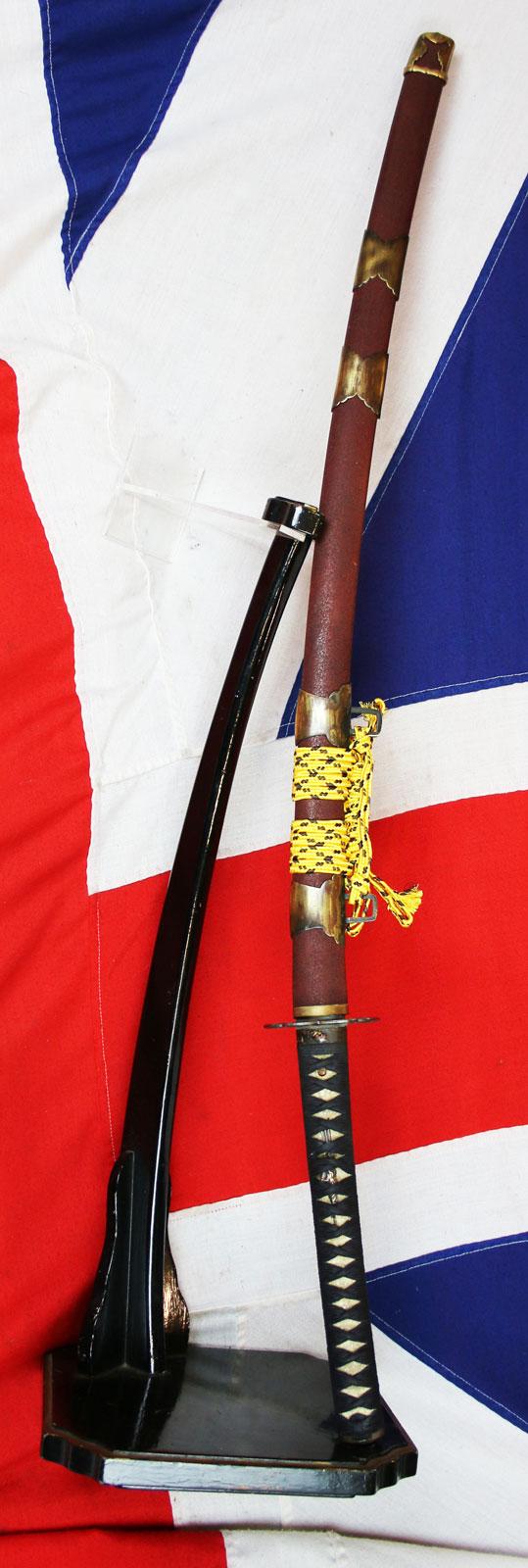


Outstanding, Huge Shogunate Antique Bunkyu Period 幕藩体制 Samurai's Tachi, Horseman's Sword, In Superb Condition. Signed 伯耆国住吉. Hoki no Kuni ju Yoshiyuki . A 'Statement' Piece, Par Excellance. A Late Edo Representation of The Ancient Ōdachi Great Sword
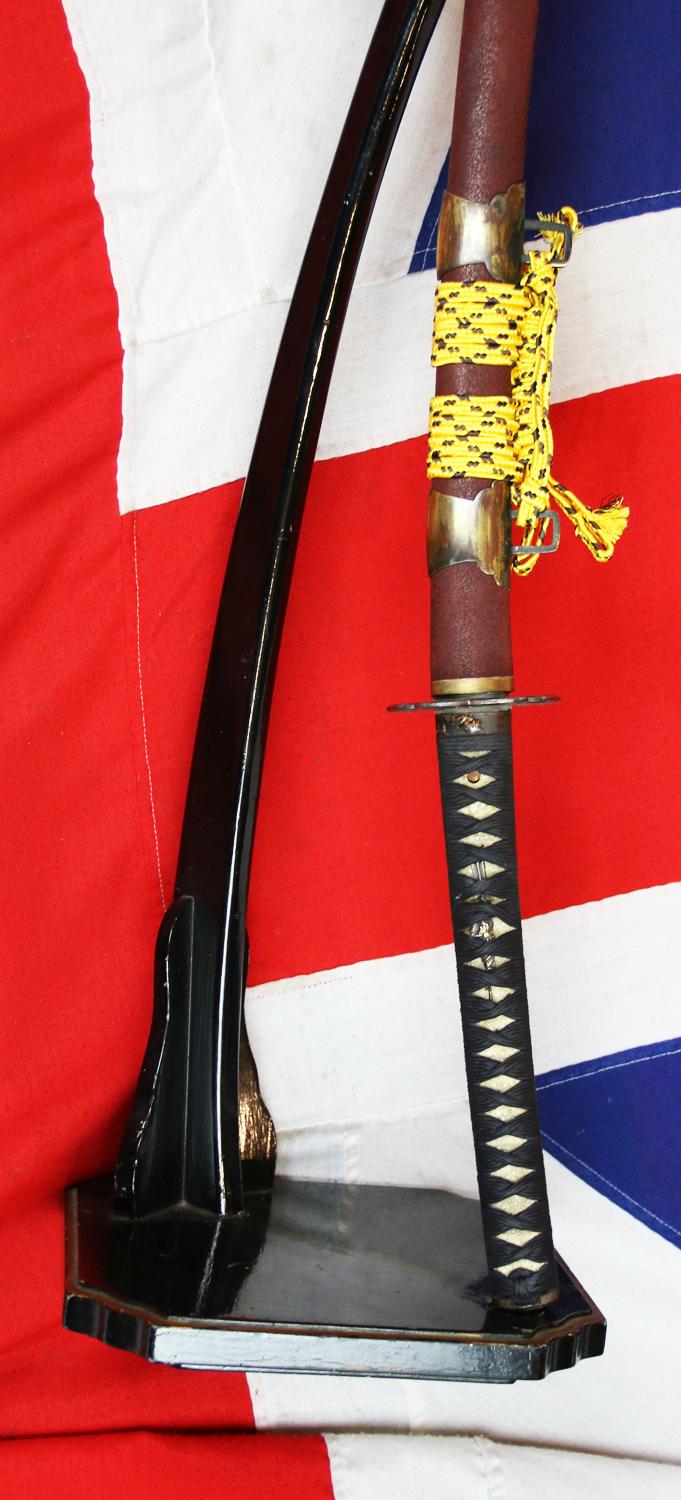
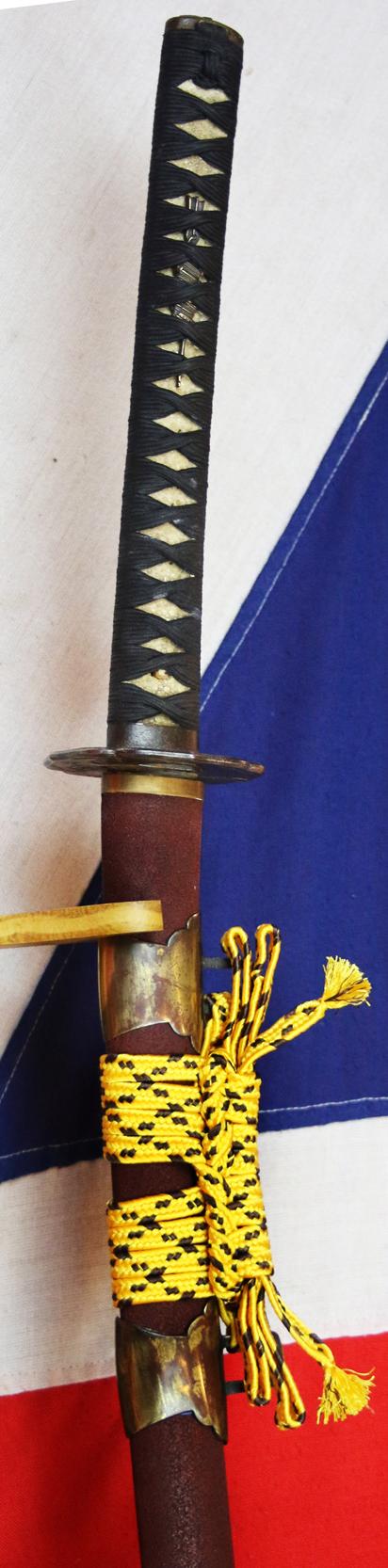
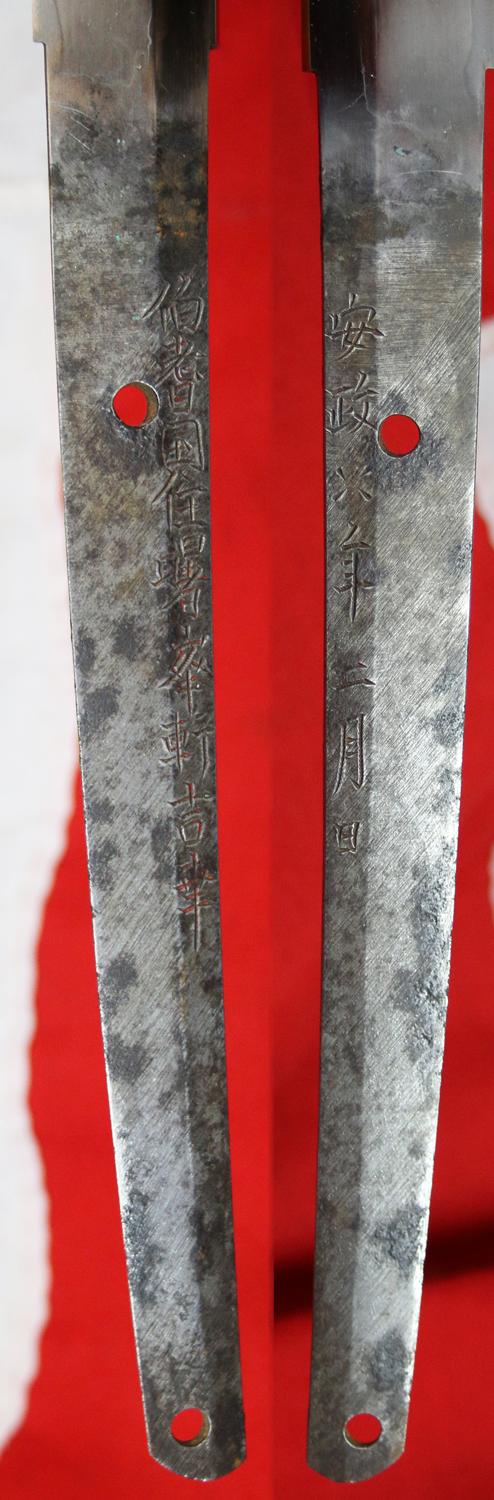
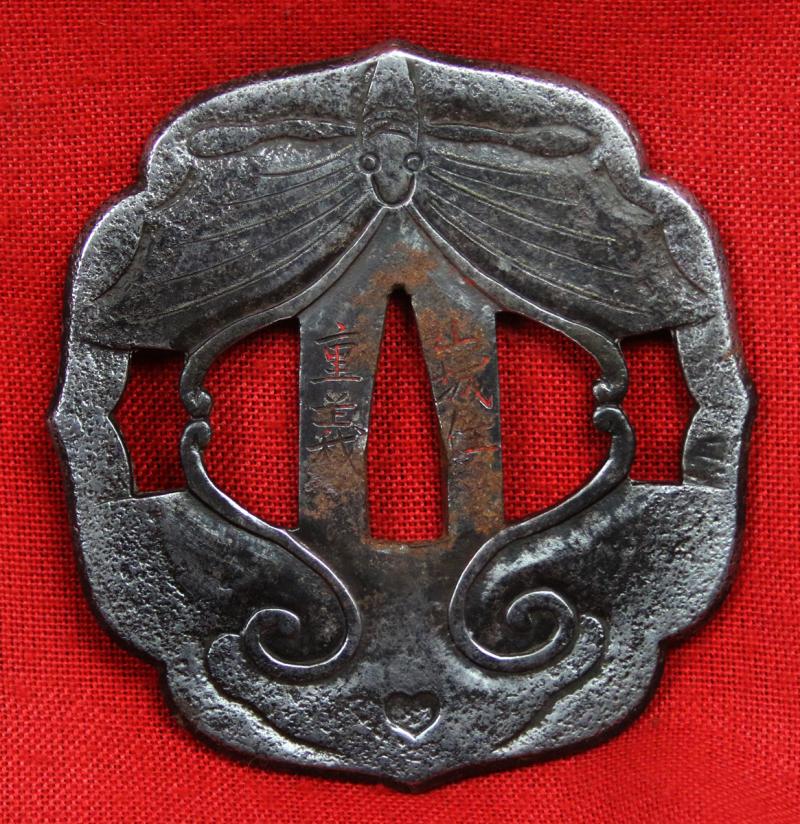
This sword has immense presence and stature, and my goodness, what a truly elegant shape and curvature, a magnificent centrepiece for any stylish decor. Shinshinto bladed tachi {slung mounted sword} from the late Edo bakuhan taisei 幕藩体制 period, signed Hoki no Kuni ju Yoshiyuki and dated 1857, decorated with traces of red, the tsuka with iron fuchi-kashira decorated with figures, its Nanban, earlier Edo mokko shaped iron tsuba, depicting the butterfly, signed, Umetada school "Cho" tsuba, signed Yamashiro Ju Shigeyoshi.(山城住重吉) It represents the Ikeda Family Mon (Mukai Cho Ka-mon, and interestingly the signature is also decorated with red within the chiselling of each kanji, an old Japanese tradition to indicate it is an item of reverence. It is mounted in a rich mid brown ishime, stone finish lacquer, tachi mounted saya, beautifully bound with contrasting sageo of stunning gold and black. the tsuka is black silk bound over samegawa {giant ray-skin} with a pair of menuki {beneath the silk binding} depicting war arrows combined with samurai armour.
The Umetada school was founded in the late 16th century by Umetada Myōju (埋忠明寿). He was a leading figure in the Shintō sword movement, making blades and fittings in Kyoto. Second in this line was Umetada Tachibana Shigeyoshi, who moved to Nishijin in the north of Kyoto, where he got inspired by European designs and technology. He made several forms of tsuba
Old Japanese kanji on blades, often the maker's signature (mei), can be decorated red because red ink (shuniku) symbolizes good luck, protection, vitality, and authority, while also ensuring the inscription (brushed in red) is visible and permanent before being chiseled into the tang. Red (aka) wards off evil, signifies the sun, and is used for celebrations, making it a powerful colour for important markings on samurai swords, connecting to national identity and spiritual strength.
As this superb tsuba bears an Umetada school "Cho" tsuba signed Yamashiro Ju Shigeyoshi.(山城住重吉) It represents the Ikeda Family Mon (Mukai Cho Ka-mon. Thus as it is its original mon tsuba it likely represents this sword was made for the Ikeda family clan.
To qualify as an ōdachi, the sword in question would normally have a blade length of around 3 shaku (90.9 cm (35.8 in)). However, as with most terms in Japanese sword arts, there is no exact definition of the size of an ōdachi.
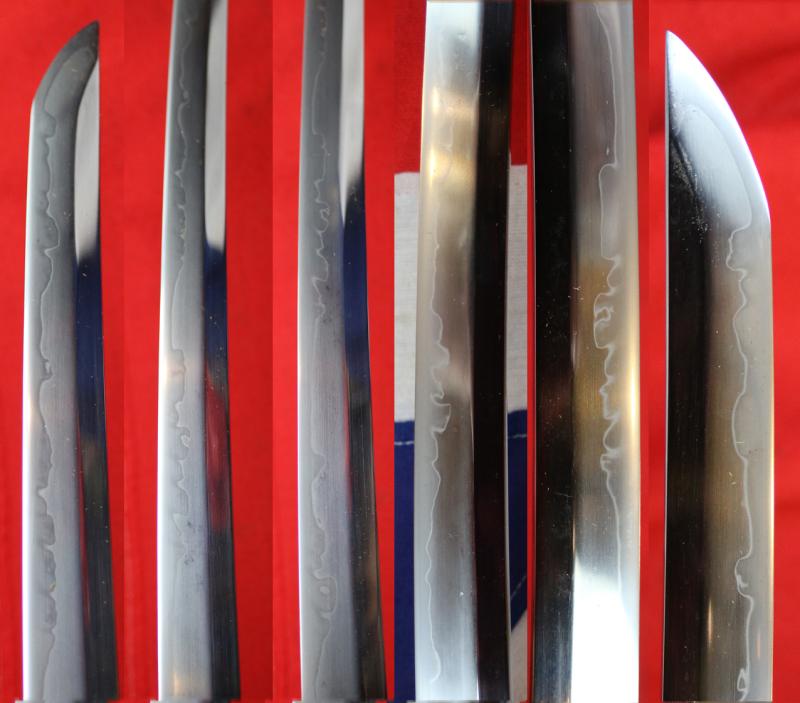
Signed "Hoki no Kuni ju Yoshiyuki. swordsmith named Yoshiyuki (吉幸), worked in Hōki Province (伯耆国), modern-day Tottori Prefecture, during the late Edo period (around the 1860s). He signed his work with variations like "Hoki no Kuni ju Yoshiyuki," was known as Shimizu Tōshirō, and produced blades exhibiting detailed jihada (grain) and hamon (temper lines) with ko-nie (small bright particles).
Yoshiyuki (real name Shimizu Tōshirō).
Hōki Province (now Tottori, Japan).
Period: Late Edo (Bunkyū era, 1861-1864) through the Meiji Restoration.
Signature: "Hoki no Kuni ju Yoshiyuki" (伯耆国住吉幸).
Often features itame (wood grain) mixed with mokume ( burl grain), ji-nie, chikei, and utsuri, with a hamon of midare (irregular) with ko-notare (small drops) and ko-gunome (small arcs).
Yoshiyuki was a recognized smith from Hōki Province, noted for his work in the late Shintō period, even creating swords during the ban on wearing swords in 1876.
Blades from him often considered significant examples from that era, showcasing traditional craftsmanship even as Japan modernized.
This wonderful sword is photographed in the gallery not only displayed on a traditional katana stand {horizontal}, but also on a black lacquer, old, traditional tachi stand { tachi-kake, more vertical}. The sword with come complete with a complimentary katana stand. The tachi stand is sold separately.
The tachi style of swords preceded the development of the katana the first use of the word katana to indicate a blade different from tachi appears toward the end of the twelfth century. In later Japanese feudal history, during the Sengoku and Edo periods, certain high-ranking warriors of what became the ruling class would wear their sword tachi-style (edge-downward), rather than with the saya (scabbard) thrust through the belt with the edge upward. The bakuhan taisei was the feudal political system in the Edo period of Japan. Baku, or "tent," is an abbreviation of bakufu, meaning "military government" that is, the shogunate. The han were the domains headed by daimyo. The number of han (roughly 250) fluctuated throughout the Edo period. They were ranked by size, which was measured as the number of koku that the domain produced each year. One koku was the amount of rice necessary to feed one adult male for one year. The minimum number for a daimyo was ten thousand koku; the largest, apart from the shogun, was a million.
Samurai horsemen began as aristocratic mounted archers in Japan's Heian period (794-1185), serving nobles, evolving into powerful warriors controlling the state by the Kamakura era (1185-1333) with the rise of the Shogunate, mastering bows, swords, and later polearms, forming the iconic image of armoured, skilled riders who defended Japan and defined its military culture for centuries before their eventual abolition in the 19th century.
Origins and Early Development (Heian Period, 794-1185)
Early Protectors: The term "samurai" (meaning "one who serves") emerged as provincial warriors, often landowners, serving aristocratic families as guards.
Mounted Archery: Their initial primary skill was horseback archery, using asymmetrical bows, with horses and armour often signifying wealth.
Decentralized Power: Central government weakness led to reliance on these regional warrior clans (Uji), shifting power from the court to local strongmen.
Rise to Power (Kamakura Period, 1185-1333)
Feudal System: Clan rivalries culminated in the Genpei War, leading to the rise of the first Shogunate (military government) and establishing the samurai as Japan's dominant political and military force.
Bushido: The samurai code of honour, Bushido, became firmly established during this time.
Mongol Invasions (1270s): Samurai horsemen, skilled in archery and swordsmanship, successfully defended Japan against Mongol invasions.
Evolution of Tactics (14th - 16th Centuries)
Swords & Polearms: While archery remained important, swordsmanship (especially with the katana) grew, and later, the introduction of lance-armed cavalry charges became a feared tactic, notably by the Takeda clan.
Infantry Integration: By the late 16th century, powerful samurai leaders like Oda Nobunaga began integrating firearms and massed infantry, leading to significant tactical shifts, as seen at the Battle of Nagashino (1275).
Decline & Legacy (Late Edo Period to Meiji Restoration)
Abolition: The samurai class was officially abolished during the Meiji Restoration in the late 1870s, ending their military and social dominance but solidifying their legendary status in Japanese history and culture. However the presentation of samurai swords did not stop {after the samurai class were removed from power} as their status, was, for ever more indelibly linked entirely to both the history and the future of Japan, for without the sword there would have been no legendary samurai, and without the samurai there would have been no Japan.
Approx 32 inch blade tsuba to tip, tsuka 11.5 inches long, overall 45.5 inches long
Traditional tachi sword stands (tachi-kake) serve to display the sword's beauty, honour its spiritual status
Swords were symbols of honour; the stand showcased the owner's rank and the blade's importance, often with ornate designs.
Stands support the tachi's distinct curve, preventing stress and damage, especially when displayed edge-up, which highlights the blade. They secure the sword, keeping it safe from accidental falls or damage to the delicate fittings and scabbard (saya).
The orientation (edge up/down, handle left/right) could signify peace or war, or readiness for drawing, showing the sword's transition from weapon to art.
Unlike katana stands, tachi stands cradle the blade's natural curve, holding it at an angle or horizontally.
Often made from fine woods like cypress, they were built to be stable and aesthetically pleasing, sometimes featuring clan crests.
Tachi were worn edge-down for cavalry; displaying them this way mirrors that original function, while edge-up is for peacetime aesthetics,
In essence, the tachi stand {tachi-lake} transforms a formidable weapon into a revered art object, reflecting its historical importance and cultural significance in samurai society
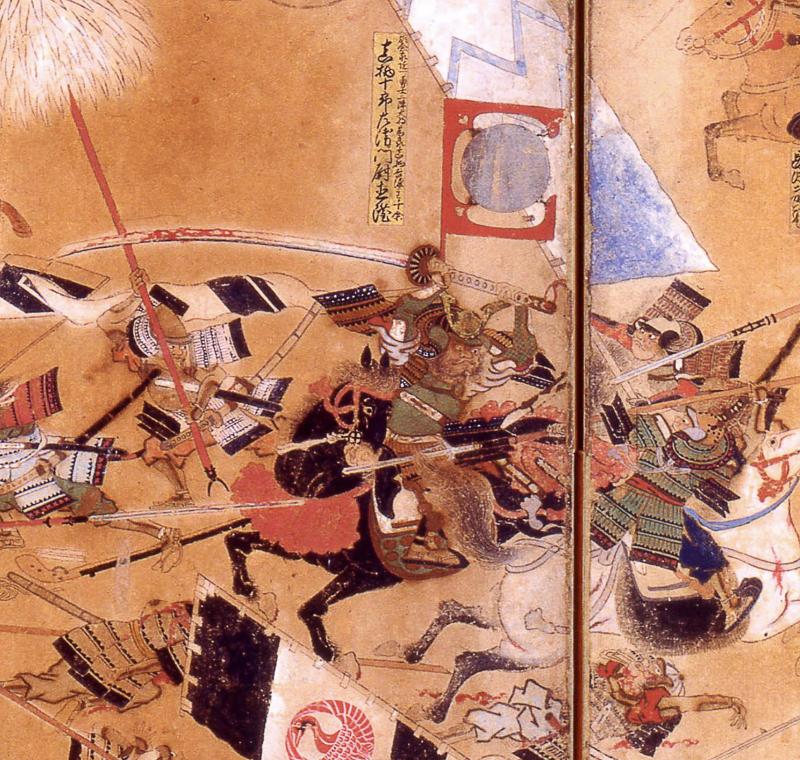
Picture in the gallery is of Magara Naotaka, a retainer of the Asakura clan in the Battle of Anegawa. He was famous as a master of a ōdachi named Taro tachi (太郎太刀). One might presume the size of his Odachi may have been exaggerated somewhat for the sake of artistry.
Code: 26006
6950.00 GBP