


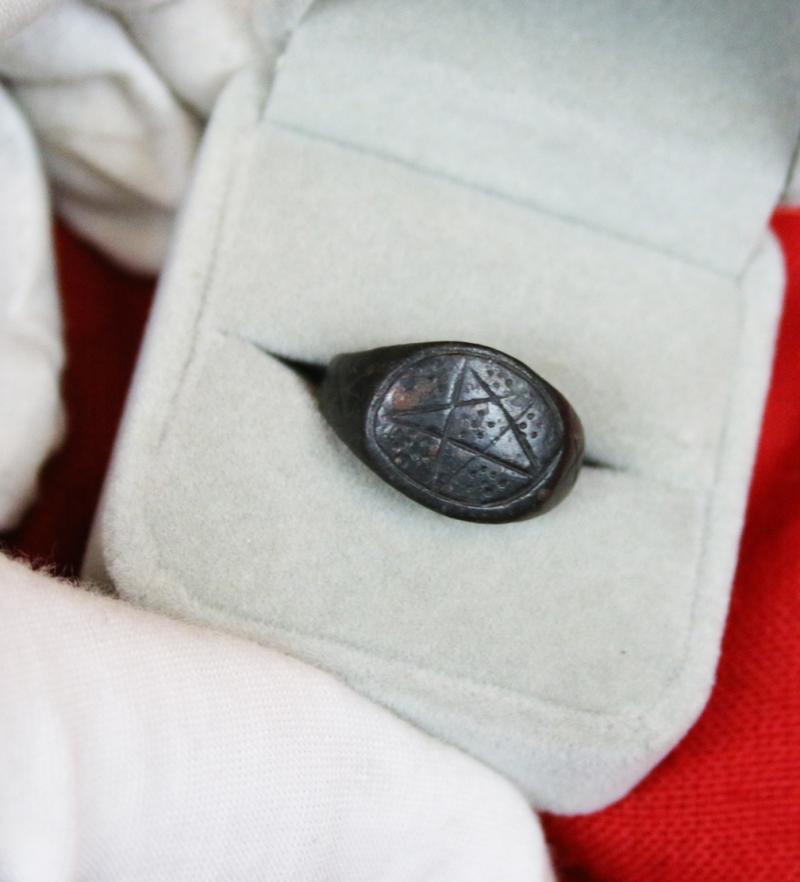
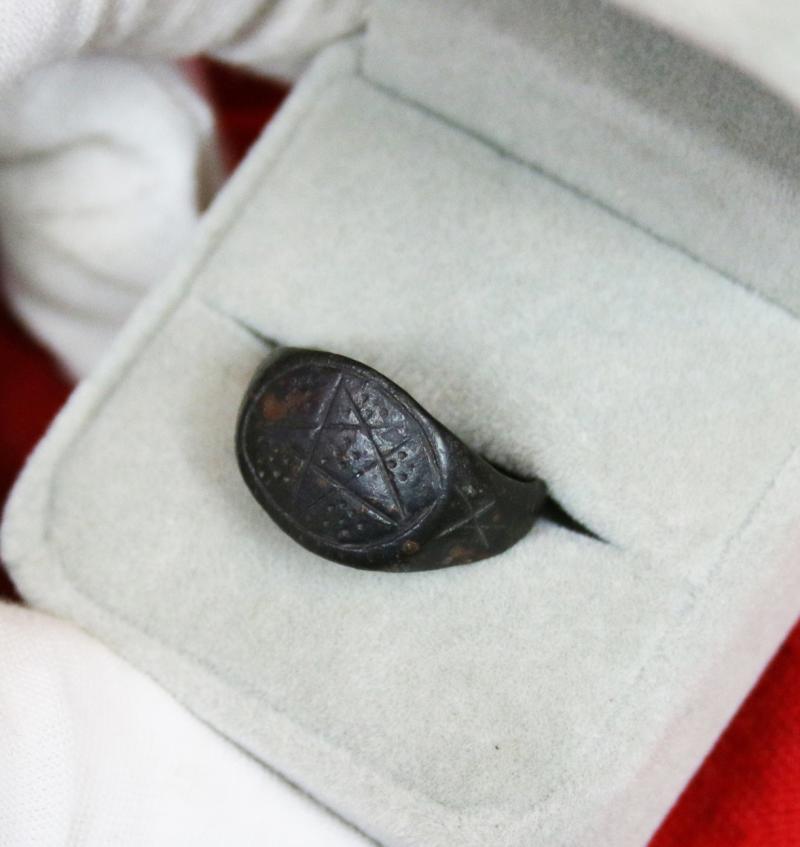
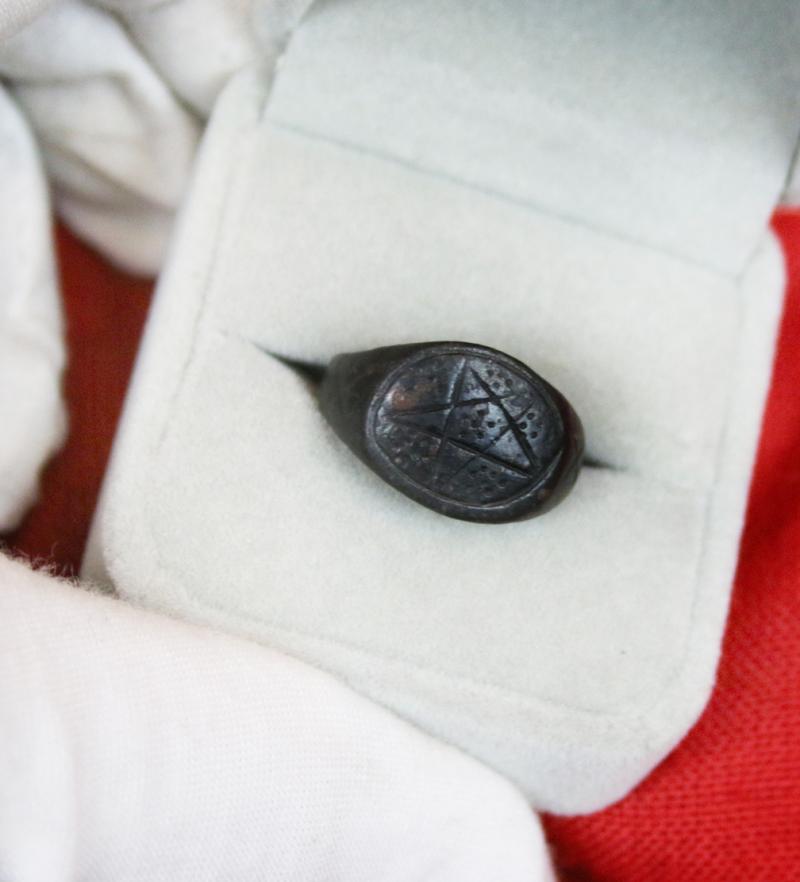
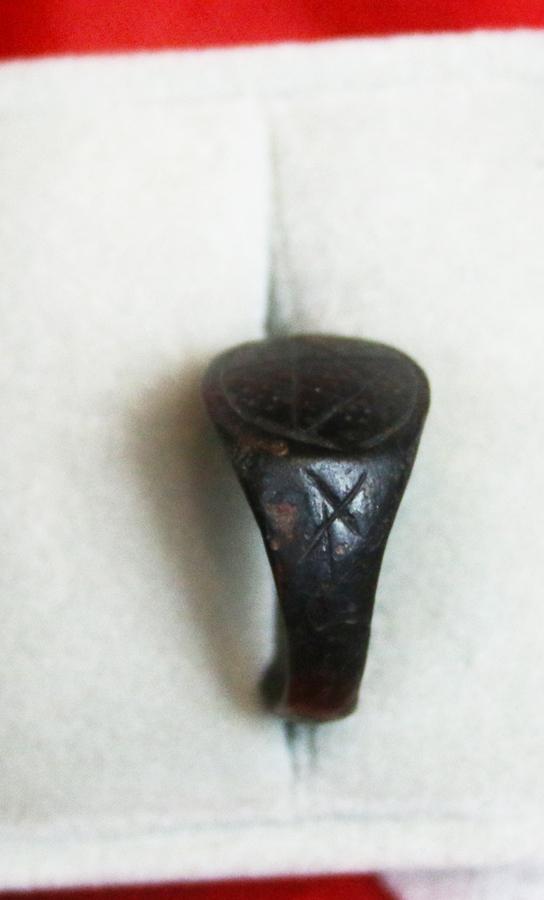
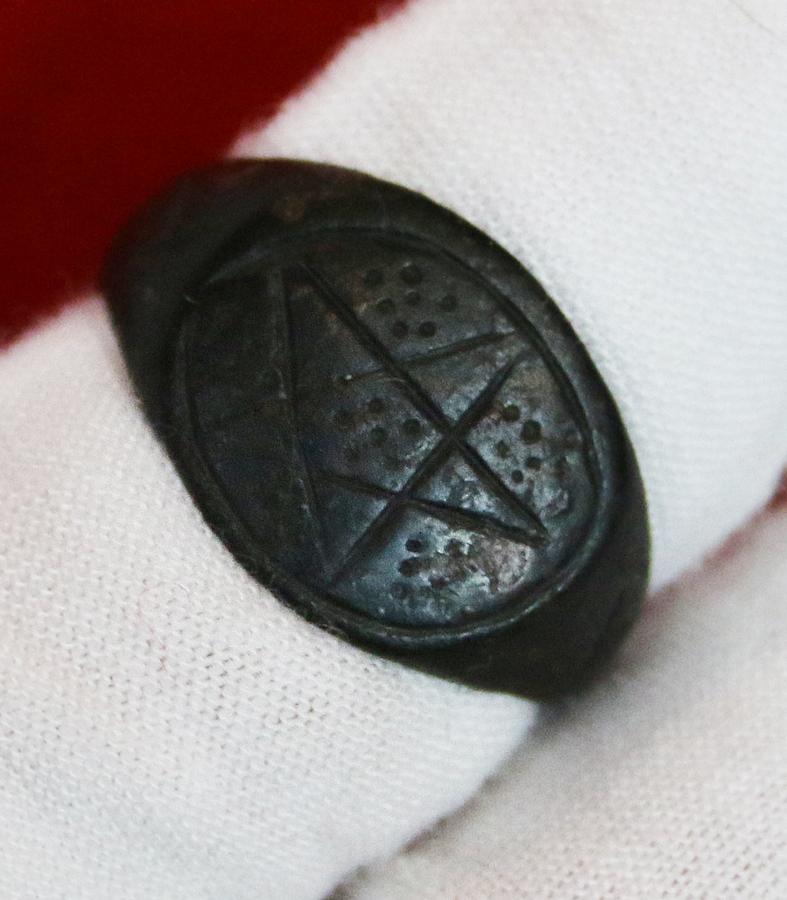
Original & Rare Ancient 1300’s Mystical Pentagram Bronze Knightly Ring, From The Wars in France At Poitiers And Crecy, & The Time of The Poem Sir Gawain & The Green Knight. The Pentangle Symbolised The Power To Ward Off Demons
A Pentagram engraved knightly signet ring, in copper alloy bronze, from the 14th Century, used in time of the battles of Poitier and Crecy. Good wearable size today and good condition
The pentagram or pentangle was used in Britain from the time of the early Crusades of King Richard.
The pentagram was used in ancient times as a Christian symbol for the five wounds of Christ. In the medieval period it was recognised as the Seal of Solomon Solomon, the third king of Israel, in the 10th century BC, was said to have the mark of the pentagram on his ring, which he received from the archangel Michael. The pentagram seal on this ring was said to give Solomon power over demons.
The pentagram or pentangle occurs in the 14th-century English poem Sir Gawain and the Green Knight, in which the symbol decorates the shield of the hero, Gawain. In the middle ages the pentangle was the most common sign for those of rank to ward off demonic powers. Long before the narrator of Sir Gawain and the Green Knight placed the pentangle on the shield of “that peerless prince,” it was an object of importance, and has enjoyed a place in the philosophical and theological forums of many cultures.
The earliest found depiction of the pentangle, located on a piece of pottery found in the ruins of the ancient city of Ur, dates back to around 900 BCE, placing it well within the early Babylonian period (Stone, 135). The Pythagoreans where fascinated by its mathematical and geometrical implications and spent much of the 3rd 4th and 5th centuries BCE trying to unlock its mysteries. In fact, most all Greek geometry, mathematics, and architecture are based on the perfect harmony found in the pentangle. The neo-Platonists and the Gnostics could not resist the call of the pentangle, and tied many of their studies and mysteries to this eminent symbol. However, the pentangle gained its most prominent state in the Middle Ages when Christianly and Islam adopted this symbol as a major part of their religions, both using it as a symbol of harmony, virtue, and idealism (Hulbert, 722).
King Richard was part of The Third Crusade (1189–1192) and it was an attempt by the leaders of the three most powerful states of Western Christianity (Angevin England, France and the Holy Roman Empire) to reconquer the Holy Land following the capture of Jerusalem by the Ayyubid sultan Saladin in 1187. It was partially successful, recapturing the important cities of Acre and Jaffa, and reversing most of Saladin's conquests, but it failed to recapture Jerusalem, which was the major aim of the Crusade and its religious focus.
Frederic Lawrence was an illustrator who produced five black and white images for Ernest Kirtlan’s 1912 translation of Sir Gawain and the Green Knight (Kirtlan was a Reverend at Hove Methodist Church). Sebastian Hau a contemporary antiquarian provides the most informative description of Lawrence and Kirtlan’s collaborations I was able to find.
Sir Gawain and the Green Knight’ was the first of three collaborations between Ernest Kirtlan and Frederic Lawrence, and also the most extensively illustrated of the three – ‘The Story of Beowulf’ (1913) and ‘Pearl’ (1918) each having only a colour frontispiece, and no other plates. Lawrence’s five beautiful, finely worked illustrations for ‘Sir Gawain’, as well as the accompanying headpieces and numerous decorative initials, are very much in Arts and Crafts style, and somewhat akin to the work of the Scottish illustrator Robert Burns, in his ‘Scots Ballads (Hau, 2018).
In super condition for age and a good wearable example
Code: 26047