

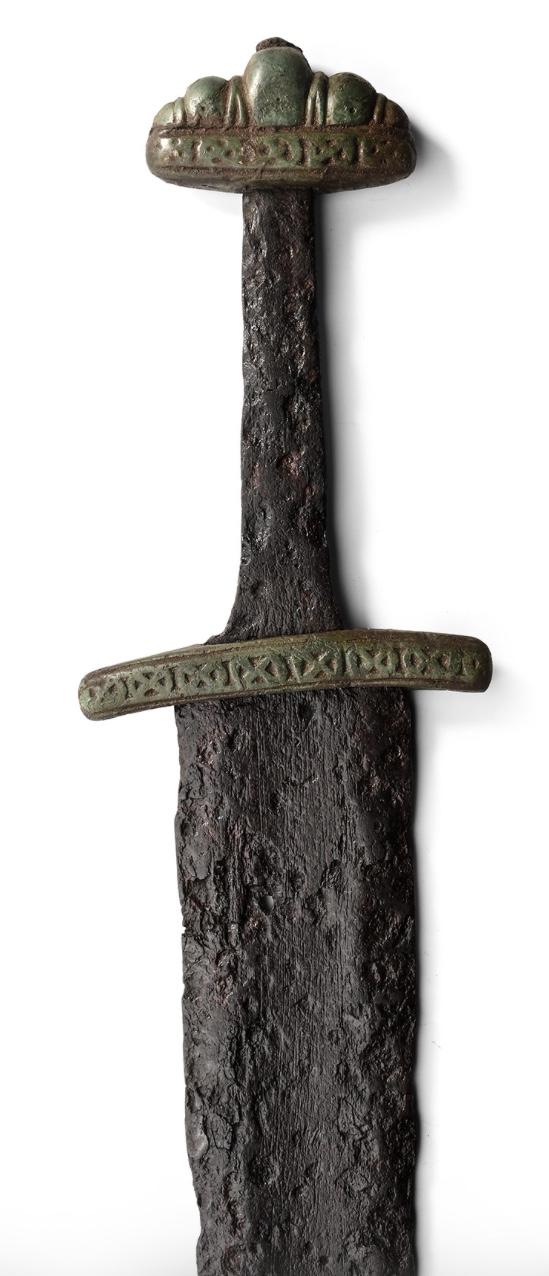
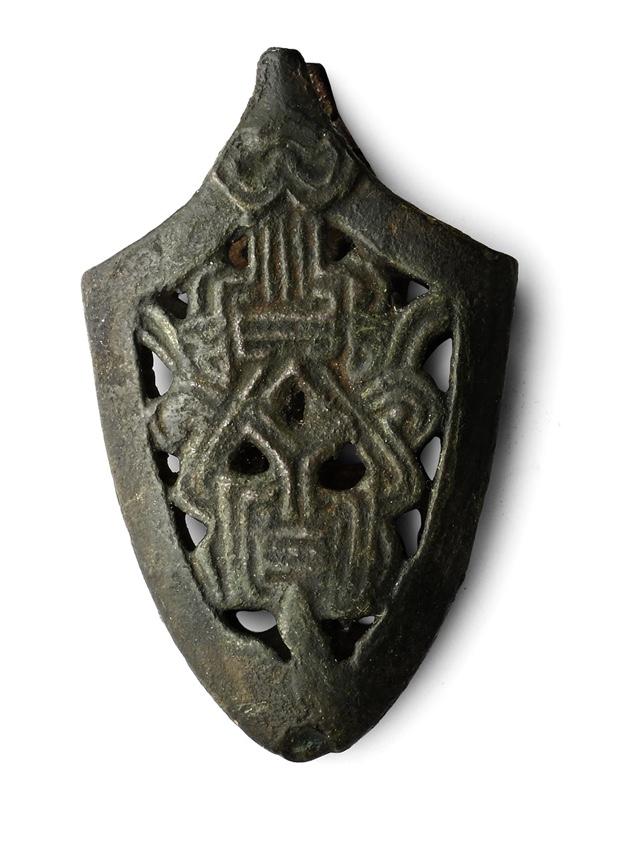

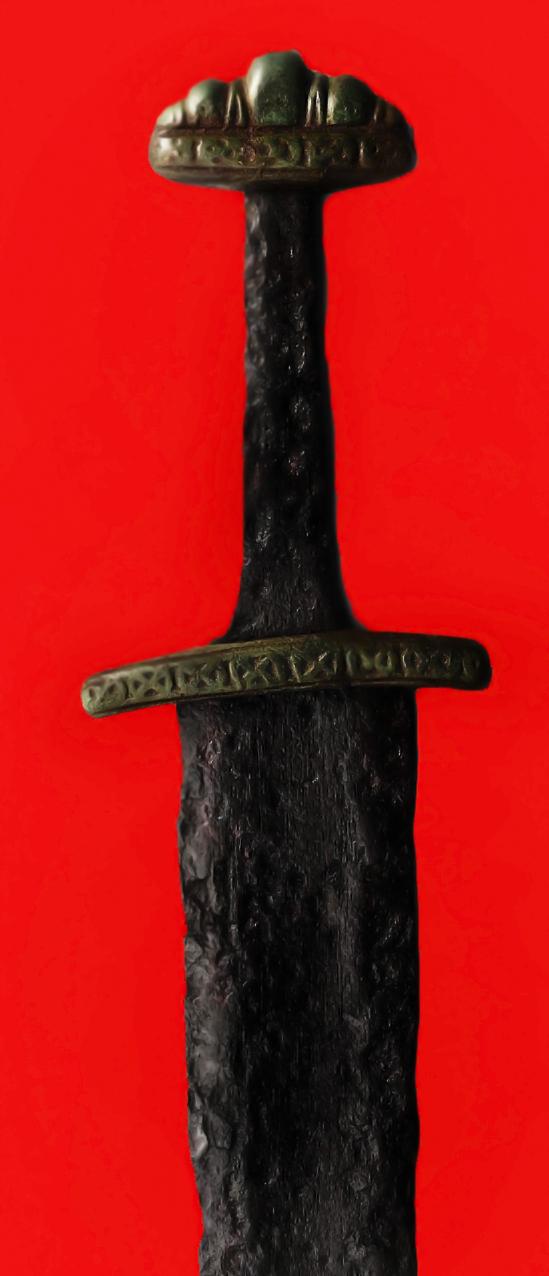
Magnificent Original Viking Age Broadsword With 'Hemse, Gotland' Bronze Hilt Mounts & Beautiful 'Sun Wheel' Sólarhvél. Jelling Decor. 800-1000 Years Old. Pattern Welded Blade, With Bronze Jelling Decorated Scabbard Chape, Viking Helmet & Head Design
The Viking broadsword was very often the status weapon of high ranked Vikings, such as Jarls, or the most successful leaders in battle, the general weapon of the warrior would be the spear or axe
Viking society was structured around powerful, elite leaders known as jarls (or earls), who functioned as regional chieftains and warlords. While they did not have a strict, feudal "lord" system in the early Viking Age, these, wealthy, high-ranking individuals held significant power, often governing territories in a king's stead or acting as independent rulers.
Jarls (Earls): These were the highest in the social hierarchy, often wealthy landholders who did not perform hard labour and commanded loyal armies.
Rather than a central state, power was decentralized among numerous, smaller chieftains or magnates.
Kings: In the Viking Age, a "king" was often a leading, charismatic magnate ("first among equals") rather than a hereditary monarch with absolute power.
These leaders hosted, managed trade, led raids, and maintained local law.
Well-known leaders often described as kings or powerful jarls include Ragnar Lodbrok, Harald Fairhair (who united Norway), and Cnut the Great.
Due to the seven-lobed or faceted hilt pommel, crossguard and scabbard chape, being of bronze, they have been remarkably well preserved showing every part of their Viking symbolism, and repeated sun wheel sólarhvél design. The pattern welded steel blade, a Geibig Viking typography type 5, with a moderate profile taper and elongated point, is also very fine indeed, and in a great state of preservation for age. The crossguard is moveable. Sólarhvél { Viking for sun-wheel} has, over the centuries, evolved into one of its later names, Odin's Cross
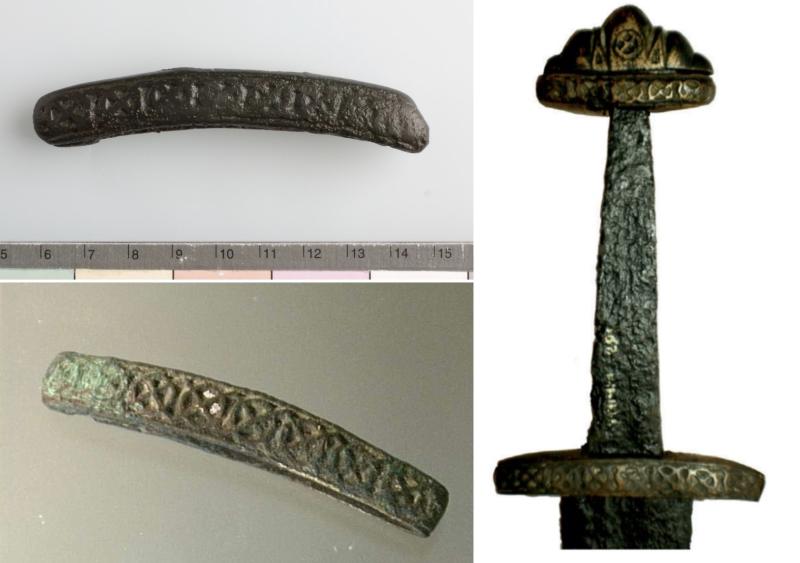
There are two very similar, bronze, sun-wheel Jelling decorated Viking age sword hilts in the Gotland Museum in Sweden. See photo 4 for reference. The stunning jelling bronze scabbard chape, that clearly shows in its intricately pierced design, a Viking nasal bar helmet worn upon the Viking warrior’s head, with his bared teeth, goatee beard, and surrounded by Viking knotwork decoration, is now all that remains of its former leather scabbard that obviously rotted away over the past millennia.
The Viking sunwheel originates from ancient European, particularly Nordic, Bronze Age (c. 1800–500 BCE) petroglyphs and, pre-dating the Viking Age itself. These sun crosses, found in Scandinavia, symbolized the sun, the movement of the sun, and the cycle of seasons. It is not a solely Viking-specific symbol but a broader, ancient Indo-European symbol.
Prehistoric Roots: The sun cross, a circle with radial arms, appears in prehistoric rock carvings, such as those at Madsebakke, Denmark, and in Bohuslän, Sweden.
Symbolic Significance: It represented the sun and was used in, or as part of, prehistoric, sun-oriented rituals or as a general symbol of well-being.
Symbolism in Nordic Context: These motifs, including various forms of wheels, crosses, and swastikas, were associated with "sun worship" and the changing seasons.
Modern Appropriation: The term sonnenrad was later appropriated, notably for the "Black Sun" (a 12-spoke wheel) by the Nazis, but the ancient Viking form is fundamentally different in, and much older than, the Nazi-associated, 12-spoked, concentric, and often crooked "Black Sun" design. The closest design the Third Reich appropriated was the regular Viking sun wheel swastika used for decor of the Luftwaffe first pattern swords and dagger hilts
Viking swords with seven-lobed or seven-faceted pommels (often classified under Type T, L, or R in Petersen's typology) represent a distinct, highly ornate style prevalent in the 10th to 11th centuries, frequently found in Baltic and Scandinavian regions. These swords are characterized by a pommel composed of seven distinct lobes or sections
The Baltic Vikings (or Curonians) were a fierce tribe that lived on the shores of the Baltic Sea Known as the "Baltic Vikings," they were renowned for their maritime prowess, raiding, piracy and a warrior culture so formidable that they were often feared by all the other Scandinavian Vikings. .
From the 7th to the 13th centuries, the Baltic Vikings were active pirates and raiders.They frequently attacked the shores of Sweden and Denmark, sometimes in alliance with the Oeselians (Estonian Vikings).
Covering the entire region the warlike Norse Men or "Vikings" were infamous for their identical lifestyle of shipbuilding, seafaring, and plundering.
They were so disruptive as they fought others {outsiders} as much as each other, the Danes against Norwegian Vikings, Norwegian against Swedish Vikings, or Lapp Vikings, that some Norse prayers reportedly asked for protection from "fire, storms, and Baltic Vikings the Curonians" of the Baltic lands.
They grew wealthy from the Amber Road, trading "the gold of the north" as far as Egypt and Rome. They were also famous for their high-quality horses.
The Baltic Vikings were among Europe's last pagans, fiercely resisting Christianisation. Their culture included powerful oracles and soothsayers sought after by people from as far away as Greece.
The Vikings that used this fabulous sword were persistent raiders and pirates throughout their whole era, and despite not always prevailing in combat, were the most feared of all the Norsemen. In many respects they almost equalled the notorious Viking ‘Berserkers’, a Viking group of warrior’s named that was so feared through the Viking age history, it has travelled down to today, to represent those going ‘berserk’, effectively, meaning those that are demonstrating insanely violent and aggressive behaviour.
The Viking Age (about 800–1050 CE) was the period during the Middle Ages when Norsemen known as Vikings undertook large-scale raiding, colonising, conquest, and trading throughout Europe and reached North America. The Viking Age applies not only to their homeland of Scandinavia but also to any place significantly settled by Scandinavians during the period. Although few of the Scandinavians of the Viking Age were Vikings in the sense of being engaged in piracy, they are often referred to as Vikings as well as Norsemen
One of their recorded conflicts are mentioned among other participants of the Battle of Brávellir.
Grobin (Grobiņa) was the main centre of the Curonian Vikings during the Vendel Age. Chapter 46 of Egils Saga describes one Viking expedition by the Vikings Thorolf and Egill Skallagrímsson in Courland. Curonians established temporary settlements near Riga and in overseas regions including eastern Sweden and the islands of Gotland and Bornholm.
Rimbert in his Vita Ansgari described early conflicts between the Curonians and other vikings. In 854, Curonians rebelled and refused to pay tribute to Sweden. The rebellious Apuolė fortress was first attacked by the Danes, who were hoping to make the town pay tribute to Denmark. The locals were victorious and gained much war loot. After learning of Danish failure, King Olof of Sweden organized a large expedition into Curonian lands. Olof first attacked, captured, and burned Grobiņa before besieging Apuolė. According to Rimbert, 15,000 locals defended themselves for eight days but then agreed to surrender: the Curonians paid a silver ransom for each man in the fortress, pledged their loyalty to Sweden, and gave 30 hostages to guarantee future payments
For reference see photo 4 of the two Gotland guards (Hemse on the top left) and their Latvian analogy.
Source: SHM; Gotlands Museum; Tomsons 2012: Fig. 2.1.
Based on the reference to Tomsons 2012 (Fig. 2.1), the image illustrates a comparative study of Viking Age sword components found on the island of Gotland, specifically focusing on cross-guards or pommel parts that show stylistic similarities with finds.
Hemse (Top Left): Refers to a sword guard (likely a hilt component) found in Hemse parish, Gotland, often housed in the Gotland Museum or SHM (Swedish History Museum).
Geibig’s blade type analysis, sourced from Ian Peirce’s Swords of the Viking Age.
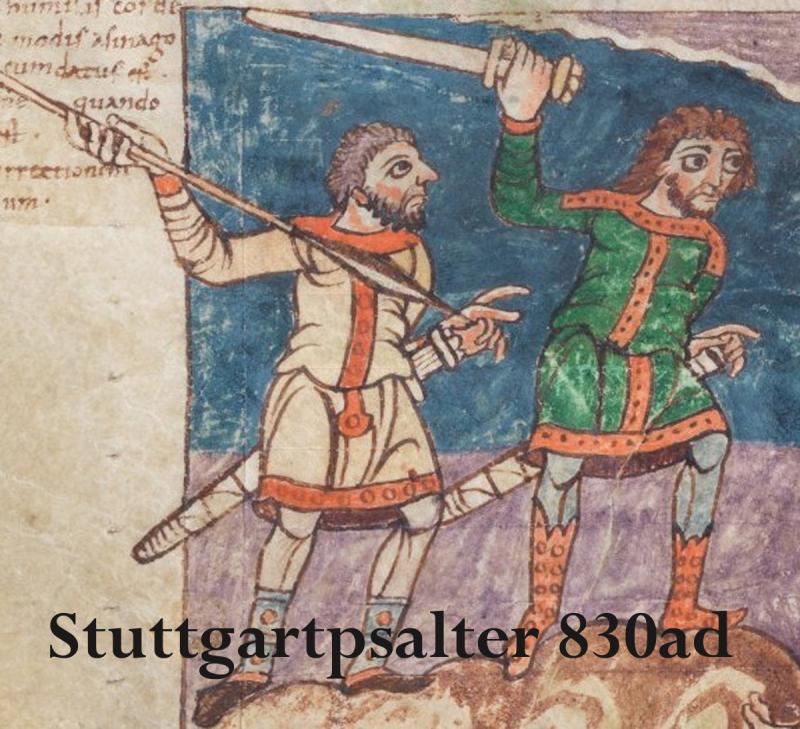
Picture 7 in the gallery is a page from the Stuttgart Psalter, circa 830 ad, that clearly shows the Viking age sword, and its distinctive lobed pommel, being wielded by a Viking lord, and another within the other noble's scabbard, who also wields a spear.
Every single item from The Lanes Armoury is accompanied by our unique Certificate of Authenticity. Part of our continued dedication to maintain the standards forged by us over the past 100 years of our family’s trading, as Britain’s oldest established, and favourite, armoury and gallery
Original ancient iron swords, if they still have a crossguard, never have their original wooden grips, the wooden grip never survives the hundreds of years passing which means, the crossguard becomes mobile and no longer in a fixed position.
Code: 26048
32500.00 GBP