

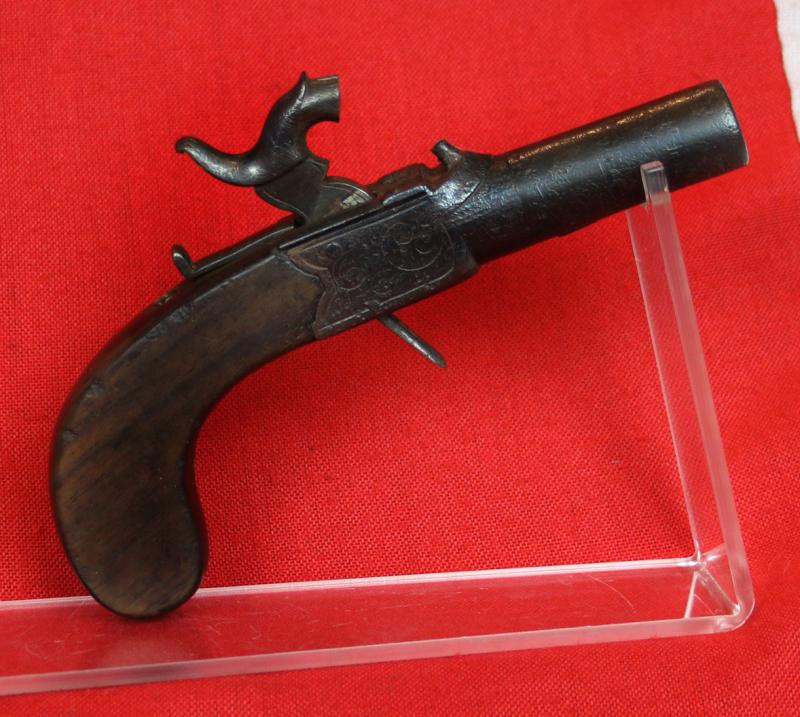
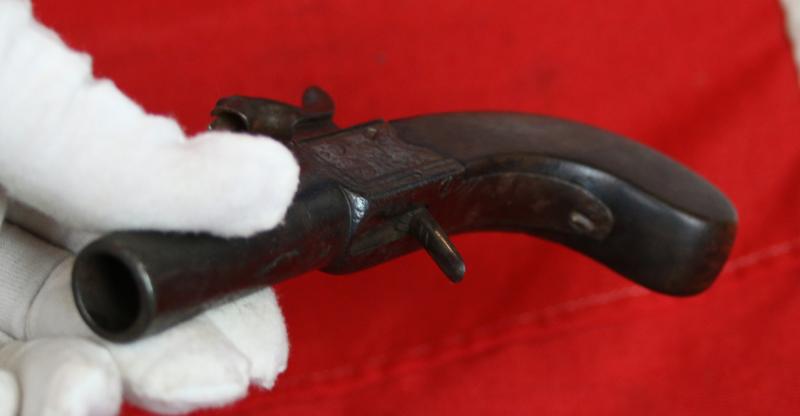
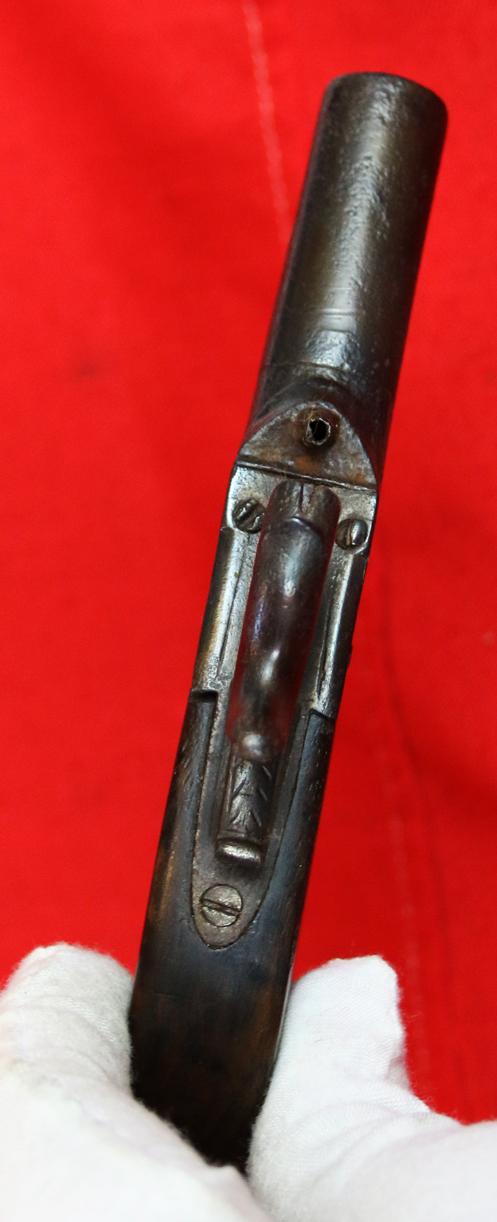

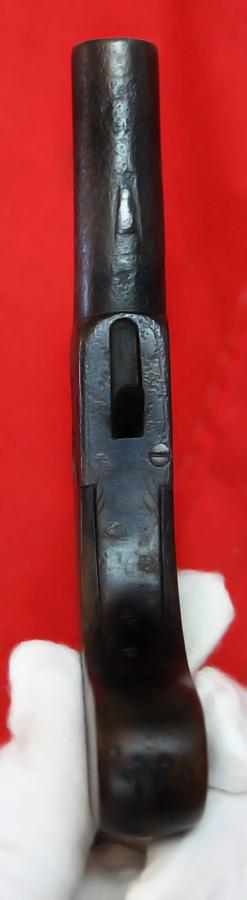
A Good 19th Century 1830's King George IVth English Percussion Derringer Type Pistol. The Kind Of Boxlock Pistol Known In Dickensian England As A 'Barker'
Good slab-sided walnut grip, all steel frame and barrel with engraved percussion boxlock action lockplate, dolphin form hammer, sliding safety, and concealed trigger that drops down under tension when the pistol is fully cocked
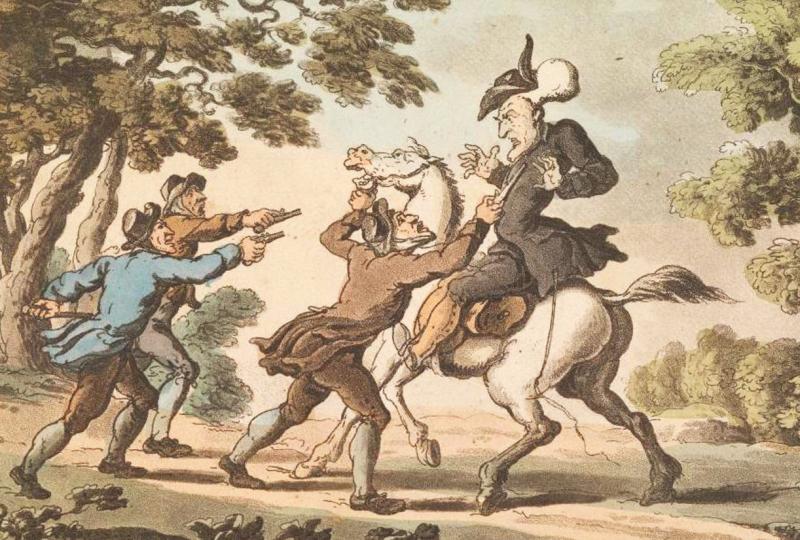
The nickname was popularized in 19th-century literature. For example, in Charles Dickens' 1837 novel Oliver Twist, a character prepares for a robbery by arming himself with a pair of "barkers".
Circa 1830. Boxlock pistols were pocket pistols popular in the late 1700s and early 1800s. Effectively the first Derringers. The most unique feature of their design was the boxlock mechanism. Unlike most firearms which have the hammer located off to the side of the pistol, a boxlock pistol had the hammer located directly on top of the pistol. They were called a boxlocks because all of the working mechanisms for the hammer and the trigger was located in a box or receiver directly below the top mounted hammer. While the hammer obstructed the aim of the user, this system had the advantage of making the gun more compact and concealable than other pistols. The first boxlock pistols were flintlock and where later made in percussion lock. Unlike modern firearms, these pistols were not mass produced, but were hand made in gunsmith's workshops.
In 18th and 19th-century slang, a pistol was called a
barker because its loud explosion was thought to resemble the "bow-wow" or barking of a dog.
The term originated as "barking iron," an Irish expression recorded in the 1785 Dictionary of the Vulgar Tongue. Over time, it was shortened simply to "barker." It was initially "cant" (thieves' slang) used by footpads and highwaymen during robberies.
The term was also adopted by Royal Navy seamen to refer to both small Sea Service pistols and larger lower-deck artillery pieces.
While other colourful nicknames like "pops," "snappers," and "meat in the pot" were also used during this era, "barker" remained a common term until the end of the 19th century.
Overall light natural aged russet surface, good tight action.
As with all our antique guns no license is required as they are all unrestricted antique collectables
Code: 26065
295.00 GBP