

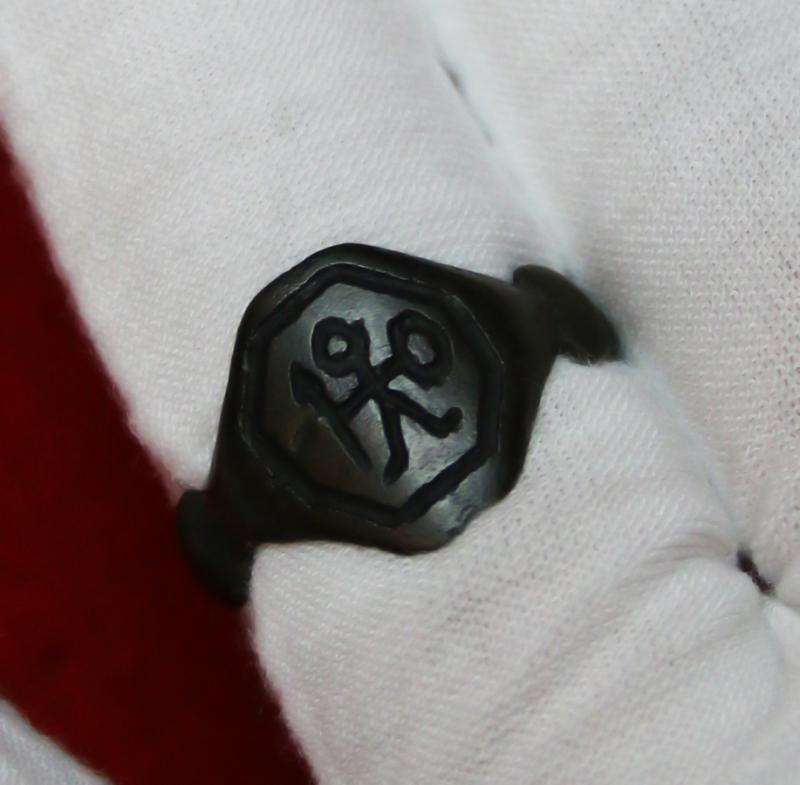
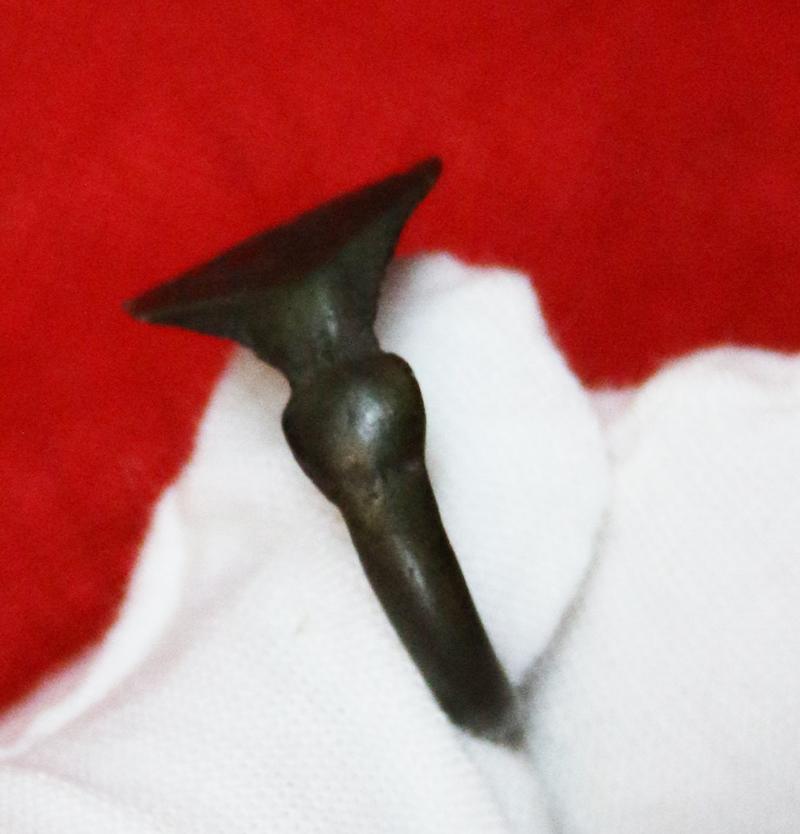

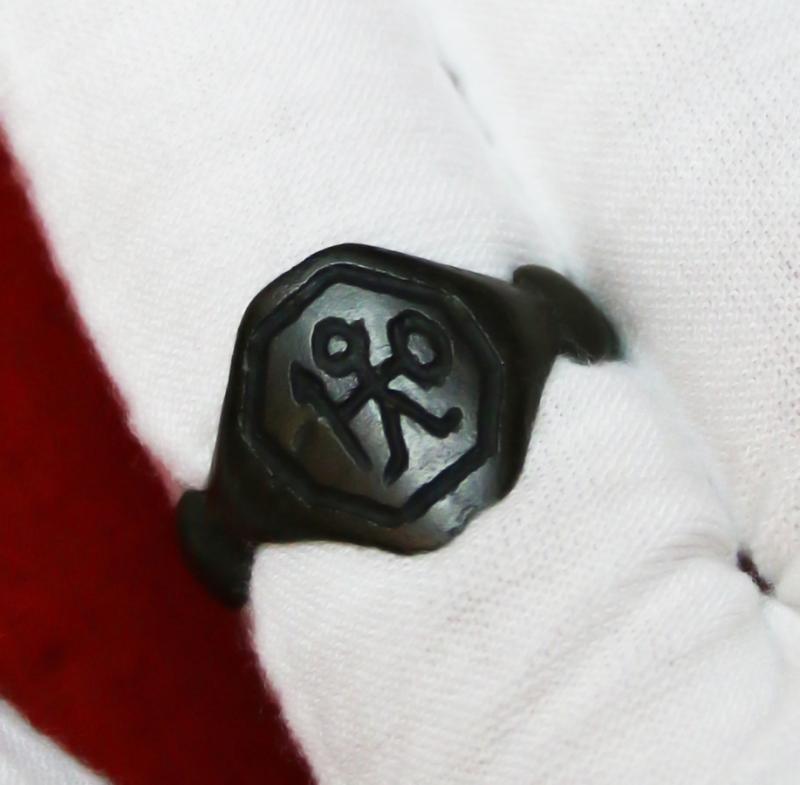
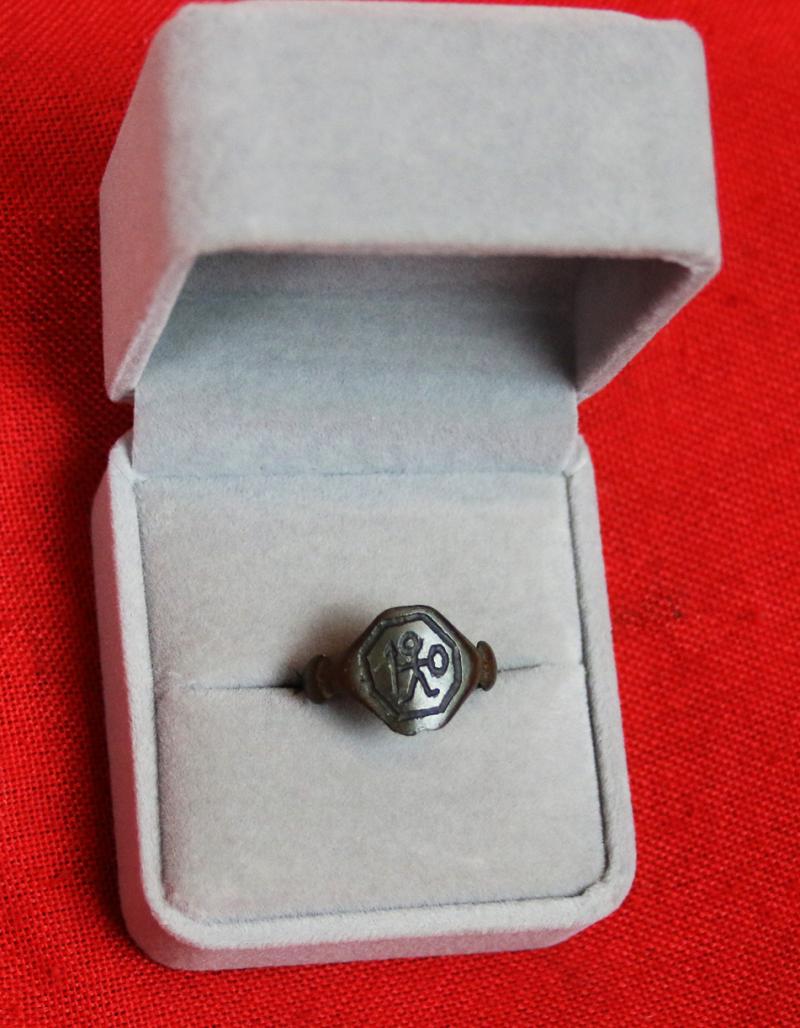
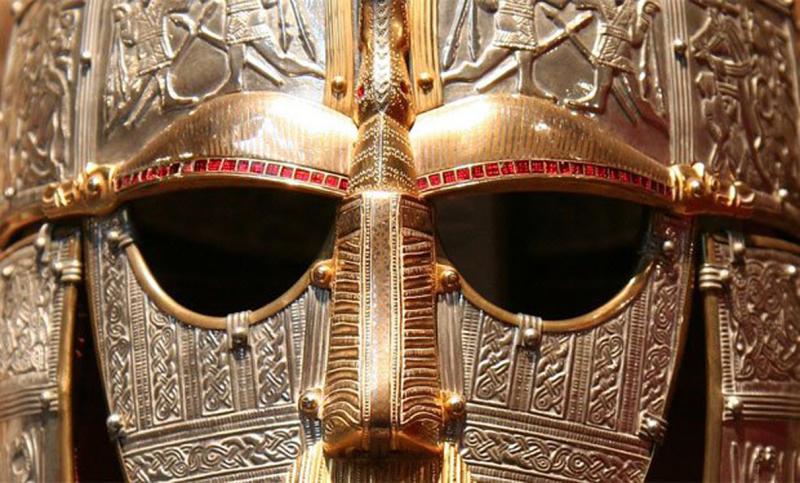
6th-7th Century Anglo Saxon Period Warrior's Bronze Ring from the Time of The Sutton Hoo Burial & the Ancient Story of Beowulf Engraved With a Warrior Armed With a Shield and Spear. Possibly a Stylized Representation of a Warrior of Such as King Raedwald
A ring of incredible ancient beauty, and in such remarkably fine condition. Good wearable size and condition, UK P 1/2. Likely recovered in a soil that contained little caustic elements for bronze surface encrustation. Engraved with a stylized figure, superbly defined and with fine clarity.
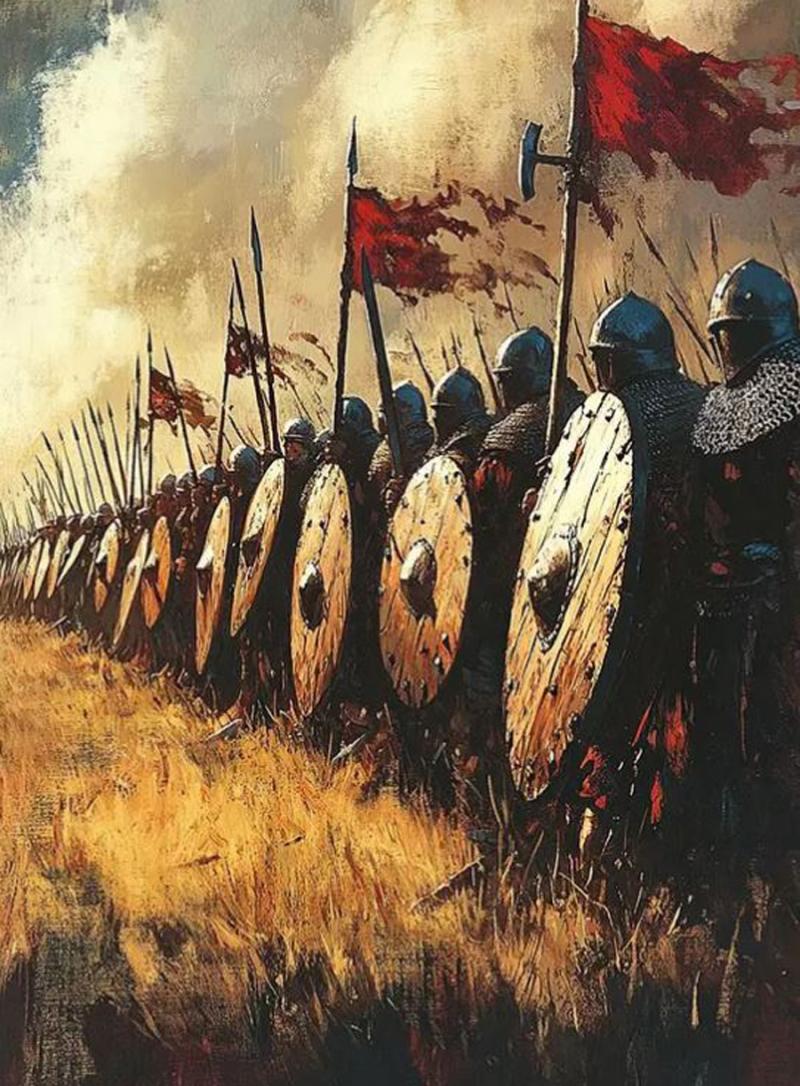
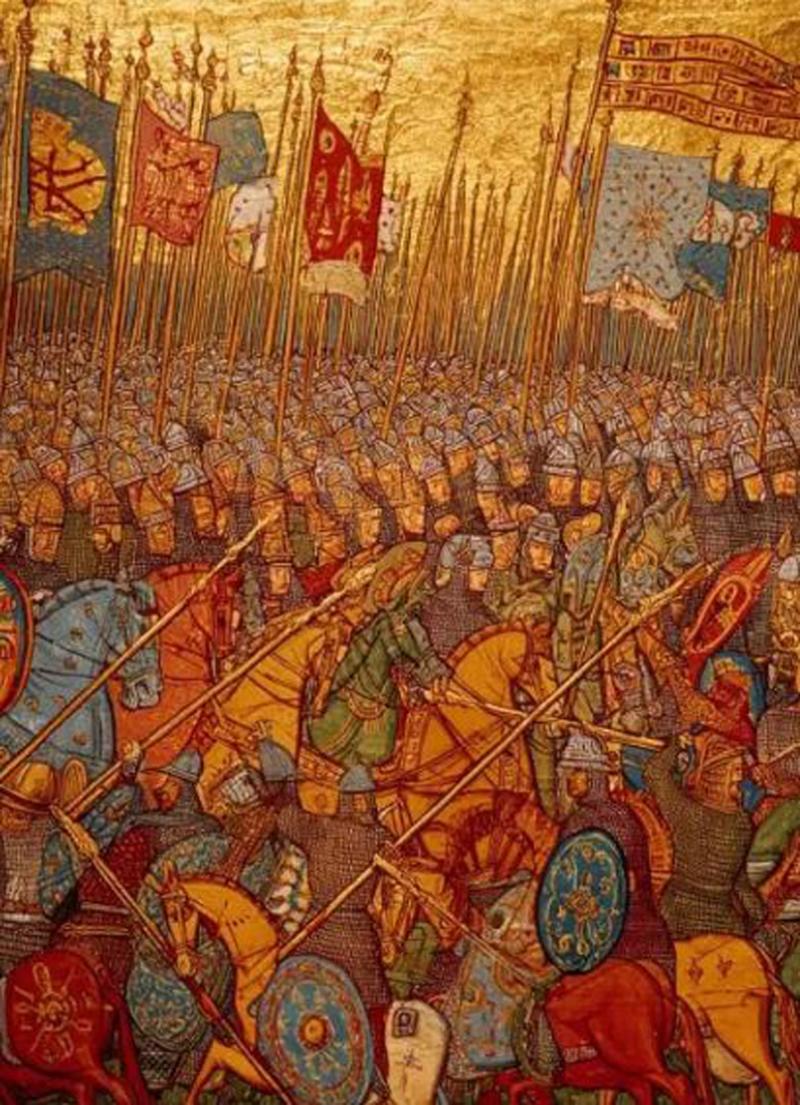
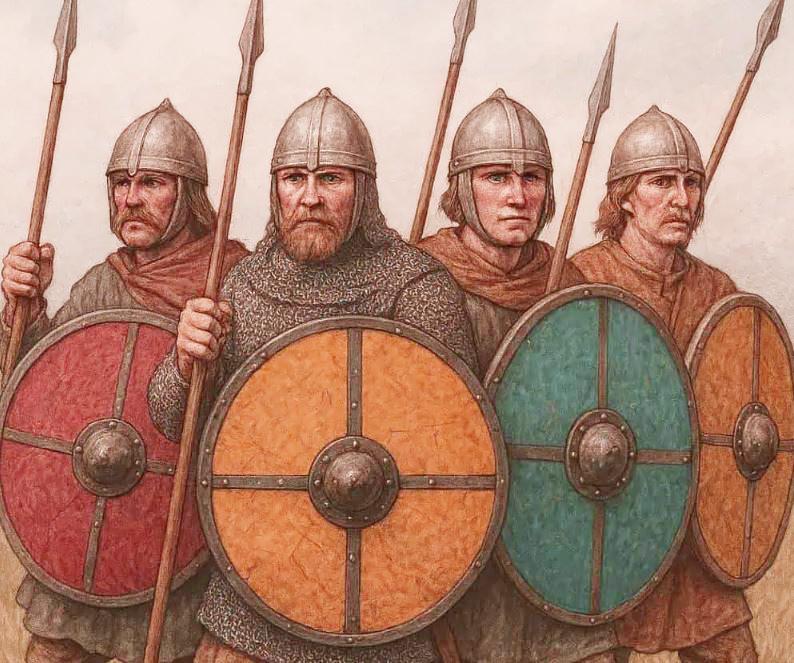
A warrior of the Anglo Saxon battle tactic of the 'Shield Wall and Spears'. The Bordweal Ond Gār
Because Anglo-Saxon armies relied almost entirely on infantry, the shield wall became the centrepiece of their battlefield tactics.
In this formation, warriors stood shoulder to shoulder, interlocking their round shields to form an unbroken barrier. Behind this defensive line, men would throw spears or javelins, while others waited to push forward in close combat.
When two shield walls collided, it became a brutal contest of strength, stamina, and courage—a “push and break” fight where formations could collapse under pressure, leading to chaos and slaughter. The shield wall was the core Anglo-Saxon defensive tactic, relying on unity and discipline, creating a tangible barrier that was difficult to break and essential for survival in battle against cavalry or flanking attacks.
From the Poem 'The Battle of Brunanburh':
The field ran thick
With heroes’ blood, when the risen sun
At morning-time, the mighty orb,
Shone o’er the earth, bright candle of God,
Eternal Lord, till the noble creature
Sank to his rest. There many men lay
Struck down with spears, men from the North,
Shot o’er the shield, and Scotsmen too,
Weary and war-filled.
The poem is considered one of the most important works of Anglo-Saxon literature
England in the Middle Ages concerns the history of England during the medieval period, from the end of the 5th century through to the start of the early modern period in 1485.
When England emerged from the collapse of the Roman Empire, the economy was in tatters and many of the towns abandoned. After several centuries of Germanic immigration, new identities and cultures began to emerge, developing into kingdoms that competed for power. A rich artistic culture flourished under the Anglo-Saxons, producing epic poems such as Beowulf and sophisticated metalwork.
The Anglo-Saxons converted to Christianity in the 7th century, and a network of monasteries and convents were built across England. In the 8th and 9th centuries, England faced fierce Viking attacks, and the fighting lasted for many decades. Eventually, Wessex was established as the most powerful kingdom and promoted the growth of an English identity.
Sutton Hoo is the site of two Anglo-Saxon cemeteries dating from the 6th to 7th centuries near Woodbridge, Suffolk, England. Archaeologists have been excavating the area since 1938, when an undisturbed ship burial containing a wealth of Anglo-Saxon artifacts was discovered. The site is important in establishing the history of the Anglo-Saxon kingdom of East Anglia as well as illuminating the Anglo-Saxons during a period which lacks historical documentation. The ship burial has prompted comparisons with the world of Beowulf. The Old English poem is partly set in Götaland in southern Sweden, which has archaeological parallels to some of the Sutton Hoo finds. Scholars believe Rædwald, king of the East Angles, is the most likely person to have been buried in the ship.
An English cultural identity first emerged from the interaction of the Germanic immigrants of the 5th and 6th centuries and the indigenous Romano-British inhabitants. Although early medieval chroniclers described the immigrants as Angles and Saxons, they came from a much wider area across Northern Europe, and represented a range of different ethnic groups. Over the 6th century, however, these different groups began to coalesce into stratified societies across England, roughly corresponding to the later Angle and Saxon kingdoms recorded by Bede in the 8th century. By the 9th century, the term the Angelcynn was being officially used to refer to a single English people, and promoted for propaganda purposes by chroniclers and kings to inspire resistance to the Danish invasions
Despite repeated crises of succession and a Danish seizure of power at the start of the 11th century, it can also be argued that by the 1060's England was a powerful, centralised state with a strong military and successful economy.
As with all our items it comes complete with our certificate of authenticity
Code: 26076
740.00 GBP