
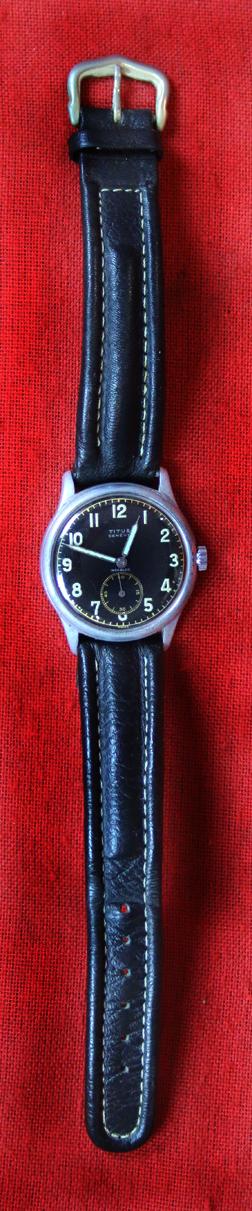
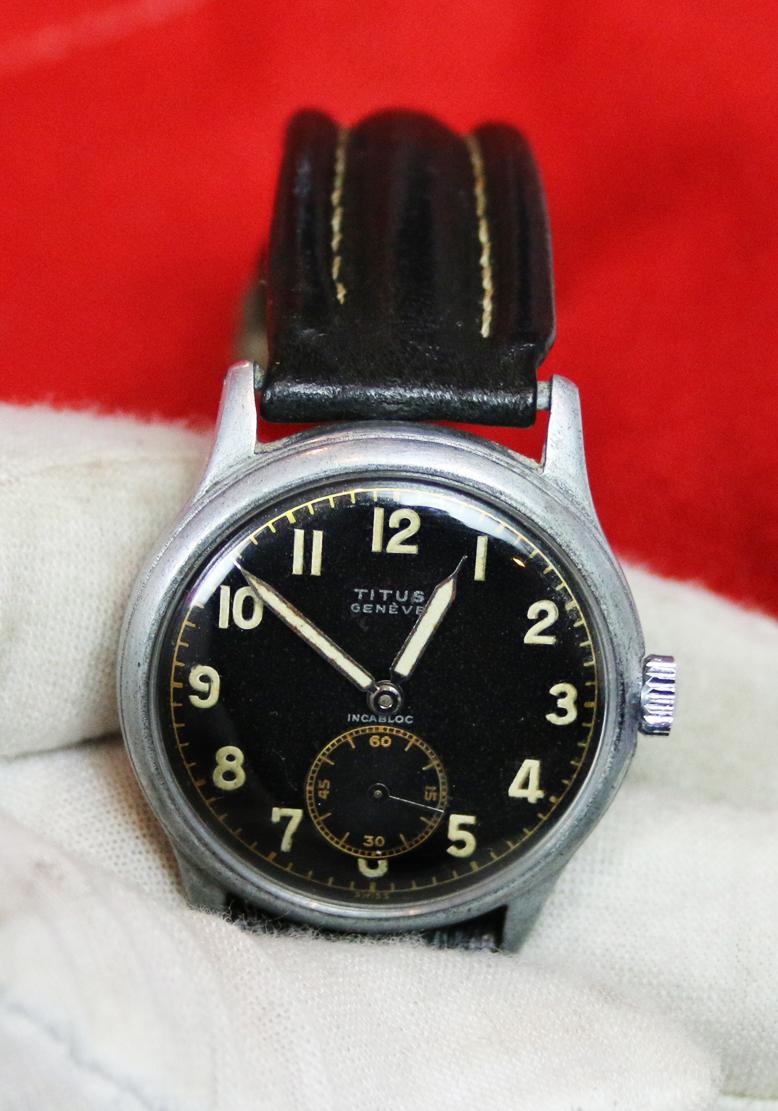
A Superb and Iconic WW2 German Luftwaffe Officer's 'Black Face' Watch By Titus, Geneva, {Switzerland} Incabloc. A Superb Original Artefact of WW2 German Aeronautical Warfare History
A fine survivor of WW2 a very good original Luftwaffe aircrew 'black face' wristwatch, with Luftwaffe blue strap, working order.
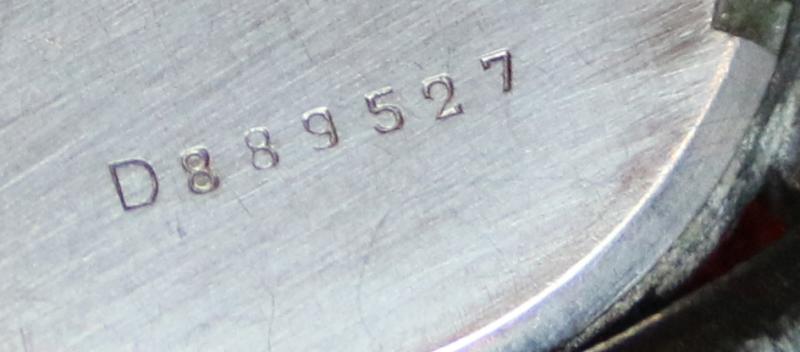
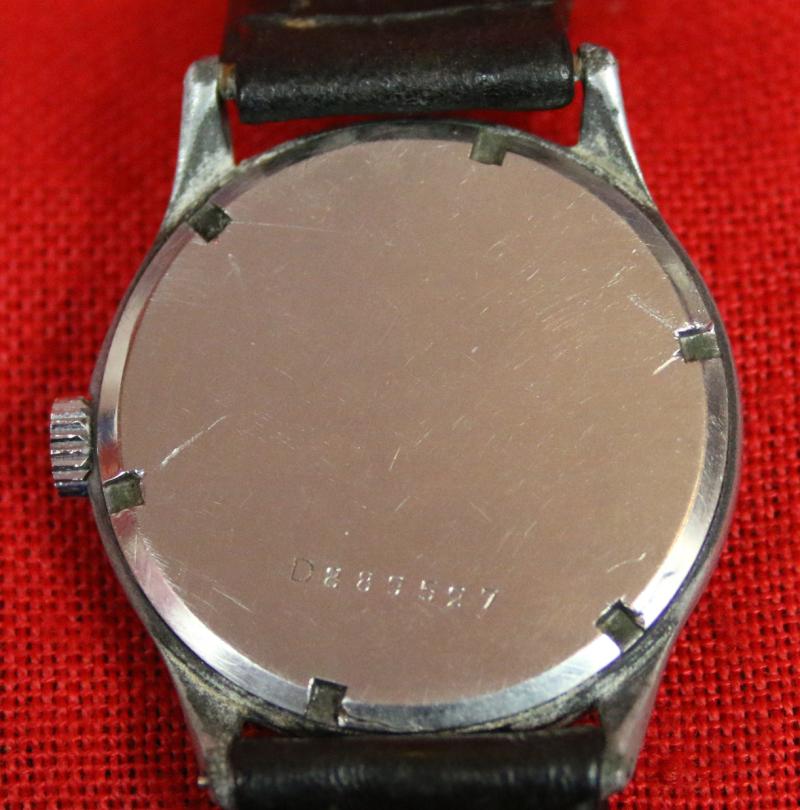
Case stamped D = Dienstuhr Luftwaffe - Air forces with serial number.
Titus (Solvil et Titus) was a Swiss watchmaker founded in 1887 by Paul Ditisheim, with production shifting to Geneva in 1930 under owner Paul-Bernard Vogel. During WWII, the brand produced robust, high-quality Swiss mechanical watches, including civilian and military-style pieces, with some models famously used by Luftwaffe aircrew. WWII-era Titus watches, featuring a 'D' prefix (e.g., D801202) on the case back, were issued to German Luftwaffe aircrew.
These watches often featured stainless steel cases, black faces with luminous numbers/hands, and small second dials. Known for high-quality Swiss mechanical movements.
Paul-Bernard Vogel took over in 1930 and steered the brand towards moderately priced, anti-magnetic, and robust watches during the 1930s and 1940s.
Post-War: The brand continued producing Chronobloc and chronograph models (e.g., with Landeron 48 movements) throughout the 1940s and 1950s.
These third Reich issue watches from the 1930s-1940s are highly sought after by collectors for their historical significance and durable design.
TITUS Watches
Paul Ditisheim: the founder
Paul Ditisheim, son of the famous Ditisheim family, was born into the small social circle of industrialist families that led the Swiss watch industry of the time.He studied at the Horological School of in La Chaux-de-Fonds, the historic birthplace of watch-making industry,4 and received his diploma at the age of 13. He was then trained in several of the major watch makers and worked at his family's Vulcain manufacture until 1892 when he founded his own brands: Solvil (whose items were often signed Paul Ditisheim) and Titus (whose items were generally marked separately).
Through its manufacture, Ditisheim was instrumental in developing the new generation of chronometers, improving them grandly through his studies on the impact of atmospheric pressure and magnetic fields. He invented the affix balance. Thanks to his inventions, he was able to make the most precise chronometers ever made. By 1903, his watches were awarded by the Kew and Neuchâtel Observatories contests. In 1912, he won the world's chronometric record of the Royal Kew Observatory. He also worked closely with Physics Nobel prize winner Charles-Edouard Guillaume and has been considered the father of the modern chronometers. According to Professor M. Andrade of the Besançon Astronomical Observatory, Solvil et Titus Ditisheim's devices "constitute the most important progress of modern chronometry"
In 1940, Germany heavily procured Swiss watches for its military, specifically for the Luftwaffe (air force) and army, due to a need for high-quality, reliable, and legible timepieces. Key Swiss brands involved included IWC, Longines, Helvetia, Titus and Tavannes, supplying watches often marked with "DH" (Dienstuhr Heer) for the army or "D" for the Luftwaffe.
Luftwaffe Watches (B-Uhren): The German air force utilized Beobachtungsuhren (Observation Watches) or B-Uhren. While German firms like Laco and Stowa were key, IWC produced specialized, high-grade navigational watches for the Luftwaffe starting around 1940.
Army/General Military Watches: The Dienstuhr Heer (DH) watches were widely procured from Switzerland. Helvetia was a major supplier, with watches featuring black dials, luminous numerals, and shock-protected movements.
Manufacturers supplying the German military included Alpina, Breitling, BWC, Doxa, Eterna, Glycine, Longines, Mimo, Minerva, Omega, Record, Revue, Roamer, Titus and others.
Significance: These watches, featuring 15-jewel movements and rugged cases, were essential for navigation and synchronizing maneuvers, particularly as the war progressed and industrial needs intensified.
Switzerland, while maintaining neutrality, provided a crucial source for these precision instruments throughout the war.
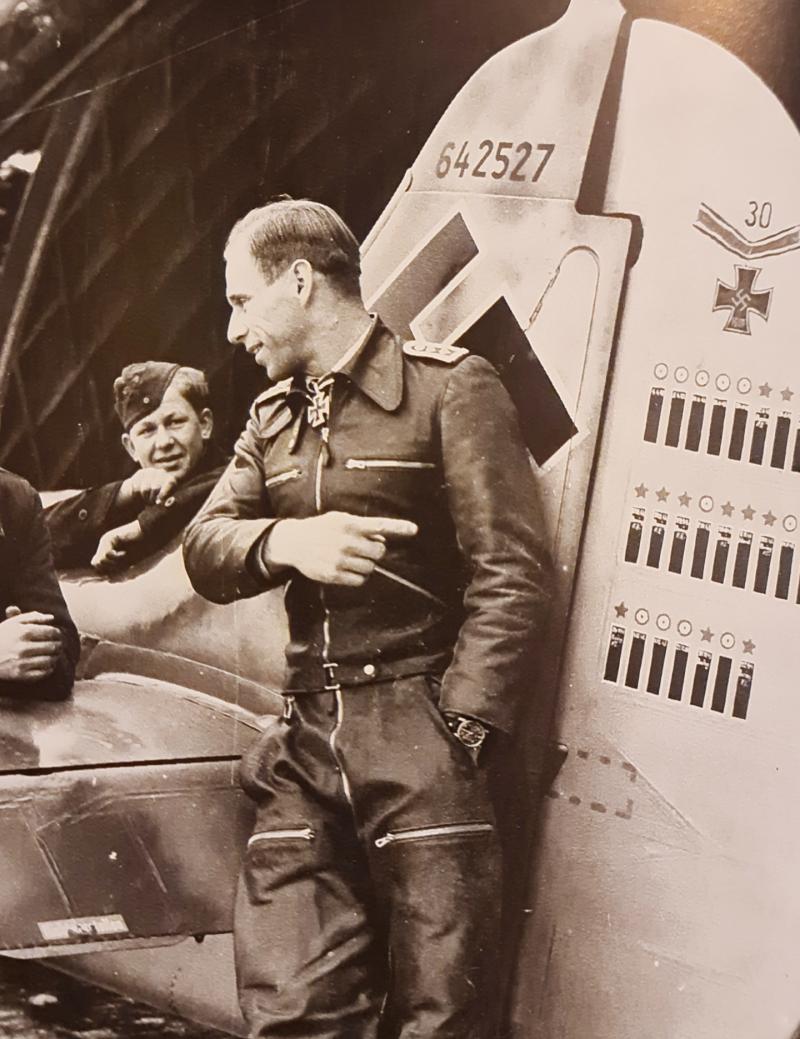
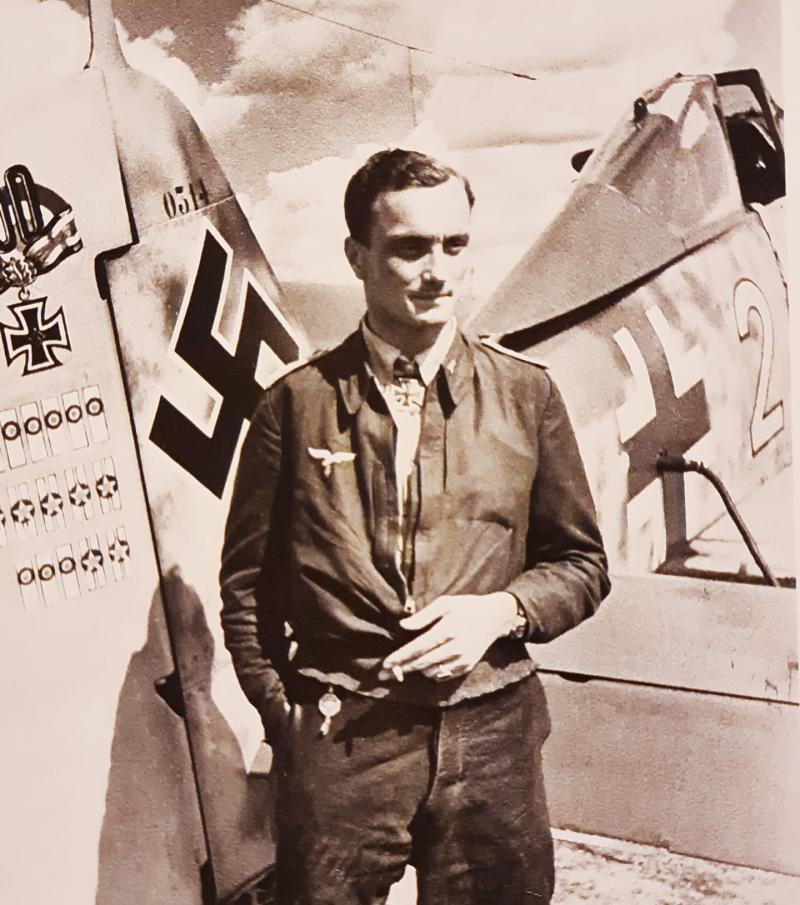
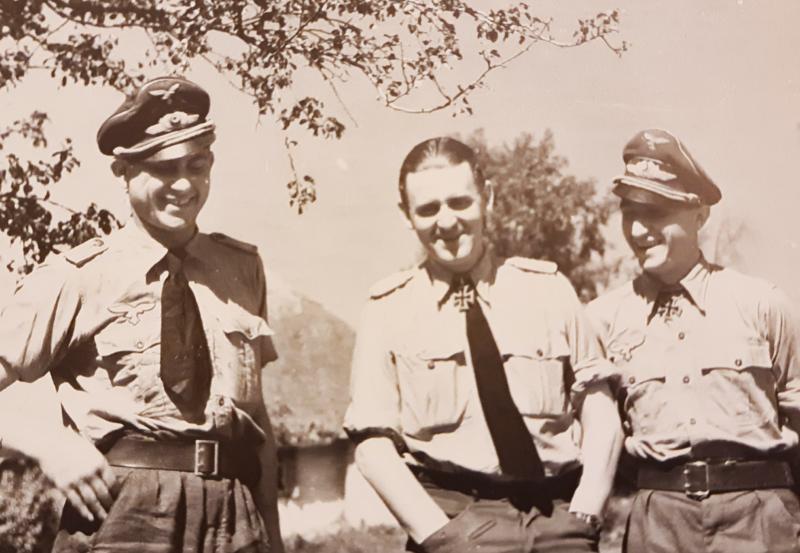
Photos in the gallery {for information only} of a few Luftwaffe aces, knights cross winner fighter pilots, each one can be seen wearing their 'black face' Luftwaffe issue Swiss wrist watch.
A superb Luftwaffe aeronautical artifact of WW2, the more technical chrongraph version, when they appear on the market, can now achieve £20,000 to £30,000. When collecting old watches it is always recommended to have them serviced.
Code: 26103