
A Superbly Beautiful Peninsular And Waterloo Service 1796 Light Dragoon Officer's Sabre 7th {the Queen's Own} Light Dragoons {Hussars} of Captain Peter Augustus Hayliger. They ‘Charged’ Between 12 to 14 Times At Waterloo, & Captured Marshal de Logis
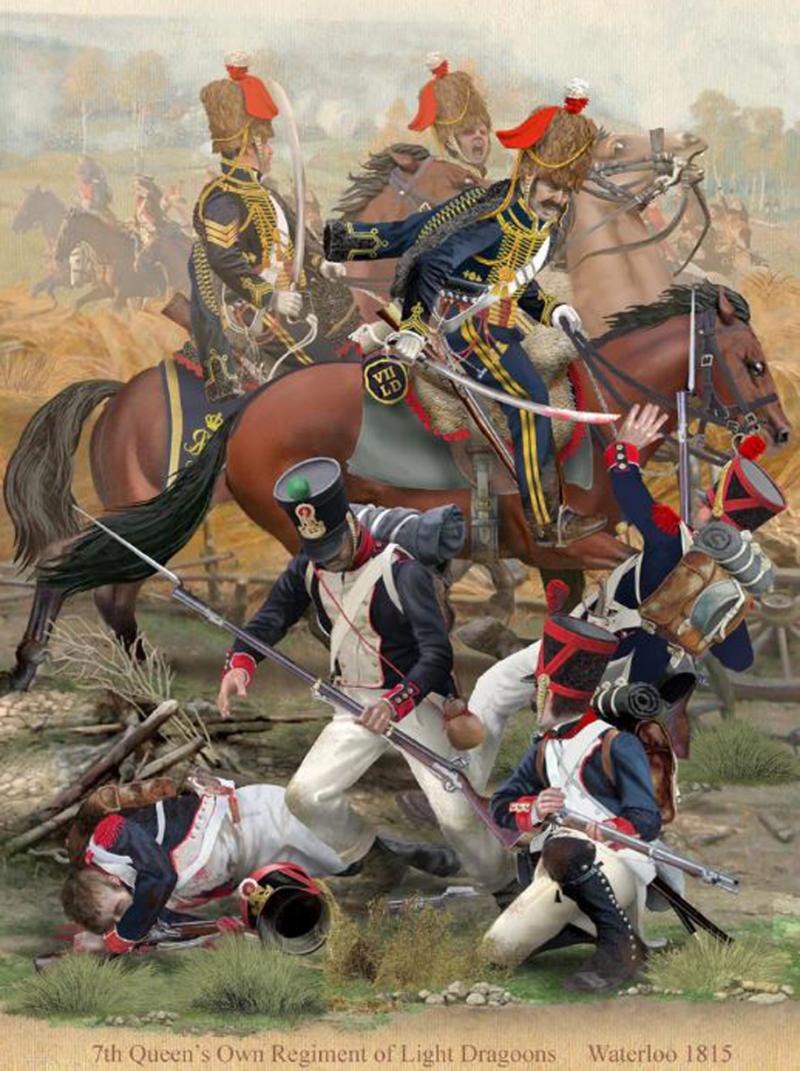
Napoleonic Wars & Hussars Light Dragoons officer's sabre: In 1807, they became the 7th (The Queen's Own) Regiment of (Light) Dragoons (Hussars). They served under Sir John Moore in Spain, fighting at Sahagún and Benavente (1808), and later in the Peninsula at Orthes (1814) and at the Battle of Waterloo (1815), where they made multiple charges.
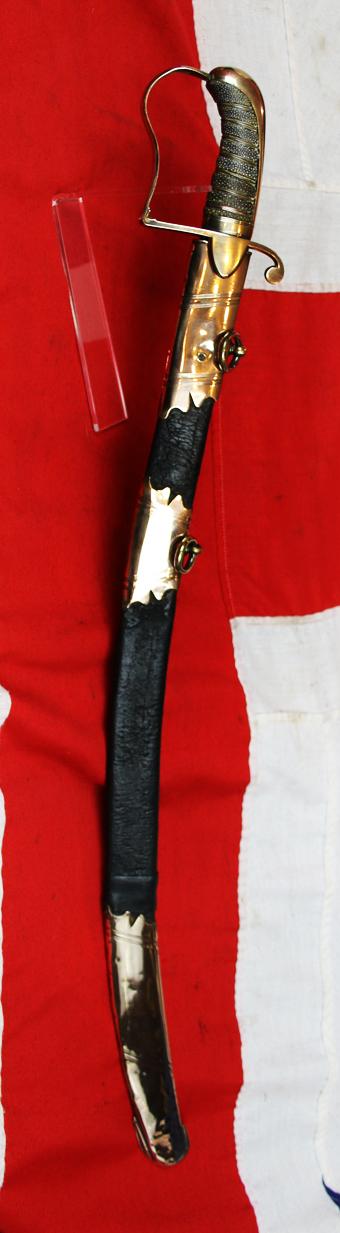
A most stunning looking original combat-combined-dress sabre, commissioned from the London sword-cutlers, Richard Johnston, by an officer of the 7th Hussars, Captain Peter Augustus Hayliger {bearing his monogram} who used this sabre in the Peninsular Campaign at the Battle of Orthes in February 1814, and at Waterloo, when he charged the advanced French Piquets on the morning of the 17th of June 1815. {Noted with distinction}
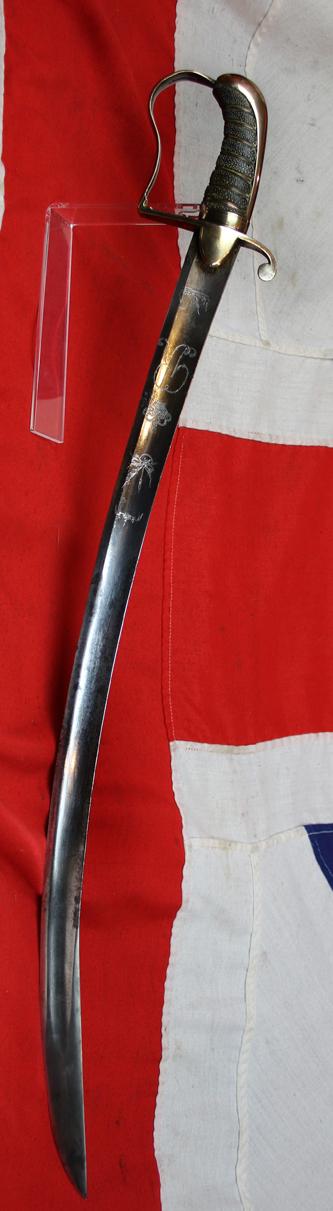
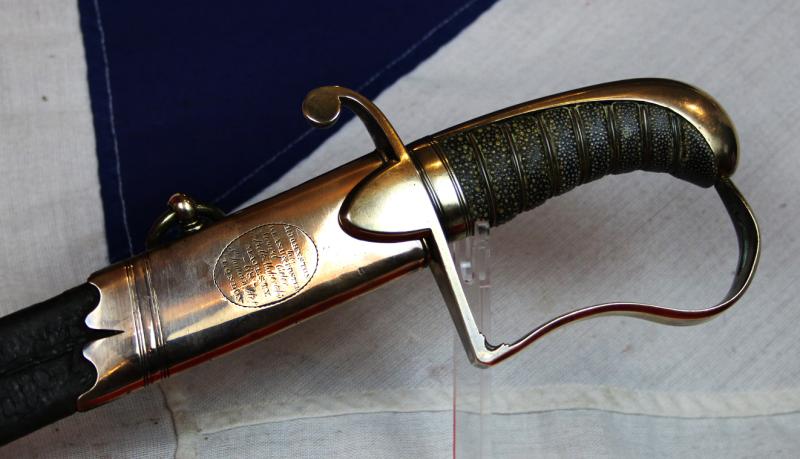
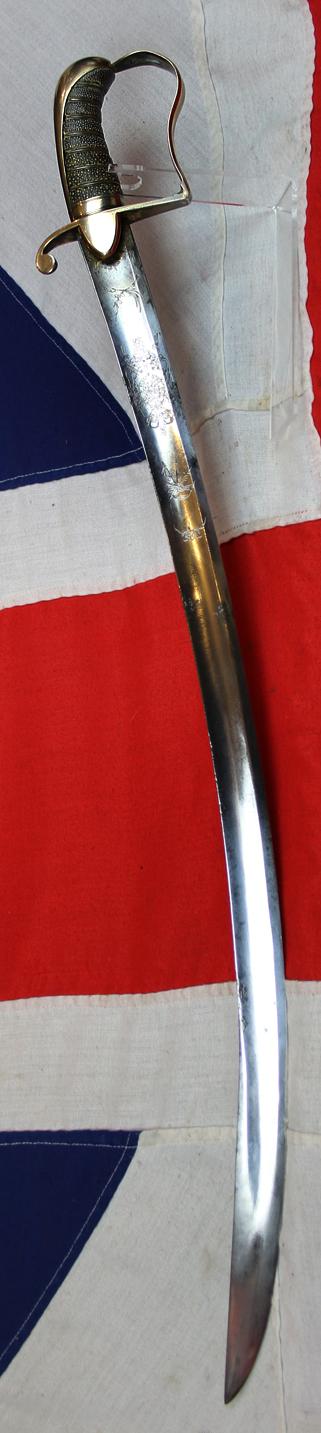
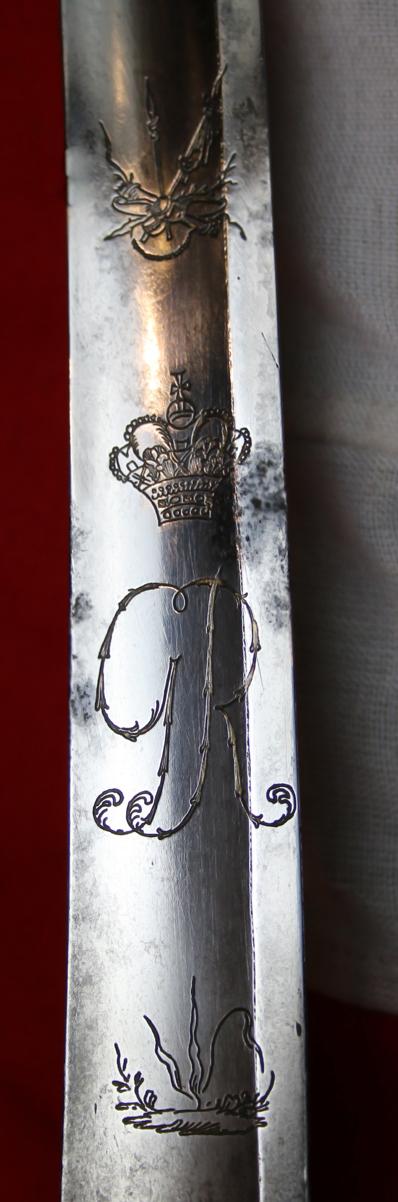
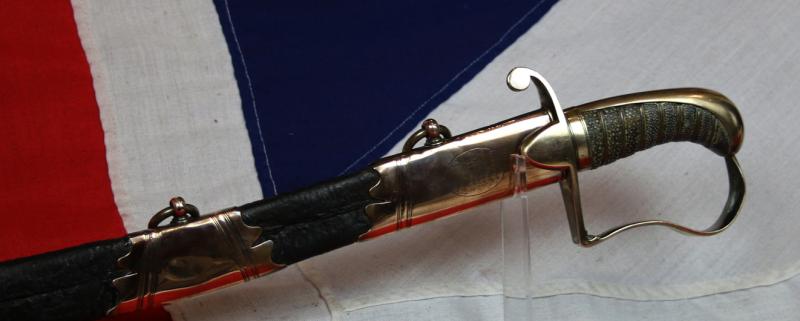
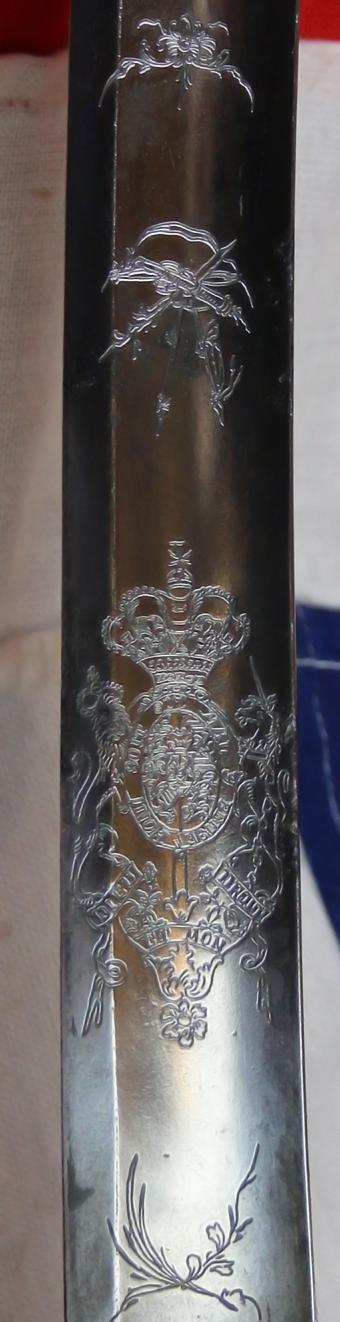
Regulation broad curved single edge blade engraved with traditional crowned GR, and the Kings’s Hanovarian 1801-1816 coat of arms, with military scrolls and symbols engraved decor, copper gilt stirrup hilt, excellent wire bound fish skin covered grip, in its original copper-gilt mounted leather scabbard, commissioned maker engraved at the throat mount, by its esteemed London sword cutler. Interestingly this is the very pattern of Officer’s sabre, {the 1796 copper-gilt mounted sabre} that inspired the creation of the 1803 pattern infantry officer’s sabre. The 1796 pattern infantry sword was considered by some to be inefficient at cutting down a foe in combat, but the sweeping mighty curvature of the 1796 cavalry sabre was apparently just the ticket for the more ‘derring-do’ officers, with an appetite for ‘gloire du combat’, so a version was created in copper-gilt, just like this sabre, but with an entirely new form of robust infantry hilt, more closely resembling this cavalry form. Thus it had demonstrably more force for hand to hand combat, yet still gloriously beautiful, with its stunning copper-gilt mounting.
In 1807, the regiment was designated as Hussars and retitled 7th (The Queen's Own) Regiment of (Light) Dragoons (Hussars). They were despatched to Corunna in October 1808 to support Sir John Moore's retreat, they fought at the Battle of Sahagún on 21 December 1808 and Benavente on 29th. Part of the Queen's Own was shipped home in the naval ship Dispatch, which was wrecked just south of the Lizard on 22 January 1809; 104 men were lost from the regiment, only seven in total were saved. The unit returned to the Peninsula in August 1813 and made several charges at the February 1814 Battle of Orthes, Wellington reporting that the 7th Hussars distinguished themselves on this occasion and made many prisoners.
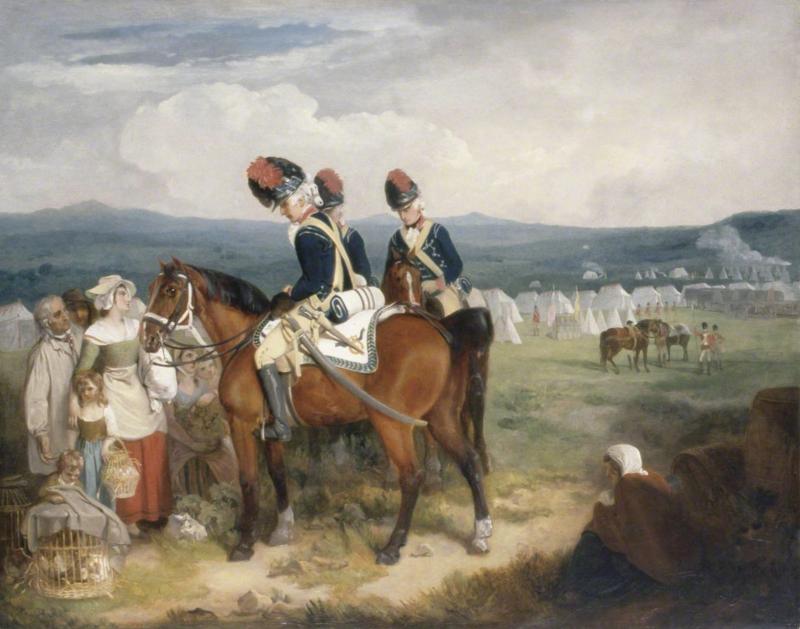
In March 1814, the unit moved to Brighton, in Sussex, where it was used to put down rioting caused by the imposition of the Corn Laws. There is a famous original oil painting of the King’s Light Dragoons by Francis Wheatley, entitled ‘The Encampment at Brighton’ {see photo 10 in the gallery} which we were delighted to provide the funds in order to acquire it in 1971, for the Brighton Museum, housed next to the Royal Pavillion palace in Brighton.
When Napoleon was restored in 1815, for the era known as the War of the 100 Days, the regiment returned to the Netherlands; during the rearguard action at Genappe on 17 June, Lord Uxbridge ordered it to attack French lancers under Colonel Jean Baptiste Joseph Sourd. The following day, at the Battle of Waterloo, the regiment was held in reserve until the evening, but then again undertook a series of charges. Standish O'Grady, {a junior officer serving under this sabre’s owner, Captain Heyliger} then a lieutenant in the 7th Hussars, wrote to his father:
"We charged twelve or fourteen times, and once cut off a squadron of cuirassiers, every man of whom we killed on the spot except the two officers and one Marshal de Logis, whom I sent to the rear"
29 inch blade, nicely maker marked by Runkel, a famous London based German emigre sword cutler/supplier, of somewhat dubious repute in his day. A most fascinating entrepreneurial King George IIIrd sword cutler and supplier who was arrested and imprisoned on numerous occasions for attempting to evade import duty on his Solingen made blades. He also imported 100 blades personally for His Royal Highness the Prince of Wales {later the Prince Regent} for the officer's swords of his 10th Light Dragoons regiment
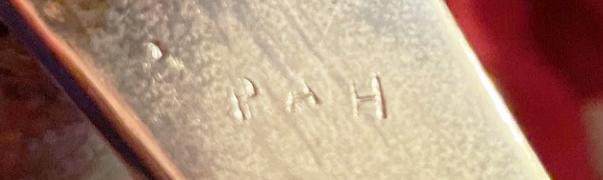
Good leather to the scabbard with one contemporary field service leather patch and a small, makers craftsman, repair. Copper gilt hilt, of much elegance and beauty, with superb original sharkskin grip, in near mint order, triple wire bound, and copper-gilt mounted scabbard with usual light surface combat wear and denting. The bright blade is simply excellent with just a few old, original, surface pitting marks. The last photo is of a close-up from the interior guard of the cutlers applied, owner's, small 'repair' monogram, PAH, likely applied when the leather was repaired. Somewhat akin to an old 19th century pawnbrokers mark on the inside of a gold pocket watch, in order to assign the item to its owner {to avoid miss placement} but, unobtrusively as possibly. The tiny stamp is almost nigh near invisible, but, clearly viewable with a powerful artisan jewellers loop {magnifying glass} See photo.
Code: 26121
2650.00 GBP