
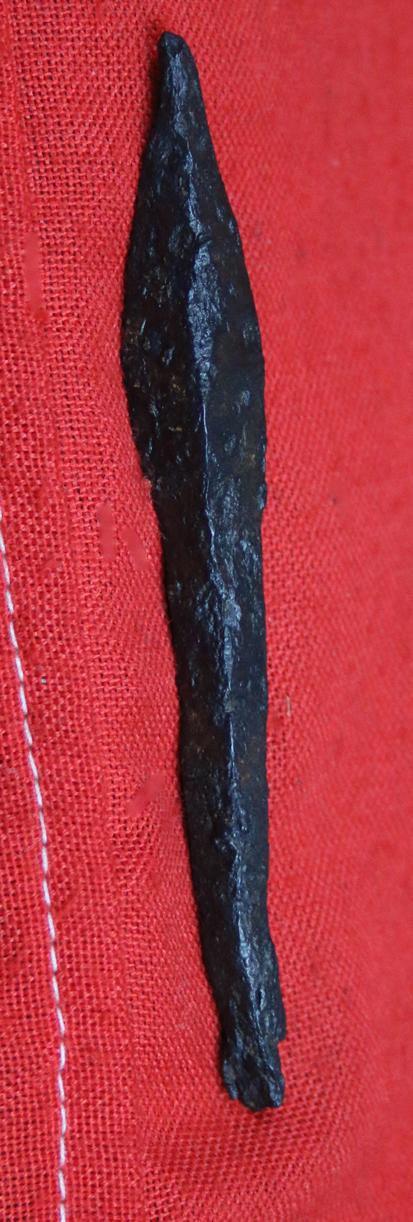
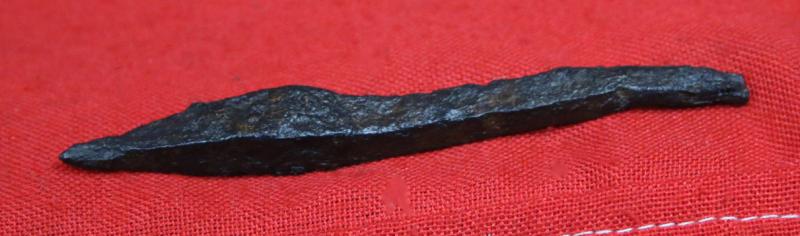
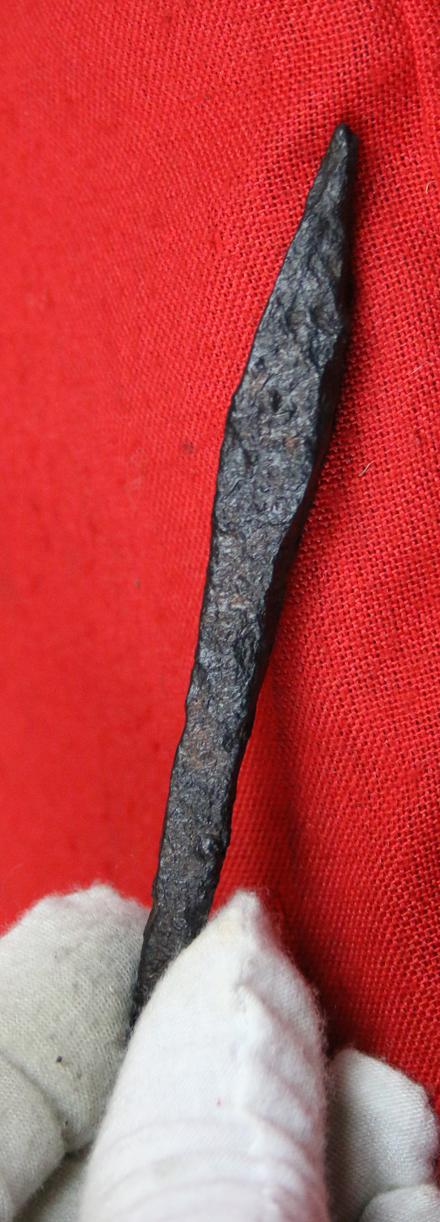
A Rare, Original, 1st Century Roman 'Ballista' Siege Engine. Tanged, Four Sided Bolt Head. Province of Britannia Use and Recovered Near Camulodunum {Colchester} In the Early 1800's
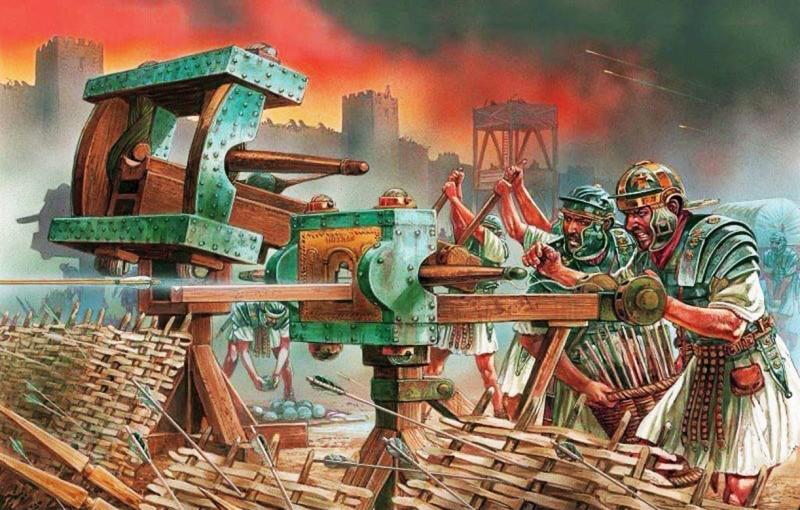
The Roman ballista was a powerful torsion-powered siege engine used from the 3rd century BCE to the 4th century CE to launch iron-tipped bolts or stone projectiles over 500 yards. It came in several forms and of various sizes. some far more mobile than others. Adapted from Greek designs, it acted as a giant, highly accurate crossbow, often featuring in, or as part of, legions to break enemy formations and defenses.
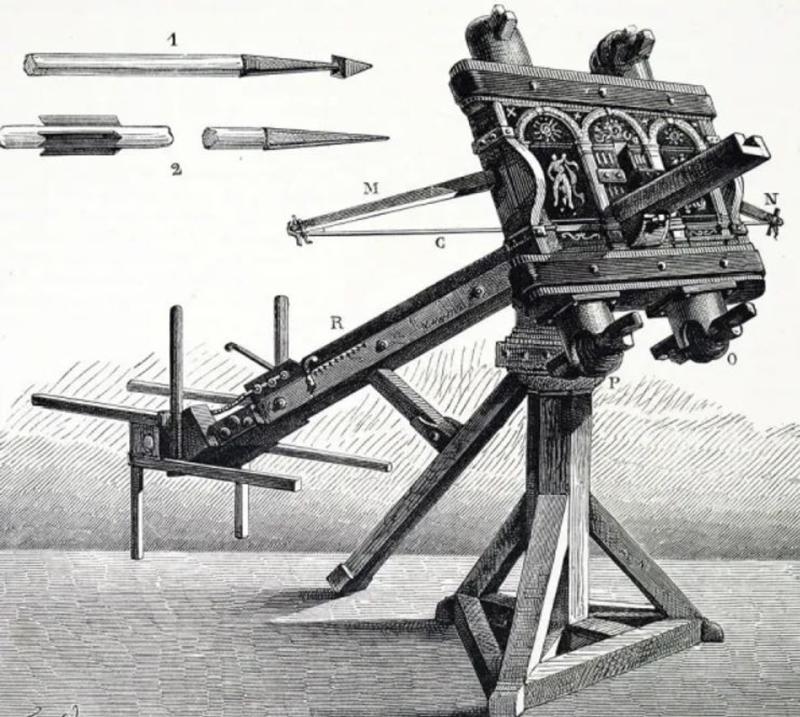
It used two wooden arms inserted into tightly twisted skeins of animal sinew or human hair, which provided the tension to propel projectiles when released.
Ranged from large, stationary siege engines to smaller, portable versions known as the scorpio or cheiroballistra (hand ballista).
A single ballista could fire up to 1,000 projectiles in a day, often operated by a crew of up to eight men.
Used for both offense and defense in sieges, they were capable of piercing armour, shattering shield walls, and, in some cases, destroying ships.
Later imperial versions, such as the carroballista, were mounted on carts, allowing them to be moved rapidly around the battlefield.
They were crucial in major sieges, such as in the Second Temple of Jerusalem's destruction (70 CE) and the Siege of Alesia (52 BCE).
By the 1st century CE, they were a standard, integrated component of the Roman legion.
Beyond physical destruction, the ballista was a terrifying weapon that could break the morale of opposing forces
The Romans referred to the island of Britain primarily as Britannia. Following their invasion and conquest, which began in 43 AD, they established it as the province of Britannia. The name was a Latinization of the native Brittonic word Pretanī, which referred to the people of the islands.
The standard Latin name for the province.
Albion: An older, indigenous, or Greek term occasionally used, but largely replaced by Britannia by the 1st century BC.
Britannia Superior & Inferior: Later (roughly 197 AD), the province was divided into two, known as "Upper Britain" (South) and "Lower Britain" (North).
Caledonia: The term used for the unconquered northern region, roughly corresponding to modern Scotland.
The inhabitants were referred to as Brittones.
From the region from whence it was recovered, may indicate that it was part of the Romano British revolt by Queen Boudica of the Iceni
The Boudican revolt was an armed uprising by native Celtic Britons against the Roman Empire during the Roman conquest of Britain. It took place circa AD 60–61 in the Roman province of Britain, and it was led by Boudica, the Queen of the Iceni tribe. The uprising was motivated by the Romans' failure to honour an agreement they had made with Boudica's husband, Prasutagus, regarding the succession of his kingdom upon his death, and by the brutal mistreatment of Boudica and her daughters by the occupying Romans.
The Boudican Revolt at Camulodunum AD 60 - 61
was the first target of the rebels and was the former capital of the Trinovantes, Camulodunum (Colchester), which had been made into a colonia for Roman military veterans. These veterans had been accused of mistreating the locals. A huge temple to the former emperor Claudius had also been erected in the city at great expense to the local population, causing much resentment. The future governor Quintus Petillius Cerialis, then commanding the Legio IX Hispana, attempted to relieve the city, but suffered an overwhelming defeat. The infantry with him were all killed and only the commander and some of his cavalry escaped. The location of this battle is unknown.
The Roman inhabitants sought reinforcements from Catus Decianus, but he sent only two hundred auxiliary troops. Boudica's army attacked the poorly defended city and destroyed it, besieging the last defenders in the temple for two days before it fell. Archaeologists have shown that the city was methodically demolished. After this disaster, Catus Decianus, whose actions had provoked the uprising, fled to Gaul.
During the 6th century, Procopius described the effects of this weapon:
"But Belisarius placed upon the towers engines which they call "ballistae". Now these engines have the form of a bow, but on the under side of them a grooved wooden shaft projects; this shaft is so fitted to the bow that it is free to move, and rests upon a straight iron bed. So when men wish to shoot at the enemy with this, they make the parts of the bow which form the ends bend toward one another by means of a short rope fastened to them, and they place in the grooved shaft the arrow, which is about one half the length of the ordinary missiles which they shoot from bows, but about four times as wide...but the missile is discharged from the shaft, and with such force that it attains the distance of not less than two bow-shots, and that, when it hits a tree or a rock, it pierces it easily. Such is the engine which bears this name, being so called because it shoots with very great force.
The missiles were able to penetrate body-armour:
And at the Salarian Gate a Goth of goodly stature and a capable warrior, wearing a corselet and having a helmet on his head, a man who was of no mean station in the Gothic nation, refused to remain in the ranks with his comrades, but stood by a tree and kept shooting many missiles at the parapet. But this man by some chance was hit by a missile from an engine which was on a tower at his left. And passing through the corselet and the body of the man, the missile sank more than half its length into the tree, and pinning him to the spot where it entered the tree, it suspended him there a corpse.
Procopius became the principal historian of the 6th century, writing the History of the Wars, the Buildings, and the infamous Secret History.
Approx 4 inches long, weight, 1.17 ounces
Code: 26130
285.00 GBP