


A Simply Stunning A Fabulous Original Antique Shinto Early Edo Period Chisa Katana. Wondrous Pure Gold and Shakudo Mounts Of The Tale of Momotarō, the Demon and The Monkey. Superbly Beautiful Blade Hamon and Hada Grain
An absolute beauty of an original samurai sword katana.
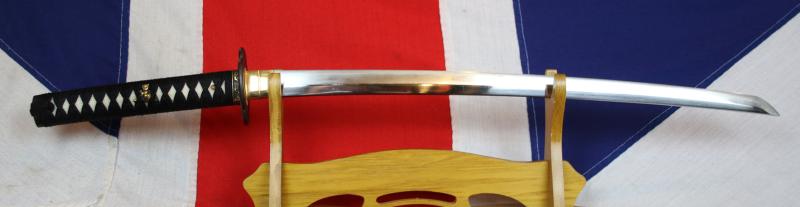
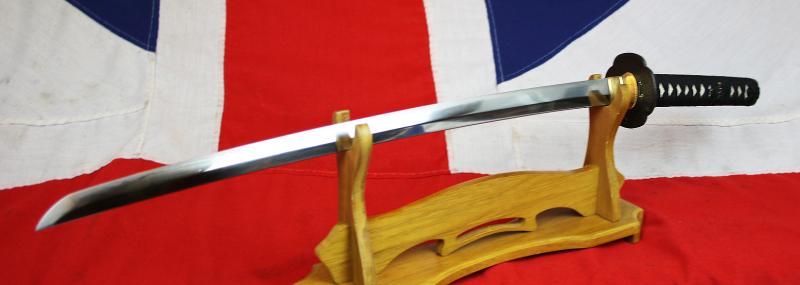
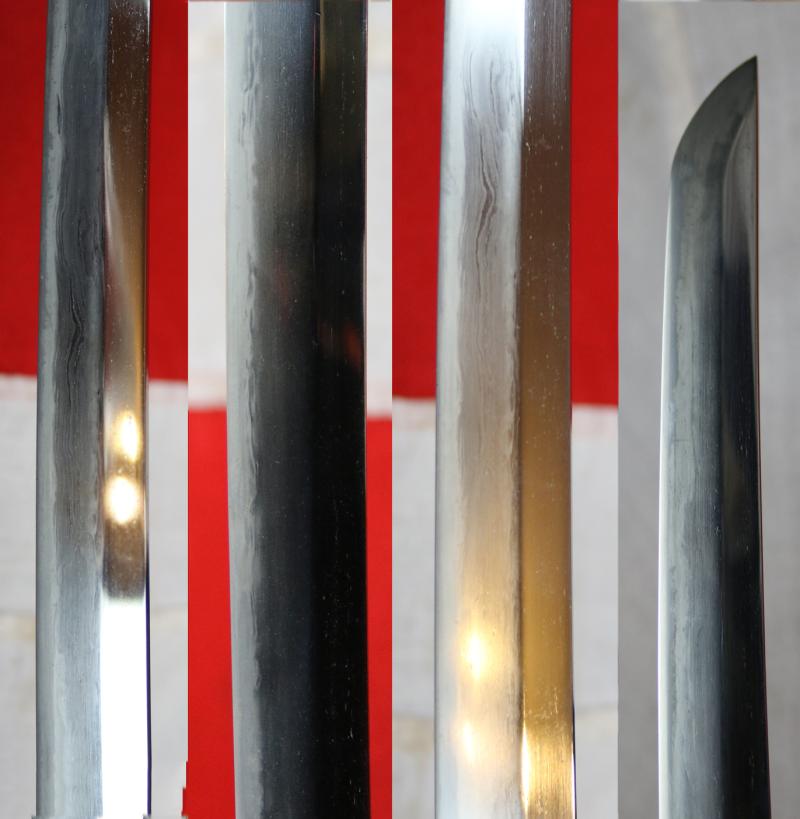
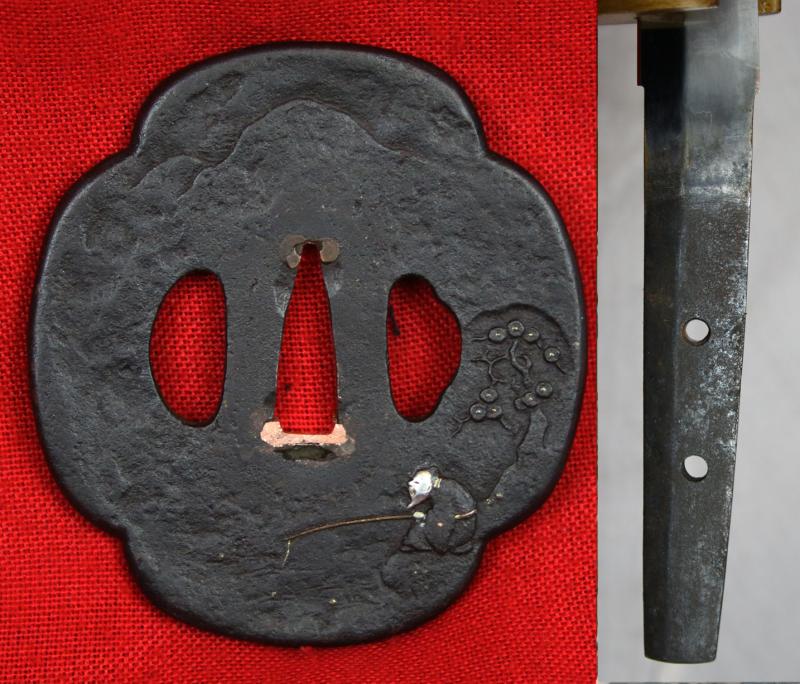
The blade is in amazing condition with a breathtaking hamon and hada, it is truly amazing! with a beautiful iron mokko plate tsuba with a silver faced figure fishing from a stream flowning down from a mountail range. The saya is decorated in ishime stone finish lacquer.
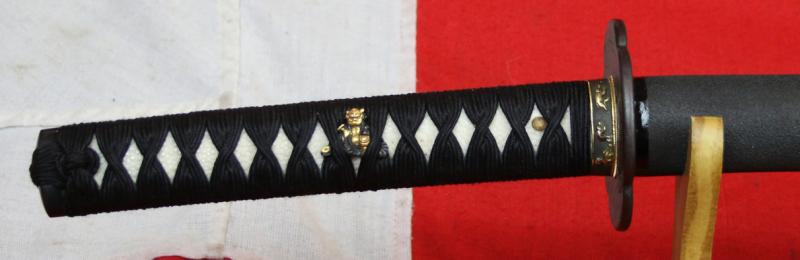
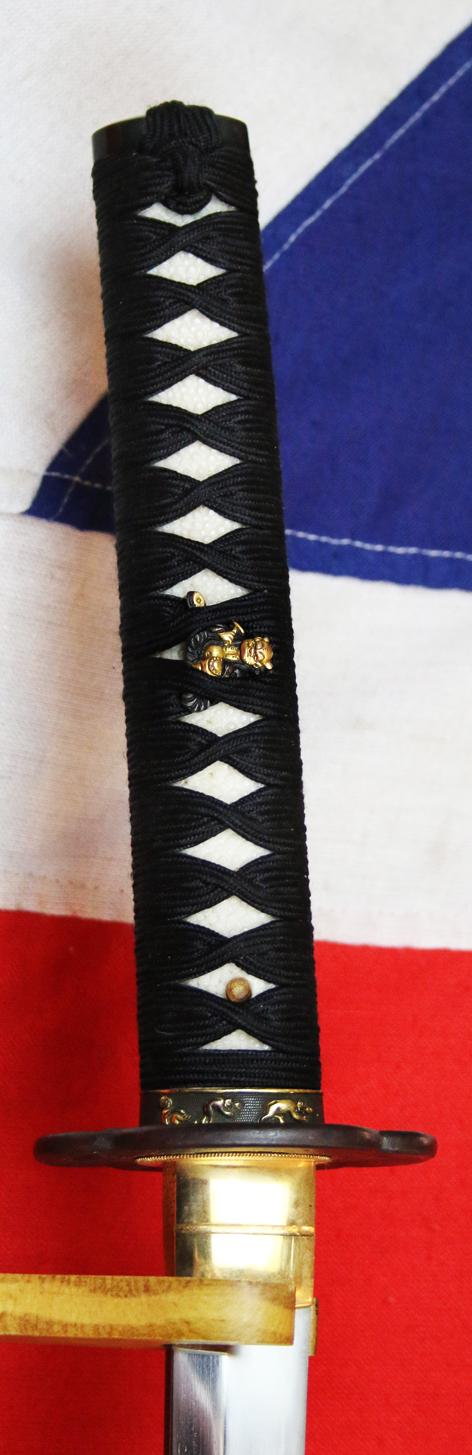
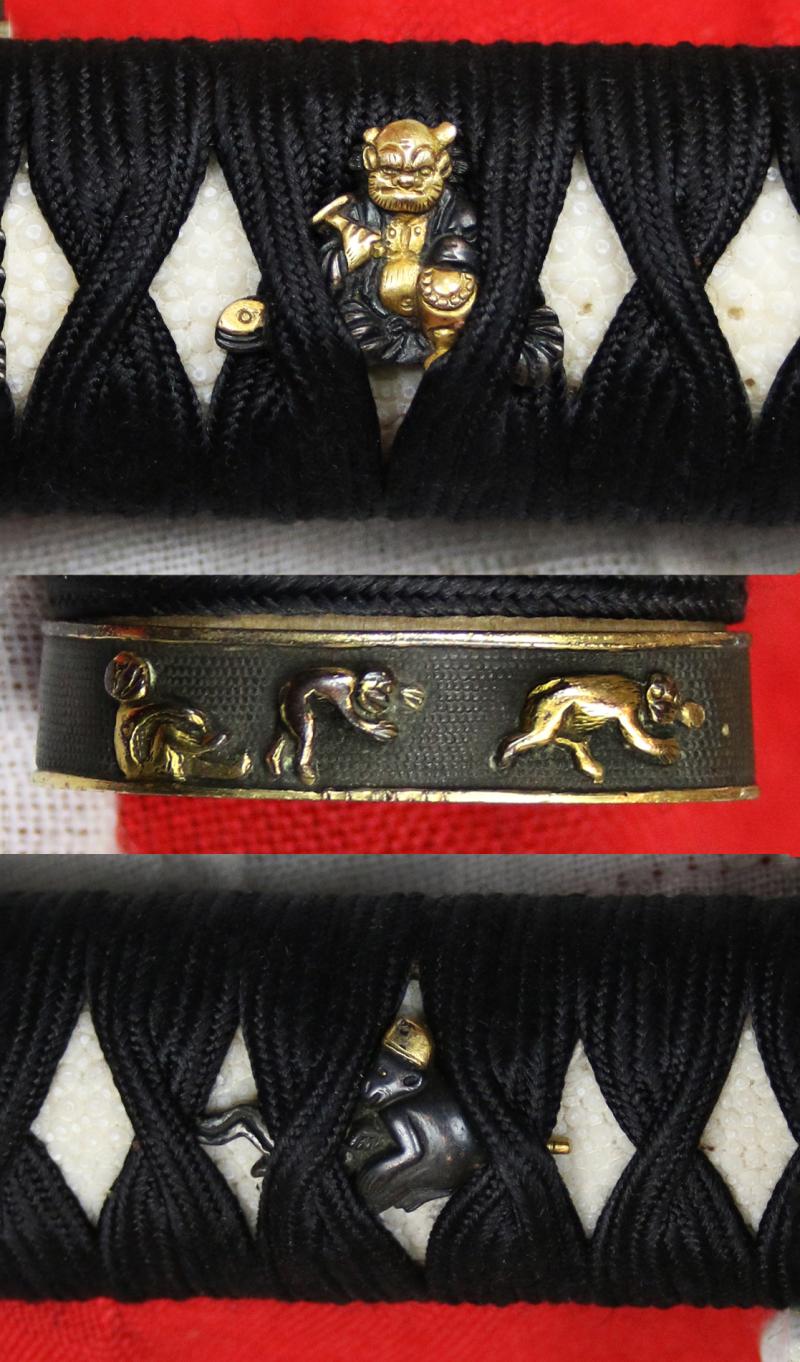
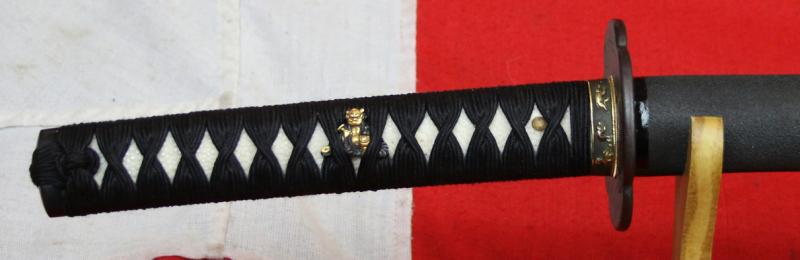
The koshirae {mounts and fittings} are equally wonderful, the kashira is carved buffalo horn and the fushi in gold and shakudo on a nanako ground, of the monkey, in three different images of it running, and the menuki are also very fine, of pure gold and shakudo depicting the monkey and the evil Oni {demon}. They represent the Japanese folklore story featuring an oni (demon/ogre) and a monkey is Momotarō (Peach Boy). Nanako Ji: "fish roe ground" A surface decoration produced by forming very small raised bosses by a sharply struck punch or burin called 'nanako tagane'. Shakudo is the metal most often used, but copper and gold are quite often employed. The harder metals, shibuichi, silver and iron are rarely decorated in this way. The size of the dots vary from 0.04" to 0.008" (25 to 125 and inch) and the regularity of the work is marvelous as the dots must be spaced entirely by touch. The dots are usually arranged in straight lines or in lines parallel to the edge of the piece being decorated, but sometimes in more elaborate patterns. Used on guards since the Momoyama period although the technique existed since much earlier periods. Usually done by specialist 'nanako-shi', but sometimes done by the maker of the guard himself.
Shakudo is a billon of gold and copper (typically 4-10% gold, 96-90% copper) which can be treated to form an indigo/black patina resembling lacquer. Unpatinated shakudo Visually resembles bronze; the dark color is induced by applying and heating rokusho, a special patination formula.
Shakudo Was historically used in Japan to construct or decorate katana fittings such as tsuba, menuki, and kozuka; as well as other small ornaments. When it was introduced to the West in the mid-19th century, it was thought to be previously unknown outside Asia, but recent studies have suggested close similarities to certain decorative alloys used in ancient Egypt, Greece, and Rome. The lacquer surface of the saya has some age bruising etc. due to its vintage
In the tale, depicted within the mounts of the sword, a monkey is one of three animal companions who aid the hero in defeating malevolent oni on Onigashima (Demon Island).
The Tale of Momotarō (Peach Boy)
An elderly couple finds a giant peach floating down a river. Inside is a baby boy, who they name Momotarō ("Peach Boy").
The Journey: Momotarō grows up with incredible strength and decides to go to Onigashima to stop the oni, who are kidnapping people and stealing treasure.
On his journey, Momotarō meets a talking dog, a monkey, and a pheasant. He shares his special millet dumplings (kibi dango) with them, gaining their loyalty and friendship.
The Battle: Upon reaching the island, the monkey uses his agility to infiltrate the demon fortress. Together, Momotarō and his companions overpower the demon chief and his followers.
Victory: The defeated oni promise never to bother the villagers again, and Momotarō returns home with the captured demon chief and stolen treasure.
The Monkey: In the story, the monkey is agile and clever, acting as a key strategist and fighter.
Oni: The oni represent evil and the obstacles that need to be overcome.
The Teamwork: The story is a famous example of team-based success in Japanese culture, emphasizing how different strengths (the dog's loyalty, the monkey's agility, and the pheasant's vision) can overcome a strong adversary.
This tale is deeply rooted in Japanese culture, particularly in Okayama Prefecture, where it is believed the legend originated.
The Chisa Katana samurai sword;
The most common blade cutting edge lengths for Chisa katana was approximately eighteen to twenty-four inches. They were most commonly made in the Buke-Zukuri mounting (which is generally what is seen on katana and wakizashi). The chisa katana was able to be used with one or two hands like a katana (with a small gap in between the hands) and especially made for double sword combat a sword in each hand.
It was the weapon of preference worn by the personal Samurai guard of a Daimyo Samurai war lord clan chief, as very often the Daimyo would be more likely within his castle than without. The chisa katana sword was far more effective a defence against any threat to the Daimyo's life by assassins or the so-called Ninja when hand to hand sword combat was within the Castle structure, due to the restrictions of their uniform low ceiling height. The hilt was usually around ten to eleven inches in length, but could be from eight inches or up to twelve inches depending on the Samurai's It has been over one thousand years ago that the art of making swords appeared in Japan. The swordsmiths of the time may not have known it but they were creating a legendary sword. The Samurai sword has seen combat in many battlefields. From the early days of the Samurai warrior to the fierce battles in the South Pacific during WWII.
From the earliest days hand-made traditional the Samurai sword was unique because it was forged using the finest skills known to man. A tremendous amount of work was dedicated to creating these pieces. They were an instrument of war as much as a beautiful artifact to adorn any decor.
As once told to us by an esteemed regular visitor to us here in our gallery, Victor Harris {the most eminent sword expert in Europe, and sword curator of the British Museum} and his same words that are repeated in his book, see below;
“In these textures lies an extraordinary and unique feature of the sword - the steel itself possesses an intrinsic beauty. The Japanese sword has been appreciated as an art object since its perfection some time during the tenth century AD. Fine swords have been more highly prized than lands or riches, those of superior quality being handed down from generation to generation. In fact, many well-documented swords, whose blades are signed by their makers, survive from nearly a thousand years ago. Recognizable features of the blades of hundreds of schools of sword-making have been punctiliously recorded, and the study of the sword is a guide to the flow of Japanese history.”
Victor Harris
Curator, Assistant Keeper and then Keeper (1998-2003) of the Department of Japanese Antiquities at the British Museum. He studied from 1968-71 under Sato Kenzan, Tokyo National Museum and Society for the Preservation of Japanese Swords
For those that have interest in original Japanese swords, this is a perfect way to have a superbly made original hand made sword that it mounted in original Japanese fittings of the early samurai form of katana.
** Authentic, currently, modern hand-made nihonto (Japanese sword blades) from licensed swordsmiths in Japan today, typically start around $10,000–$25,000 for a katana, with prices often exceeding $60,000 for renowned top-tier sword masters or customized commissions.
These blades, forged from tamahagane steel, require 12+ months to create due to strict legal limits on production, with some high-end, custom pieces from master smiths such as Yoshindo Yoshihara exceeding $10,000 for smaller tanto blades.
A brand new, katana blade from a reputable but lower ranked smith usually starts around $7,500–$10,000.
Every single item from The Lanes Armoury is accompanied by our unique Certificate of Authenticity. Part of our continued dedication to maintain the standards forged by us over the past 100 years of our family’s trading, as Britain’s oldest established, and favourite, armoury and gallery
The blade is 22 inches long from tsuba to tip
Code: 26145
4750.00 GBP