

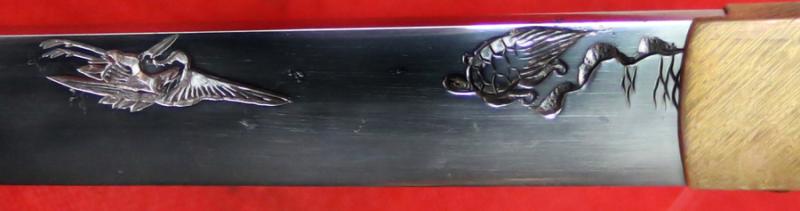
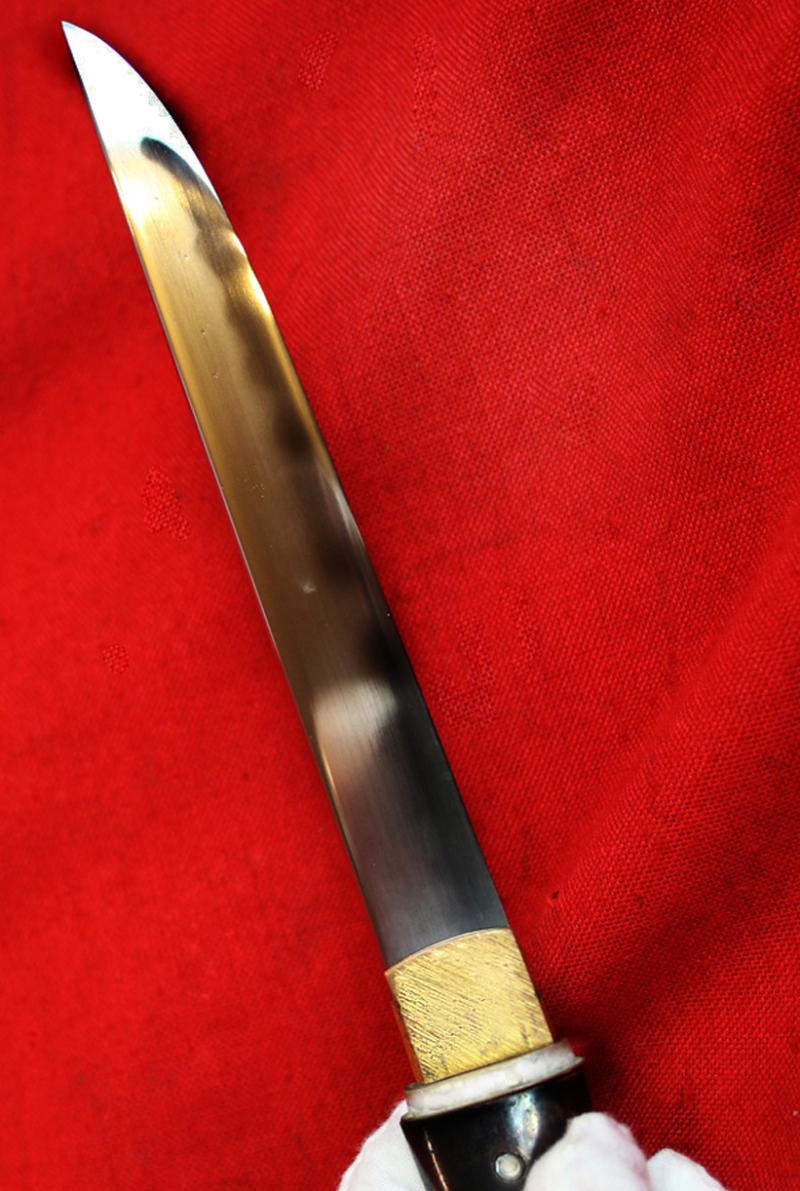
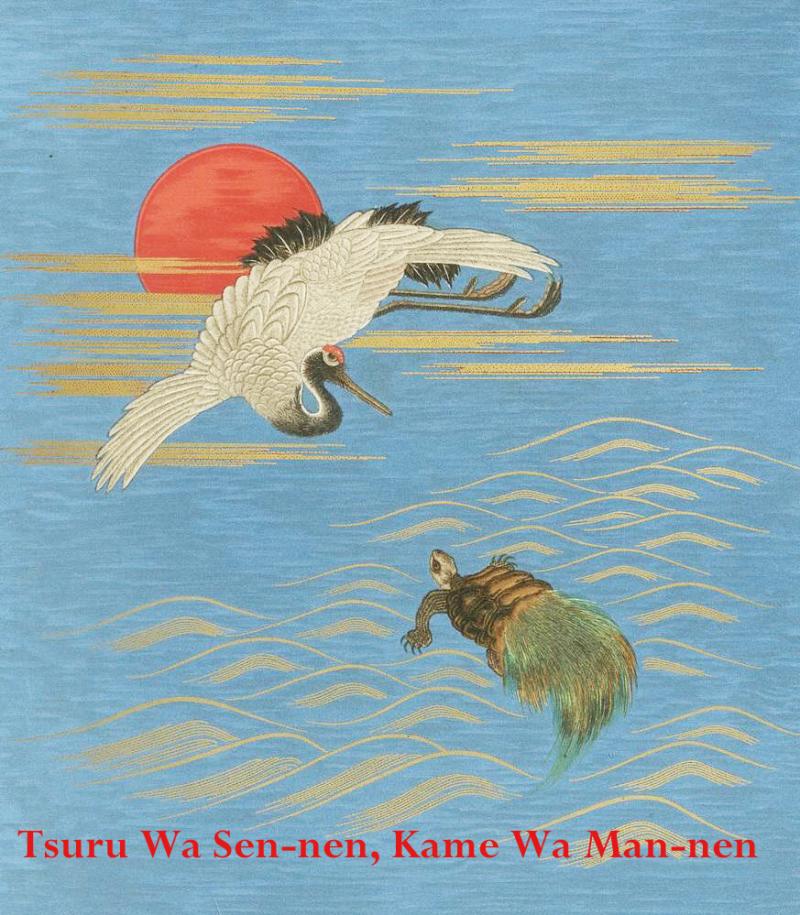
A Stunningly Beautiful, Signed,16th-17th Century Koto-Shinto Aikuchi Tanto, The Kunitsugu School, With Carved Horimono of a Crane and a Minogame Turtle, "Tsuru Wa Sen-nen, Kame Wa Man-nen". Amazing Original Edo Koshirae Of The Tokugawa. With Kamon Crest
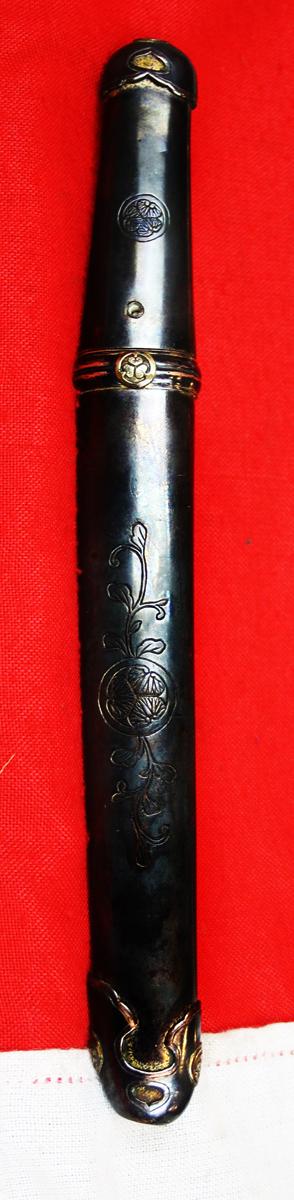
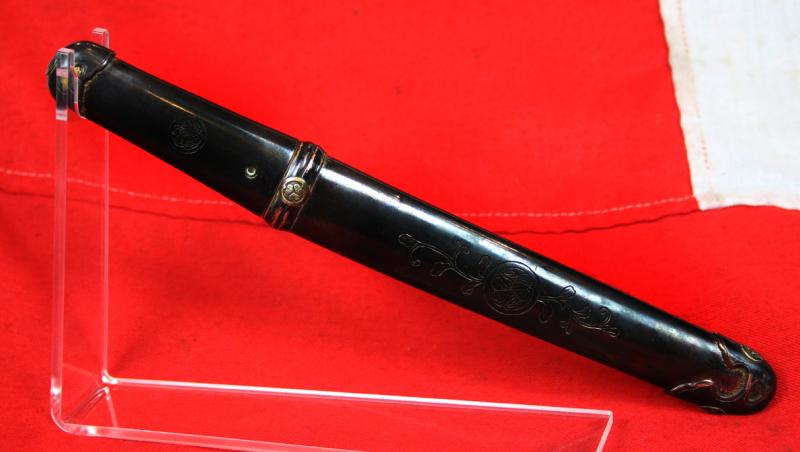
All of this Kunitsugu tanto's wonderful original Edo aikuchi koshirae {fittings and mounts} are shakudo, with small lines of pure gold highlights upon the edges, and then decorated throughout with ten 'mon' {clan crest} of Shogun Tokugawa Iyesu. Likely the stunning small aikuchi tanto of a high ranking Tokugawa retainer. There are five large engraved mon, and three of those are the larger version with scrolling vines and ginger roots. There are also five mon cartouche of silver badges, applied to the fuchikashira and sayajiri.
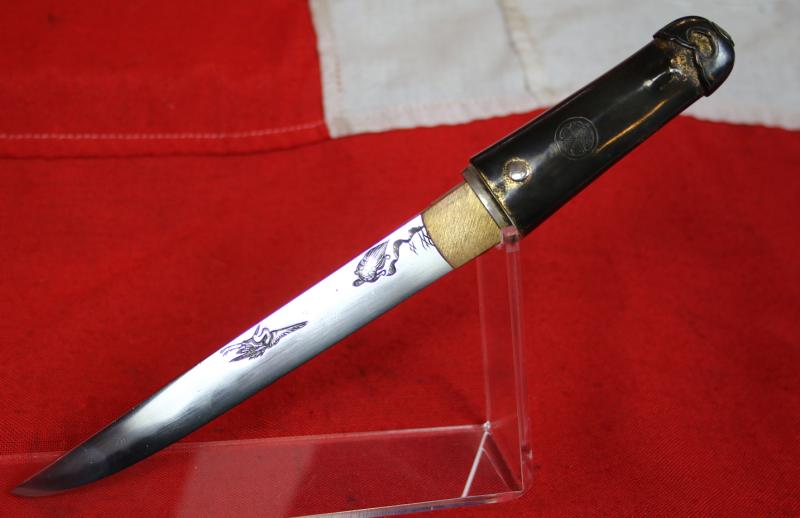
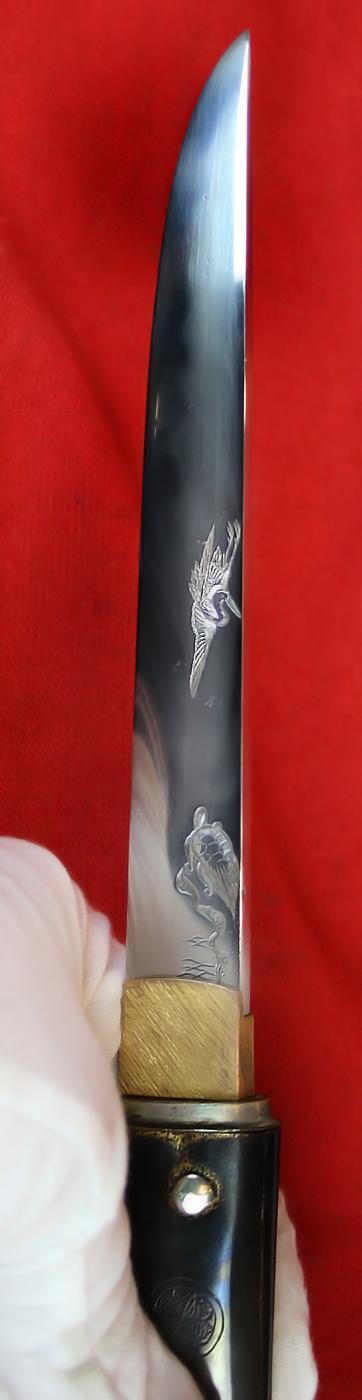
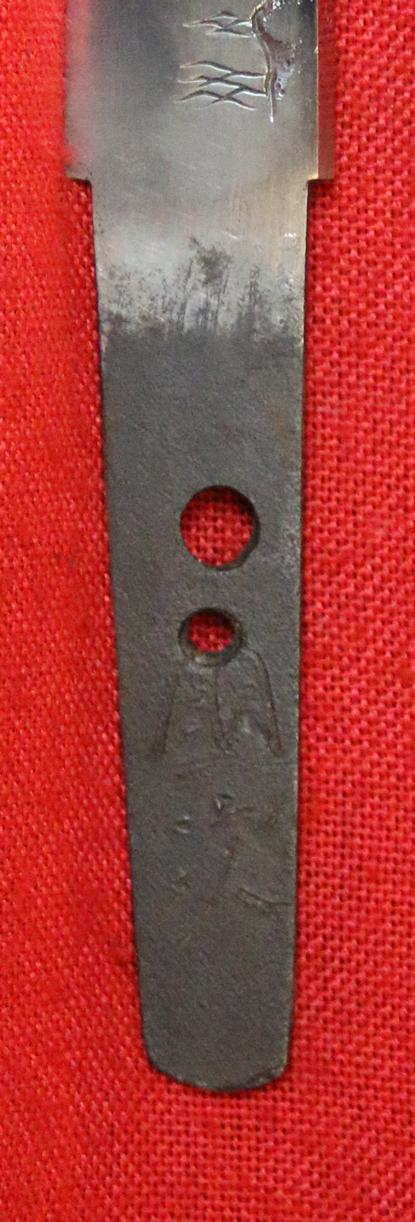
The stunning, small wazamono {very sharp} blade has an incredibly fine detailed horimono (blade carving) of a crane and minogame turtle with speckles of sea spray, and an effusive notare hamon, and the nakago is signed Kunitsugu. Circa 1580's to 1600’s. It is beautifully set off with a gold habaki with raindrop chiselling.
Shakudo is a billon of gold and copper (typically 4-10% gold, 96-90% copper) which can be treated to form an indigo/black patina resembling lacquer. Unpatinated shakudo Visually resembles bronze; the dark colour is induced by applying and heating rokusho, a special patination formula.
Elite Tokugawa weaponry and armour often feature the crest, (mon) but surrounded by leafy tendrils, particularly in elite high rank samurai weaponry and armour (they are scrolling vines and ginger roots).
In Japanese folklore, the crane (tsuru) and turtle (kame) are iconic symbols of longevity, harmony, and good fortune, often paired together to represent a long, blessed life. They are associated with the proverb "Tsuru wa sen-nen, kame wa man-nen" (cranes live 1,000 years, turtles 10,000 years).
Both animals are seen as sacred messengers of long life.
Minogame Turtles, particularly the minogame (straw-raincoat turtle), represent wisdom and are said to live so long that algae grows on their shells, resembling a tail.
The Crane (Tsuru): is much revered as a "bird of happiness," the crane symbolizes high-flying grace, fidelity (as they mate for life), and peace.
They are often found together in Japanese fine art, wedding decor, and on New Year's occasions to signify a perfect, balanced partnership and enduring life.
The Crane and the Turtle Friendships: A popular tale tells of a crane and a turtle who become friends, only for a drought to dry up the turtle's lake. To save his friend, the crane lifts the turtle into the sky. Other versions, such as one from Hiroshima, warn that the turtle must not speak while holding onto a crane’s feather, or they will fall.
Urashima Taro: This famous story features a fisherman who saves a turtle and is taken to the Sea Dragon King's palace, later marrying the princess. It incorporates themes of the sea turtle and often connects with the crane's symbolism of enduring, yet sometimes fleeting, time.
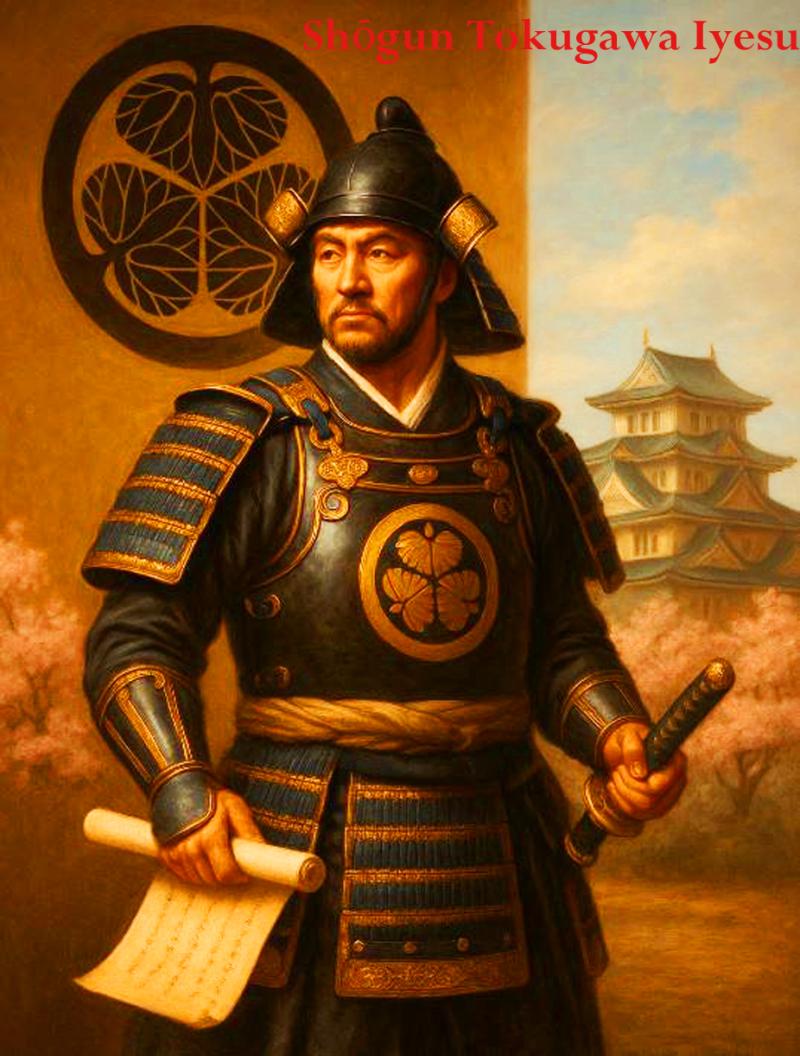
Tokugawa Ieyasu (born Matsudaira Takechiyo;January 31, 1543 – June 1, 1616) was a Japanese samurai, daimyo and the founder and first shogun of the Tokugawa shogunate of Japan, which ruled from 1603 until the Meiji Restoration in 1868. He was the third of the three "Great Unifiers" of Japan, along with his former lord Oda Nobunaga and fellow Oda subordinate Toyotomi Hideyoshi.
On March 24, 1603, Tokugawa Ieyasu received the title of shōgun from Emperor Go-Yōzei.
Key Battles and Campaigns:
Battle of Mikatagahara (1573): A significant early defeat against Takeda Shingen, which taught Ieyasu valuable strategic lessons despite his forces being severely outmatched.
Battle of Nagashino (1575): Fought alongside ally Oda Nobunaga to defeat the Takeda clan using early tactical volley fire.
Battle of Komaki and Nagakute (1584): Fought against Toyotomi Hideyoshi, leading to a stalemate that solidified Ieyasu's strength and eventually led to an alliance.
Siege of Odawara (1590): As part of Hideyoshi's army, this campaign helped remove the Hojo clan and secured Ieyasu's dominion over the Kanto region.
Battle of Sekigahara (1600): The largest battle in samurai history and a defining victory against the Western Army (led by Ishida Mitsunari), solidifying Ieyasu’s control over Japan.
Sieges of Osaka (1614–1615): Two major campaigns (Winter and Summer) against the Toyotomi clan that broke all remaining opposition and established over 250 years of peace under the Tokugawa shogunate.
As once told to us by an esteemed regular visitor to us here in our gallery, and the same words that are repeated in his book;
“In these textures lies an extraordinary and unique feature of the sword - the steel itself possesses an intrinsic beauty. The Japanese sword has been appreciated as an art object since its perfection some time during the tenth century AD. Fine swords have been more highly prized than lands or riches, those of superior quality being handed down from generation to generation. In fact, many well-documented swords, whose blades are signed by their makers, survive from nearly a thousand years ago. Recognizable features of the blades of hundreds of schools of sword-making have been punctiliously recorded, and the study of the sword is a guide to the flow of Japanese history.”
Victor Harris
Curator, Assistant Keeper and then Keeper (1998-2003) of the Department of Japanese Antiquities at the British Museum. He studied from 1968-71 under Sato Kenzan, Tokyo National Museum and Society for the Preservation of Japanese Swords.
Overall in superb condition, with just natural age and wear by an esteemed samurai with all due respect and care for its status. The sayajiri {scabbard bottom mount} has an indent at the very base.
Overall just under 10 inches long in saya, blade 6.5 inches long
Code: 26182
6450.00 GBP