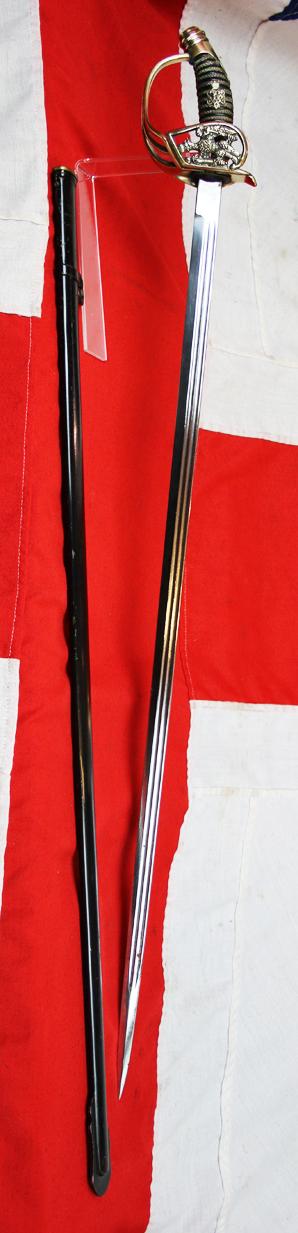
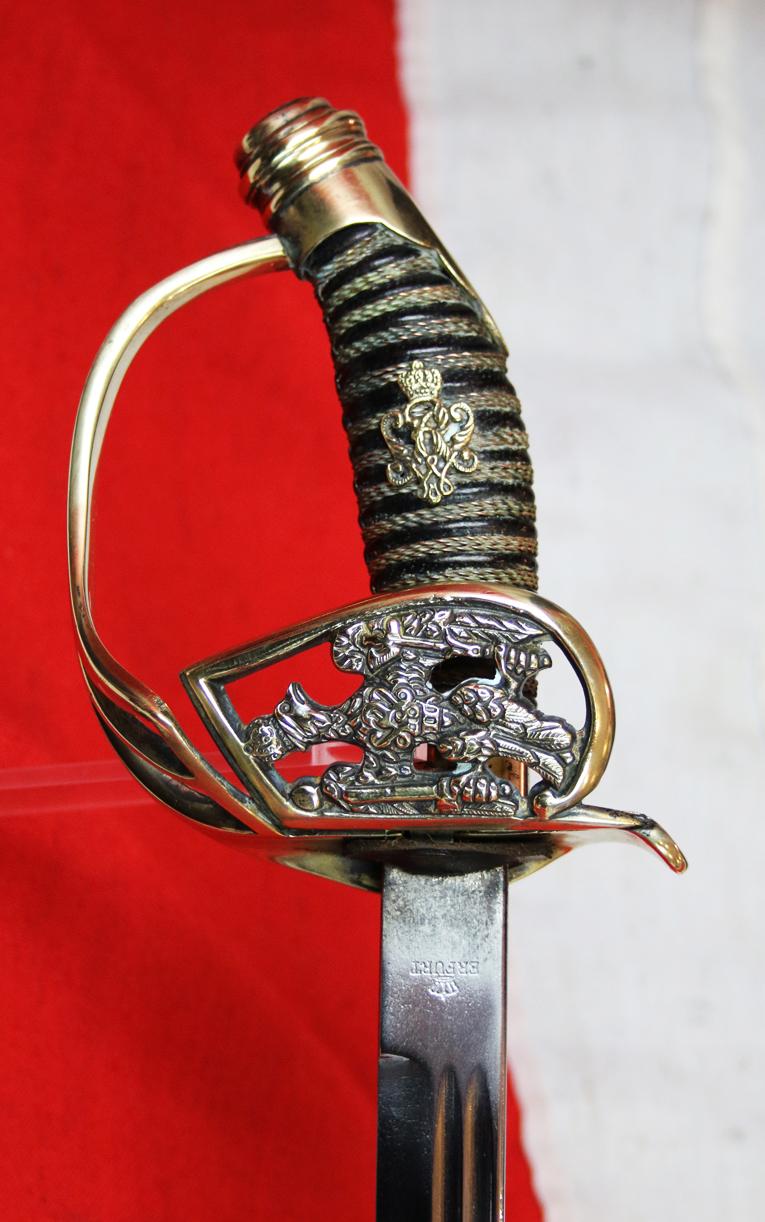
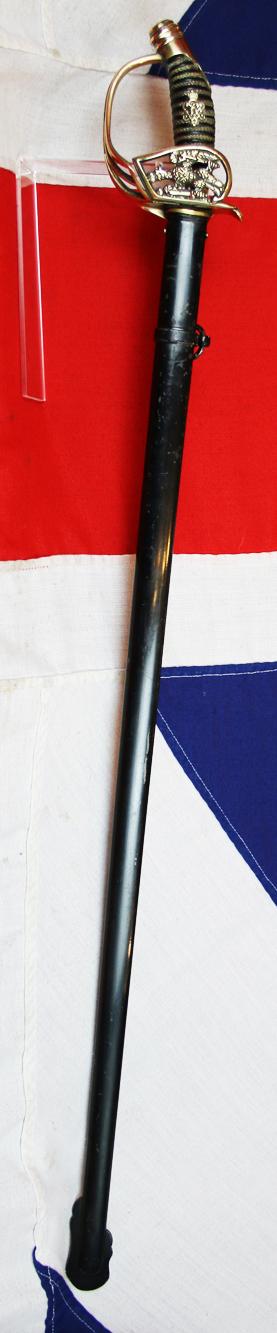
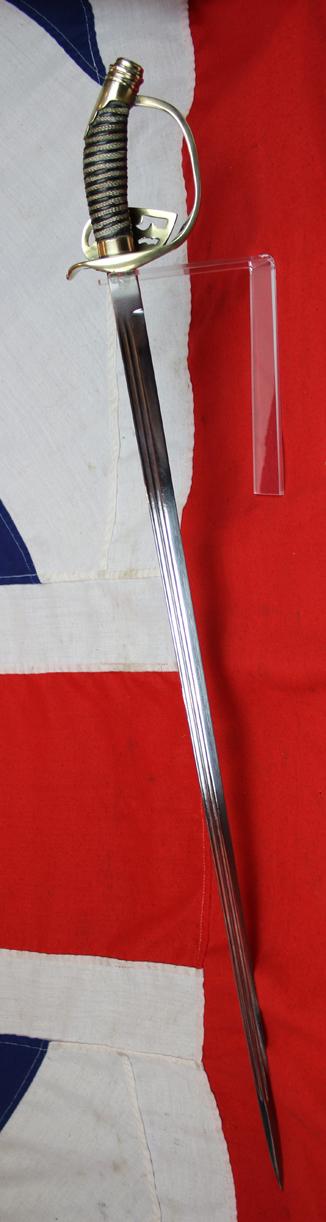
A Good Imperial German WW1 Officer's Sword A Beautiful 1889 Pattern German Infantry Officer's Sword of The Great War. and Used into WW2 Until May 1945. Wonderful Condition For Age Kaiser Wilhelm's Crest Inset Within The Grip
1889 Pattern Prussian officers sword with cast eagle guard, excellent original multi wire bound grip, with kaisers crest insert, good condition double fullered bright polished blade and black lacquered steel combat scabbard. Kaiser Willhelm crest to grip. Folding spring loaded Prussian eagle guard. Used by a German infantry officer serving in the Great War, the Weimar period, and WW2. Taken as a WW2 souvenir in 1945.
Many of these swords were also used in the 3rd Reich by veteran officers serving in WW2. Numerous Vintage photographs of WW2 German Officers show them wearing this pattern of sword, including one in the gallery of Generalleutnant Hans von Donat with his identical sword.
The Imperial German Army (Deutsches Heer) entered the Great War in 1914 as the most professional and highly trained conscript force in the world. At its peak, it mobilised millions of men, evolving from a force designed for rapid, decisive offensives into a highly adaptable master of industrialised trench warfare.Organization and Early StrategyEstablished in 1871 after the unification of Germany, the army was a federal force dominated by Prussia, though the kingdoms of Bavaria, Saxony, and Württemberg maintained their own ministries and units.The General Staff: Unlike its rivals, Germany relied on a Great General Staff to institutionalise military excellence through academic training and strategic planning.The Schlieffen Plan: Strategy was initially dictated by the goal of avoiding a two-front war. The plan called for a massive, rapid right-wing sweep through neutral Belgium to knock France out of the war in weeks before turning to face Russia.Rapid Mobilisation: Upon the outbreak of war, the army expanded from roughly 700,000 peacetime troops to over 3.8 million men within a week.
As the war of movement stalled into trench warfare, the German Army became a leader in tactical innovation to overcome the deadlock.Stormtroopers (Stosstruppen): To break the stalemate, specialized shock units were trained in decentralized, aggressive "infiltration" tactics. These focused on bypassing enemy strongpoints to strike rear-area command and artillery.
By 1917, the army shifted from defending a single, rigid front line to a deep defensive system. This allowed attackers to penetrate forward zones only to be decimated by pre-planned counter-attacks and hidden machine-gun nests.
Tactics evolved to integrate infantry, heavy artillery (coordinated by masters like Georg Bruchmüller), aircraft, and early anti-tank measures into a single cohesive system
Despite nearly breaking the Allied lines during the 1918 Spring Offensive, the army ultimately succumbed to exhaustion, a lack of mobility to exploit breaches, and the overwhelming material superiority of the Allies.Dissolution: Under the Treaty of Versailles, the Imperial Army was abolished in 1919 and replaced by the Reichswehr, a professional force strictly limited to 100,000 men with no tanks, aircraft, or heavy artillery.The "Stab-in-the-Back" Myth: Following the surrender, a powerful myth grew that the army had remained undefeated on the battlefield but was betrayed by politicians, socialists, and revolutionaries at home—a narrative that later fueled the rise of the Nazi Party.
The great ‘Myth of German WW1 Reparations’ the financial penalty for losing WW1, that fuelled the rise of the National Socialists Workers Party { aka, the Nazis}.
Effectively, the German NAZI politicians blatantly lied that Germany was ruined financially by the allied powers taking all of Germany’s wealth. Can you imagine how shocking it must of been to discover their National Socialist Workers politicians actually lied in order to gain power, shocking indeed! Thank goodness that has never happened since.
Weimar and Nazi Germany in reality only paid just one eighth of the due ‘bill’ in reparations, but it received more, approximately 12 billion dollars more, in loans, from a group of New York American financiers, than it paid out. And, another surprise, the Nazis defaulted on those loans anyway, so the National Socialists kept all the {circa} 34 billion dollars in loan funds, that they then used to help pay for the next war, that Hitler planned all along. Bear in mind, in those days, a billion dollars was a lot of money.
Germany only actually paid approximately 20 billion to 21 billion gold marks (roughly $5 billion USD at the time) toward its World War I reparations before the debt was eventually settled or written off. While the original "bill" set by the Allies in 1921 was a staggering 132 billion gold marks ($33 billion USD), Germany actually paid only about one-eighth of that total.
The repayment process was ‘interrupted’ by the economic crises, the rise of the Nazi regime, and a second world war.
Between 1919–1932 Germany transferred between 19 billion and 21 billion gold marks in cash and "in-kind" payments, such as coal, timber, and livestock.
To make these payments however, Germany ‘borrowed’ roughly 33 billion to 35 billion marks from foreign investors (mostly American). This meant Germany actually received more in foreign loans than it paid out in reparations during the 1920s. A far, far greater sum than it had paid so far to the allies. However, In 1933, Adolf Hitler ceased all reparation payments and defaulted on the foreign loans used to fund them.
It is often reported that Germany "finished" paying for WWI on 3 October 2010. A considerable ‘bending’ of the truth. This final payment of $94 million (€69.9 million) was not for the reparations themselves, which had been cancelled in 1932 anyway. Instead, it settled the accrued interest on the private bonds and foreign loans Germany took out from the financiers in the 1920s to stay afloat.
Under the 1953 London Agreement, West Germany had agreed to pay these interest debts only after the country was reunified, which delayed the final instalment until the 20th anniversary of German reunification.
Light polished out surface pitting to the blade, good 95% original black lacquer paint to the steel, dent free scabbard
Code: 26187
645.00 GBP