
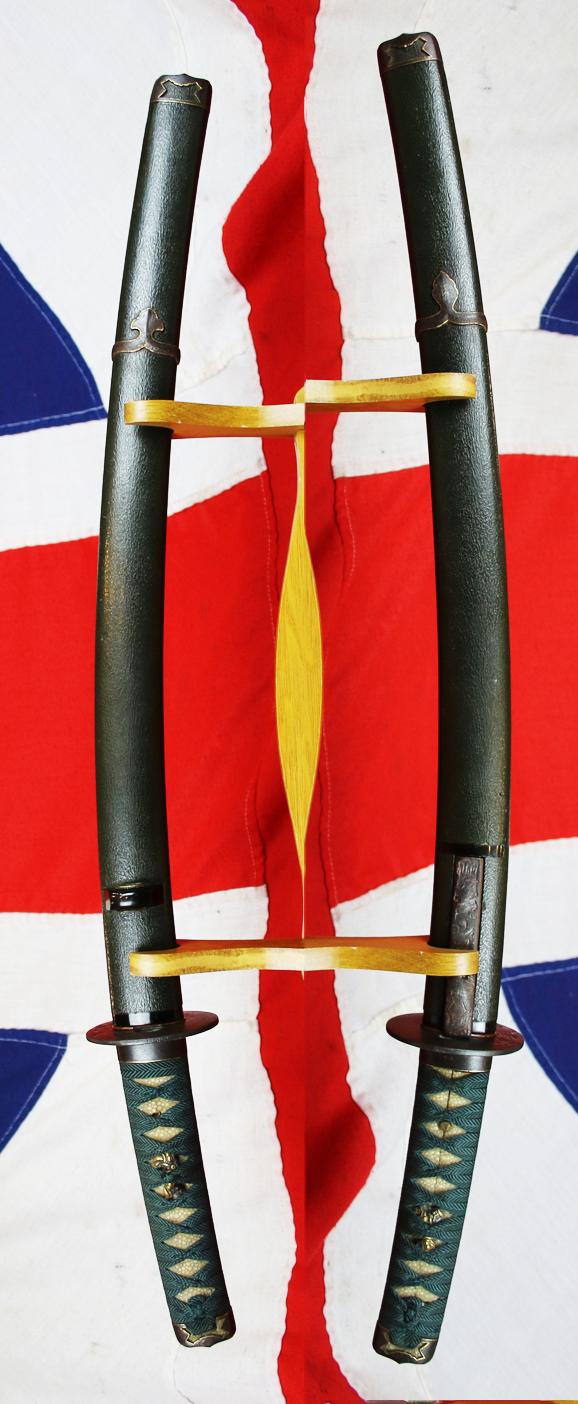

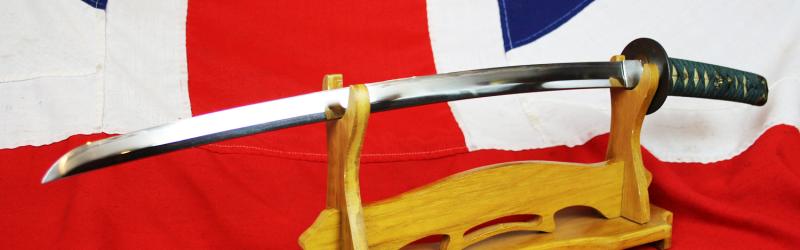
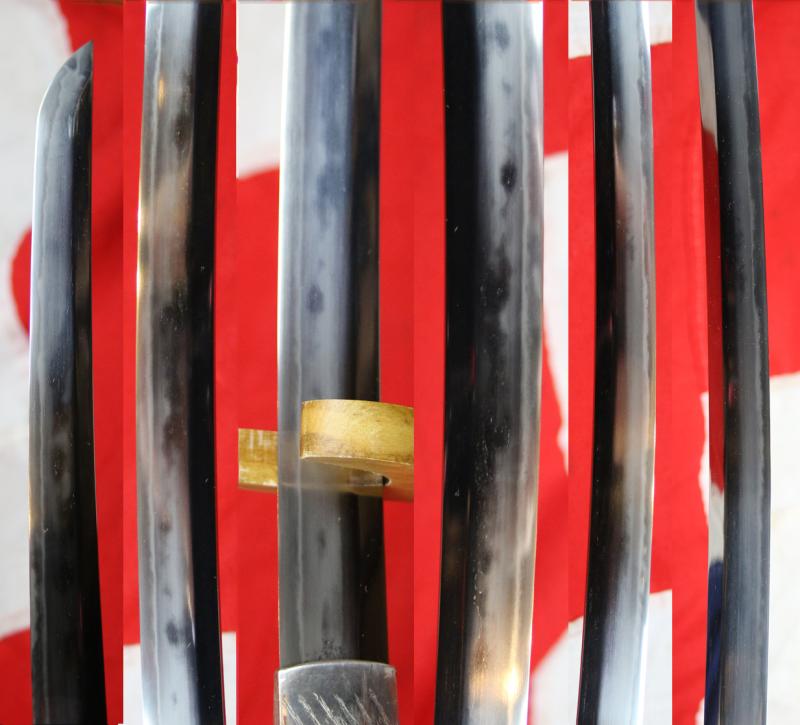

A Fabulous, Samurai Late Koto To Shinto Period Wakazashi Sword In Very Fine, All Original, Edo Period Handachi Koshirae. With Original Urushi Ishime Lacquer Saya In Chitosemidori, A Thousand Year Green. Samurai War Pony Menuki. With A Remarkable Blade
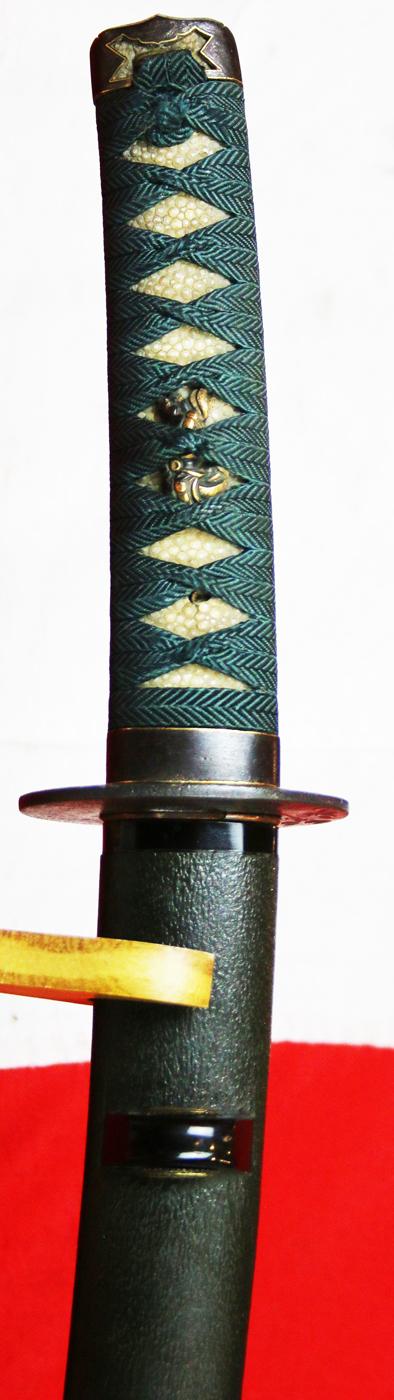
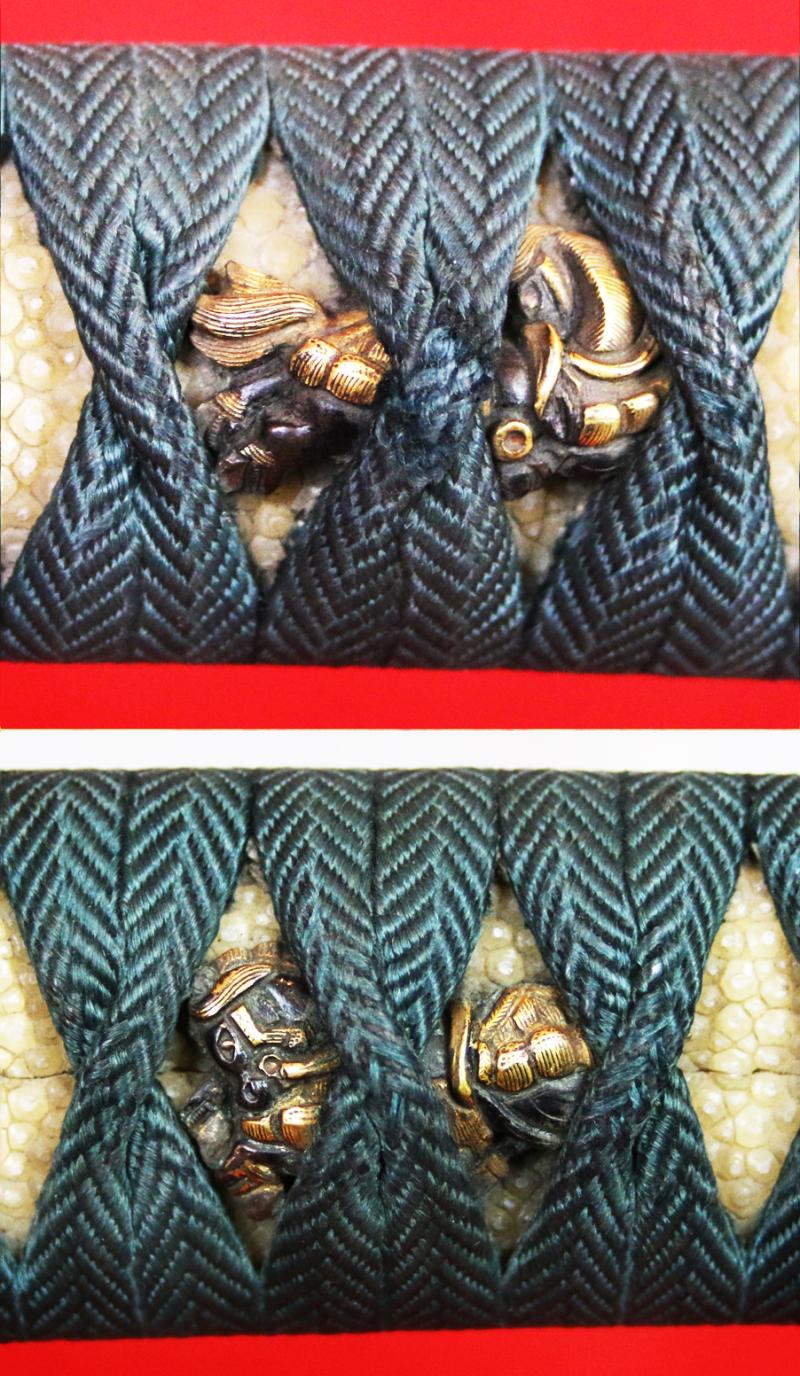
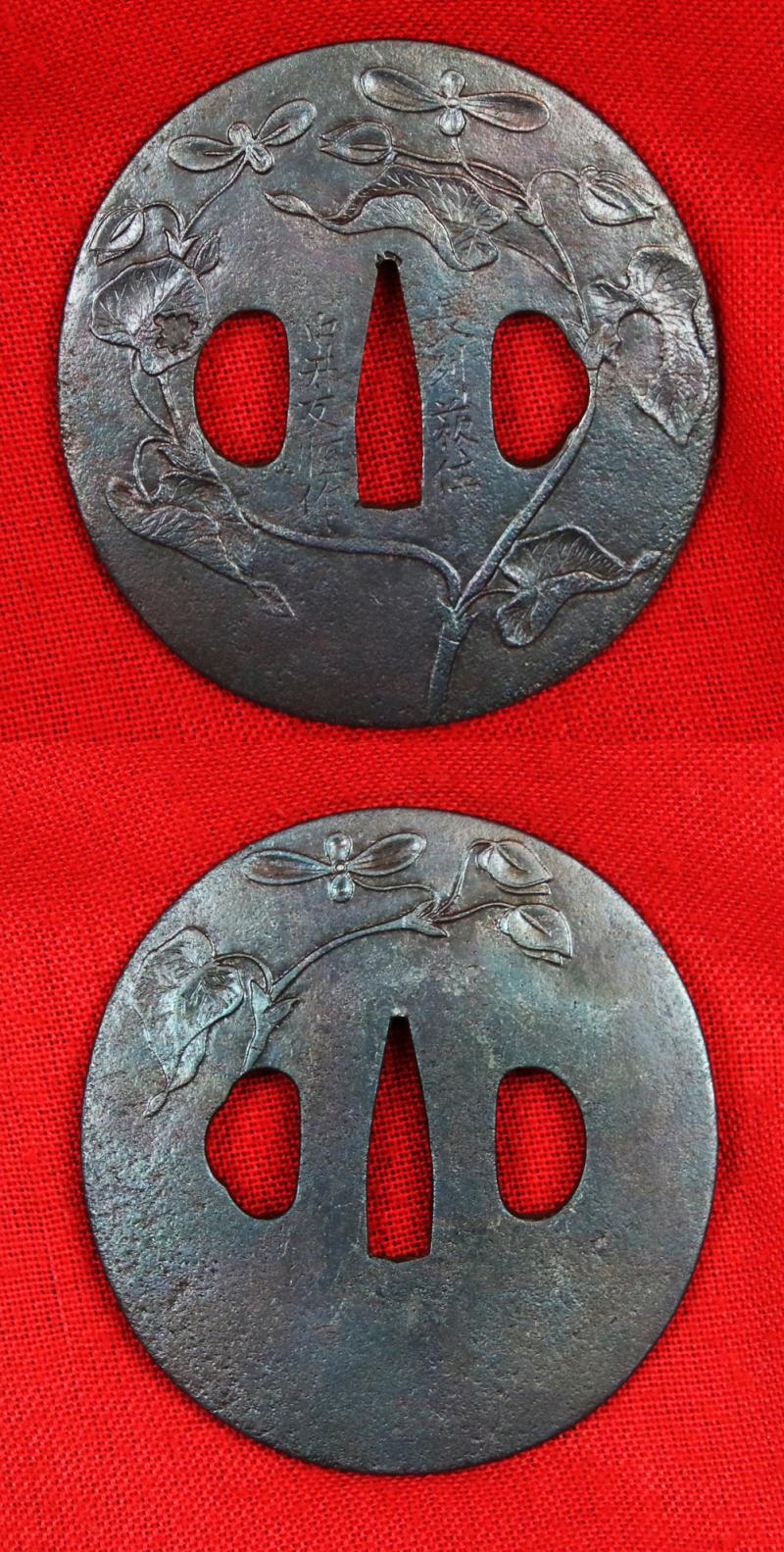
Overall this sword is is superb condition, all the handachi mountings are original Edo period, as is the saya and its urushi ishime lacquer. The tsuka-ito has a geometric weave pattern, and also original Edo period. The delightful Edo tsuba is iron, with a relief Aoi leaf pattern, and signed. The pair of Edo menuki are pure gold over shakudo of deep takebori samurai war ponies in fully saddled riding tack, without riders..
The kozuka, side knife, has a Higo school iron handle depicting two Minogame turtles, particularly the minogame (straw-raincoat turtle), represent wisdom and are said to live so long that algae grows on their shells, resembling a tail.
Chitosemidori is a traditional Japanese colour that resembles the dark green colour of Japanese pine needles. The name “Chitosemidori” comes from the Japanese pine, symbolizing longevity due to its evergreen nature. This colour is significant because it represents enduring beauty. According to legend, it remains unchanged even after 1,000 years, reflecting the timeless nature of the Japanese pine.
Japanese lacquer, or urushi, is a transformative and highly prized material that has been refined for over 7000 years.
Cherished for its infinite versatility, urushi is a distinctive art form that has spread across all facets of Japanese culture from the tea ceremony to the saya scabbards of samurai swords
Japanese artists created their own style and perfected the art of decorated lacquerware during the 8th century. Japanese lacquer skills reached its peak as early as the twelfth century, at the end of the Heian period (794-1185). This skill was passed on from father to son and from master to apprentice.
Some provinces of Japan were famous for their contribution to this art: the province of Edo (later Tokyo), for example, produced the most beautiful lacquered pieces from the 17th to the 18th centuries. Lords and shoguns privately employed lacquerers to produce ceremonial and decorative objects for their homes and palaces.
The varnish used in Japanese lacquer is made from the sap of the urushi tree, also known as the lacquer tree or the Japanese varnish tree (Rhus vernacifera), which mainly grows in Japan and China, as well as Southeast Asia. Japanese lacquer, 漆 urushi, is made from the sap of the lacquer tree. The tree must be tapped carefully, as in its raw form the liquid is poisonous to the touch, and even breathing in the fumes can be dangerous. But people in Japan have been working with this material for many millennia, so there has been time to refine the technique!
Flowing from incisions made in the bark, the sap, or raw lacquer is a viscous greyish-white juice. The harvesting of the resin can only be done in very small quantities.
Three to five years after being harvested, the resin is treated to make an extremely resistant, honey-textured lacquer. After filtering, homogenization and dehydration, the sap becomes transparent and can be tinted in black, red, yellow, green or brown.
Once applied on an object, lacquer is dried under very precise conditions: a temperature between 25 and 30°C and a humidity level between 75 and 80%. Its harvesting and highly technical processing make urushi an expensive raw material applied in exceptionally fine successive layers, on objects such as bowls or boxes.After heating and filtering, urushi can be applied directly to a solid, usually wooden, base. Pure urushi dries into a transparent film, while the more familiar black and red colours are created by adding minerals to the material. Each layer is left to dry and polished before the next layer is added. This process can be very time-consuming and labour-intensive, which contributes to the desirability, and high costs, of traditionally made lacquer goods. The skills and techniques of Japanese lacquer have been passed down through the generations for many centuries. For four hundred years, the master artisans of Zohiko’s Kyoto workshop have provided refined lacquer articles for the imperial household.
Han-dachi originally appeared during the Muromachi period when there was a transition taking place from Tachi to katana. The sword was being worn more and more edge up when on foot, but edge down on horseback as it had always been. The handachi is a response to the need to be worn in either style. The samurai were roughly the equivalent of feudal knights. Employed by the shogun or daimyo, they were members of hereditary warrior class that followed a strict "code" that defined their clothes, armour and behaviour on the battlefield. But unlike most medieval knights, samurai warriors could read and they were well versed in Japanese art, literature and poetry.
The Japanese samurai and their famously iconic swords lasted relatively unchanged for 1200 years. A Nara period tachi sword of 700 ad was not that much different from a late Tokugawa period tachi sword of 1860. Compare that to Europe, every style and pattern of sword was used, and dramatic changes meant all forms of sword, and sword combat, changed and evolved from century to century. Yet in Japan the form changed little, the style was excellent from the very earliest period, and all that was required was incremental small improvements and very subtle changes. A samurai armed with a sword from 700 ad, would not appear that much changed 1100 years later. However, the samurai sword had been improved, and improved more, to a standard of quality excellence, after 500 years, that remained unrivalled throughout the world. A sword steel that was the finest steel ever created by mankind, a steel so fine that it bears no useful comparison to every other finest blade steel ever made. Damascus is likely the closest, but still way, way, below Japanese samurai sword steel. If Japanese samurai steel, ranked in first place, was compared to a formula one racing car, Damascus or pattern welded sword steel, ranked in second place, would be the equivalent to a twenty year old New York taxicab by comparison.
Picture 7 in the gallery is of the tsukaito over the war pony menuki. They appear to difference shades of green, but this is an illusion created by the camera photo light. There is no actual difference in colour at all
Overall 27 1/4 inches long in saya, blade 19 3/4 inches long
Code: 26201
4750.00 GBP