
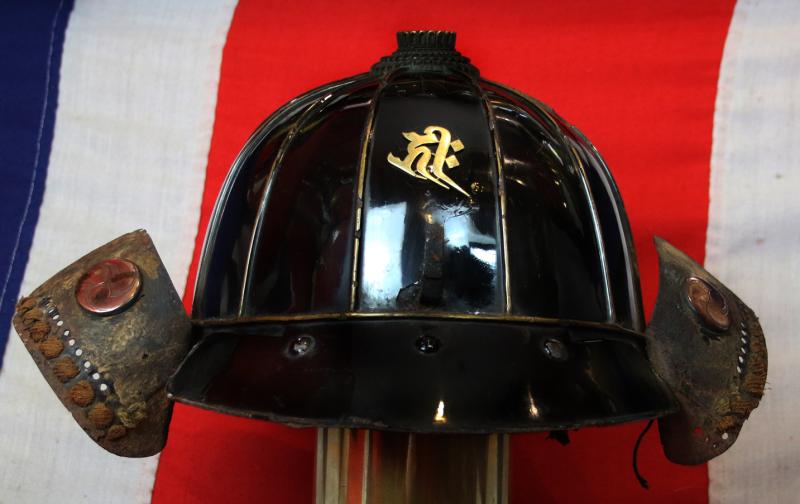
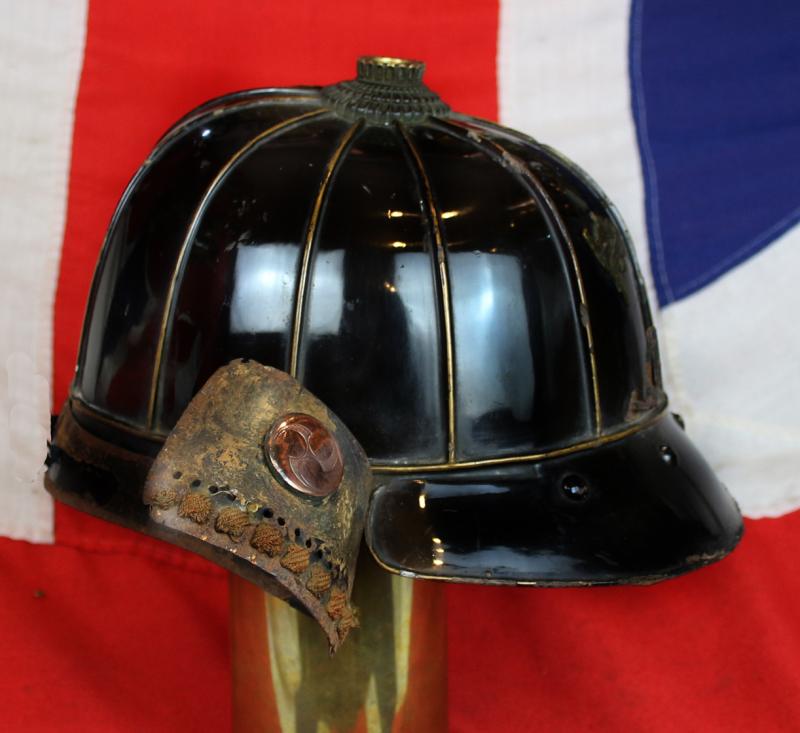
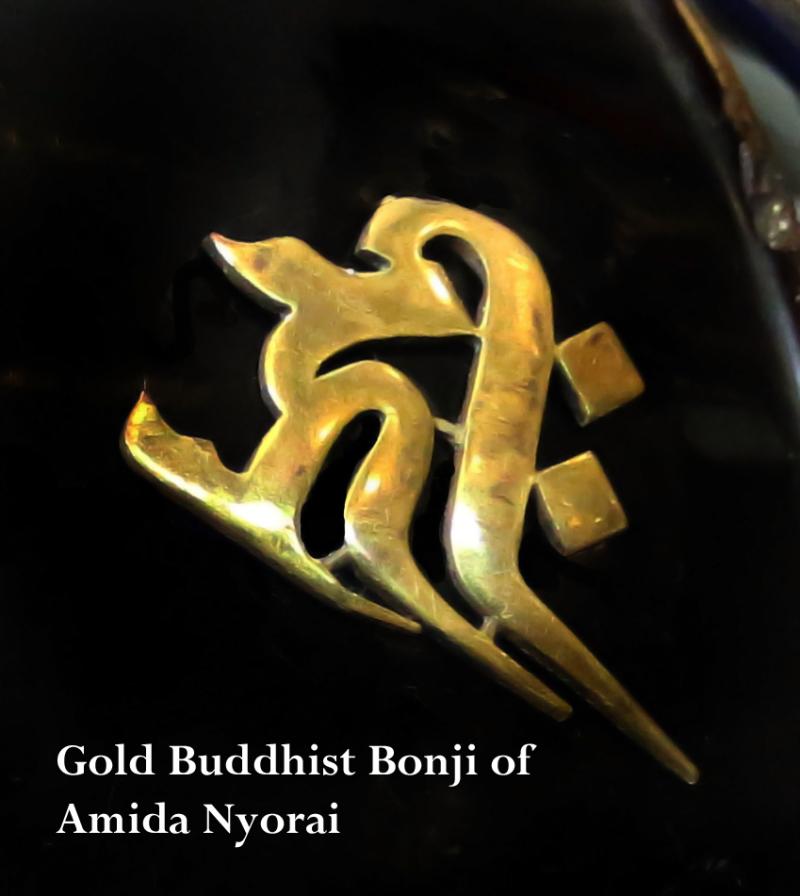
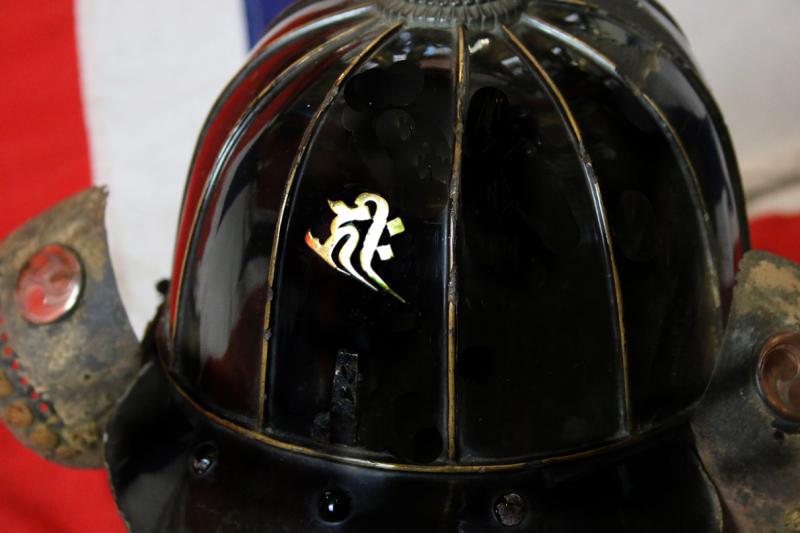
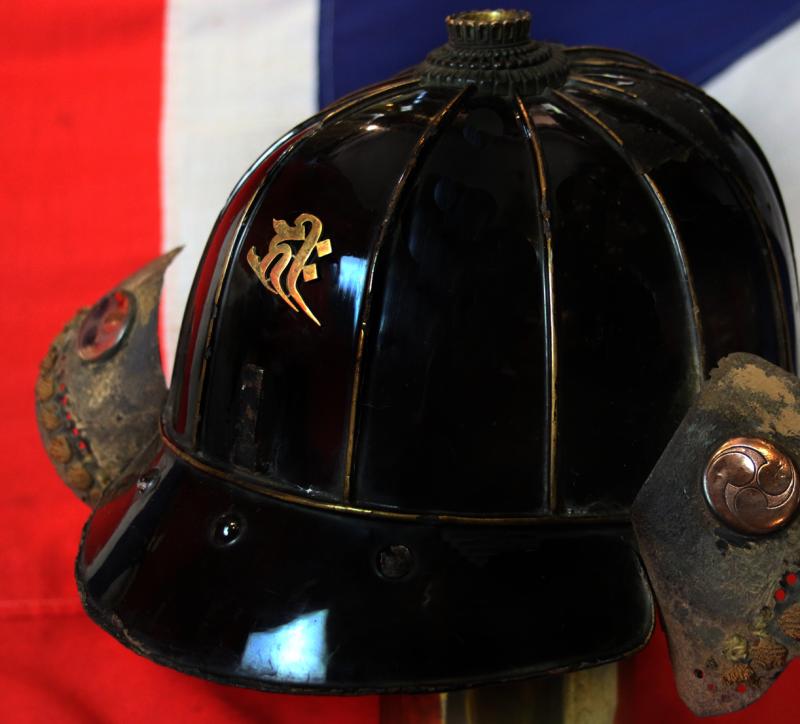
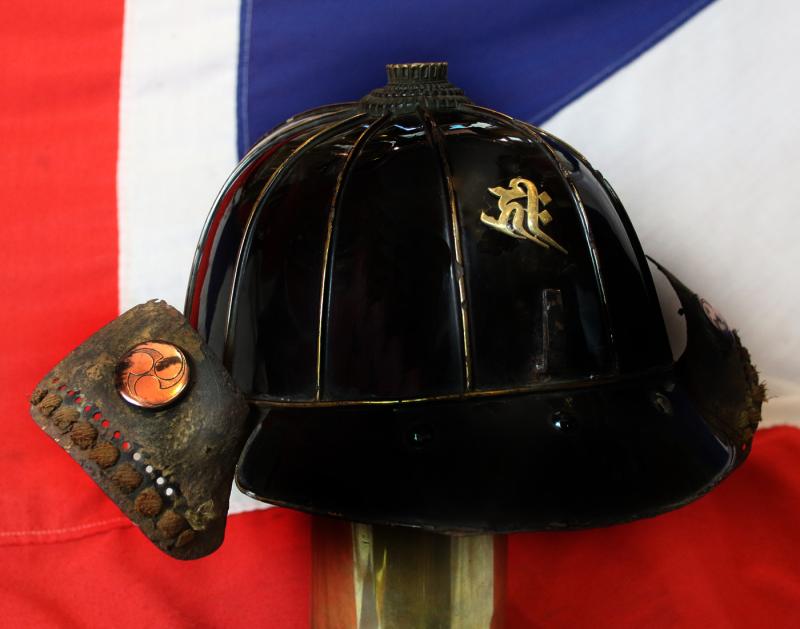
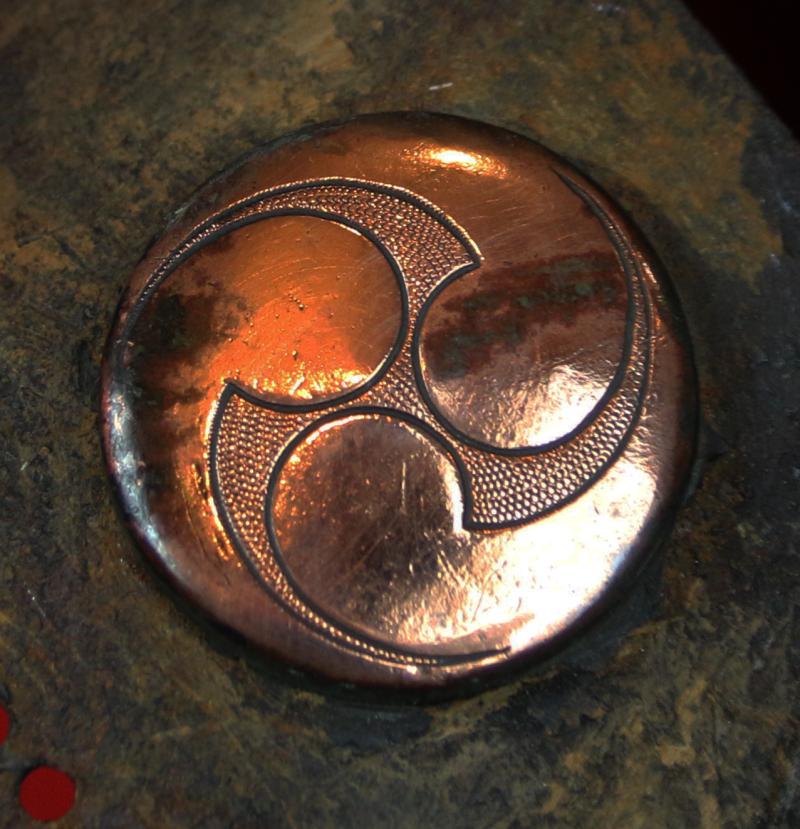
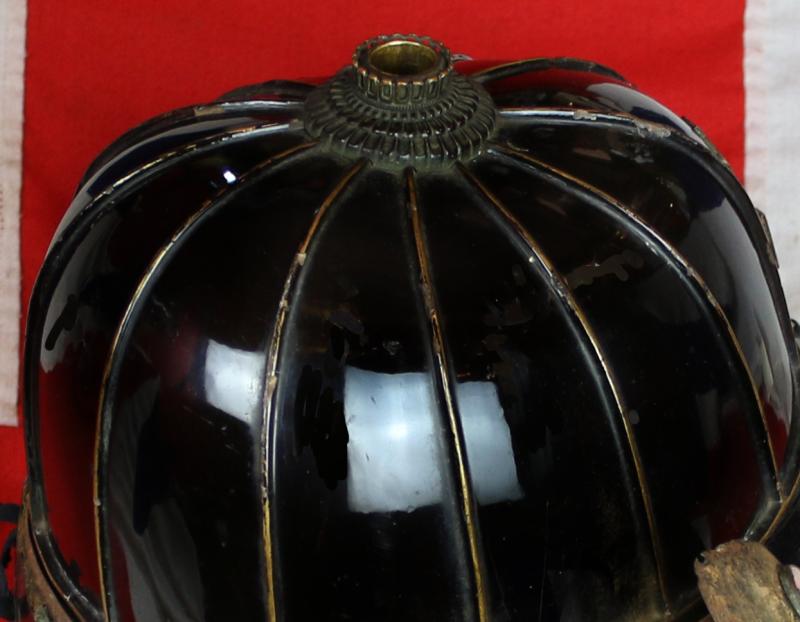
A Beautiful Kabuto 12 Plate Samurai Helmet The Hidari Mitsudomoe Mon, of Kobayakawa Takakage. Meaning "Left Threefold Tomoe". A Hachi (鉢), Mabizashi (目庇) & Fukigaeshi (吹返) Tehen no Ana / Tehen Kanamono (八幡座): & Gold Buddhist Bonji of Amida Nyorai
Around 300 plus years old. Formerly of the Sensei Roald Knutsen Collection.
The traditional Japanese kabuto war helmet consists primarily of the hachi (bowl) and shikoro (neck guard), with key components including the mabizashi (visor), fukigaeshi (side wings), and maedate (front crest). These elements combine iron, lacquer, deer hide and cotton linings, and sometimes precious metals, to create both highly decorative artistry, and functional, excellent protection for the head. This kabuto is a beauty, combat damaged and aged, but a beauty none the less, it has no shikoro {rows of rear neck guards}.
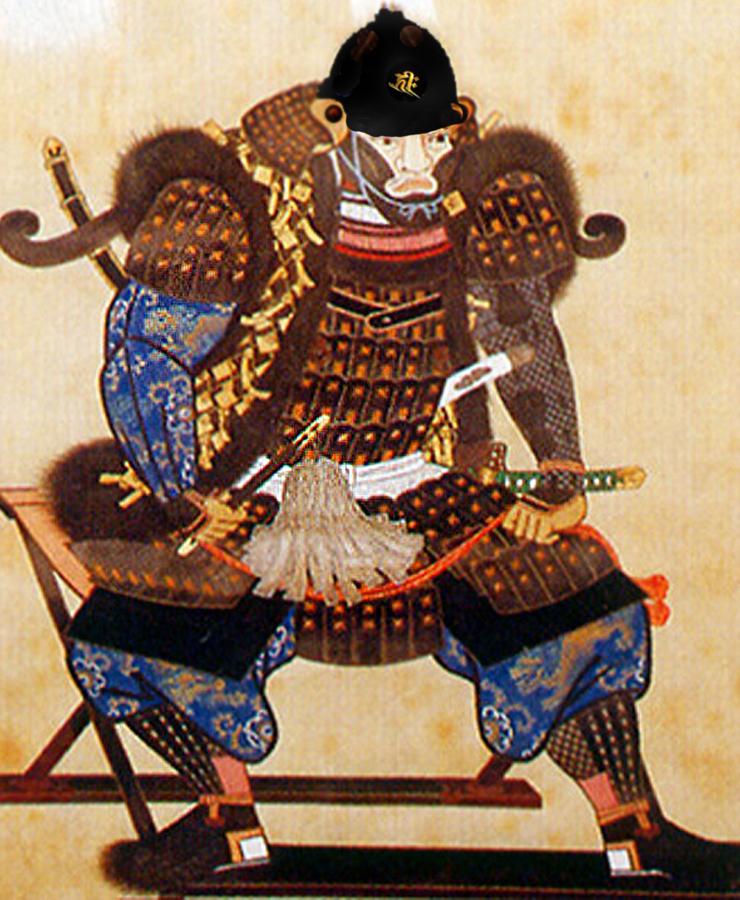
This kabuto’s hachi bowl is made of 12 seperate plates of iron linked together to make a protective skull structure. With a stunning, gold, Buddhist bonji of Amida Nyorai (Amitābha) mounted at the front of the hachi bowl. This would represent the samurai invoking the all powerful principles of Amida Nyorai within his actions as a warrior, and thus he is defined by them.
Bonji (梵字) is the Japanese term for the sacred Sanskrit characters used in esoteric Buddhist schools, such as Shingon and Tendai. Derived from the Siddhaṃ script, these syllables function as shuji (seed characters) that spiritually represent the essence of specific Buddhas, bodhisattvas, or cosmic energies.
Each Bonji character acts as a visual focal point for meditation, protection, and spiritual awakening. Because they are believed to physically manifest the enlightened world of the deities, they are treated with the same reverence as physical statues
The celestial Buddha of Infinite Light, Amida Nyorai (often called Amida Butsu) is a celestial Buddha who has the ability to intervene in this world and save people in a god-like manner. He has passed the bodhisattva path and has achieved superhuman powers giving him the power to live in the heavens.
Hachi (鉢): The main bowl/helmet shell, often made of riveted iron plates.
Mabizashi (目庇): The brim or visor located on the front of the hachi.
Fukigaeshi (吹返): Wing-like, often decorative projections on both sides of the helmet.
Maedate (前立物): The front crest or decoration, which could represent clan identity or religious symbols.
Tehen no Ana / Tehen Kanamono (八幡座): A small opening at the top of the hachi, often finished with an ornamental, chrysanthemum-shaped metal fitting.
Tsunamoto (角元): Mounting points or sockets used to attach the maedate.
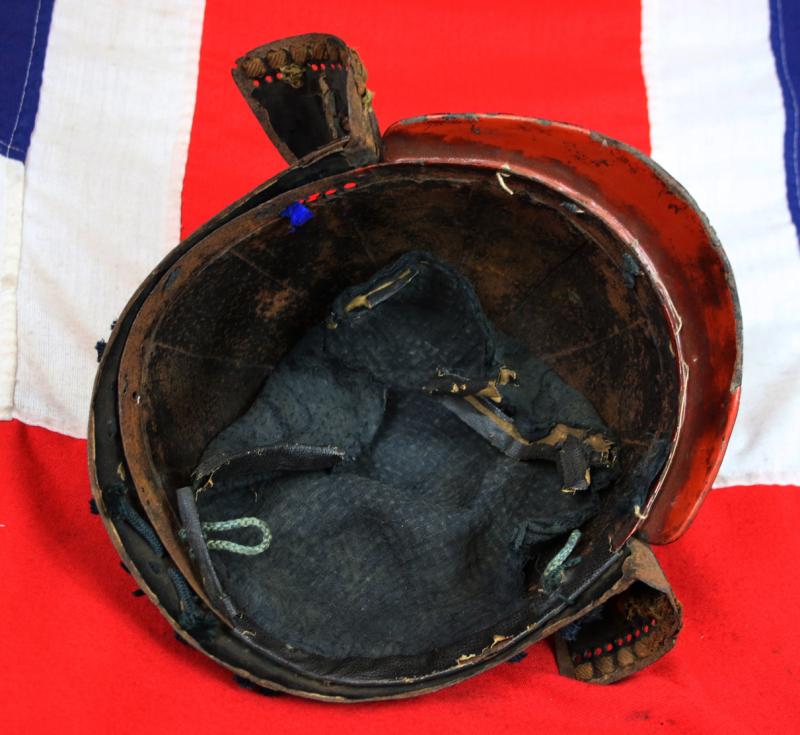
Ukebari (受張): The cloth lining inside the hachi that makes it comfortable to wear.
Suji-kabuto: Refers to the type of hachi of ridge plates (suji),
This helmet is lacking its Shikoro (錣): A flexible, multi-layered neck guard hanging from the edge of the hachi at the rear of the kabuto.
The mon of the Kobayakawa clan and Kobayakawa Takakage are mounted on copper discs on the fukigaeshi {front wings}. the front of the helmet is mounted with an applied gold mount of the bonji {script kanji} representing the Buddhist symbol of Amida Nyorai the celestial Buddha of Infinite Light. This would represent the samurai owner's ability to intervene in this world and save people in a god-like manner. In front and below that bonji is an iron prong to hold in place an optional maedate crest.
Kobayakawa Takakage (小早川 隆景, 1533 – July 26, 1597) was a samurai and daimyō (feudal lord) during the Sengoku period and Azuchi–Momoyama period. He was the third son of Mōri Motonari who was adopted by the Kobayakawa clan and became its 14th clan head. He merged the two branches of the Kobayakawa, the Takehara-Kobayakawa clan (竹原小早川氏) and Numata-Kobayakawa clan (沼田小早川氏). He became an active commander of the Mōri army and he with his brother Kikkawa Motoharu became known as the “Mōri Ryōkawa", or “Mōri's Two Rivers" (毛利両川). As head of the Kobayakawa clan, he expanded the clan's territory in the Chūgoku region (western Honshū), and fought for the Mōri clan in all their campaigns
At first he opposed Oda Nobunaga and Toyotomi Hideyoshi but later swore loyalty and became a retainer of Hideyoshi who awarded him domains in Iyo Province on Shikoku and Chikuzen Province on Kyūshū, totalling 350,000 koku. Hideyoshi gave him the title Chûnagon also appointed him to the Council of Five Elders but died before Hideyoshi himself.
The mitsudomoe is also closely associated with Shinto shrines, in particular those dedicated to Hachiman, the god of war and archery. Hachiman in Shinto cosmology and ritual, as for example at Hakozaki Shrine, is repeatedly connected with the number three. In Shintoist thinking, this number is taken to represent the three aspects of the four mitama or 'souls' (the other, the kushimitama being considered far rarer. Fragmentary sources suggest that the First Sho dynasty, who founded the Ryukyu Kingdom, used the symbol if not as their family crest. American historian George H. Kerr claims that King Sho Toku adopted the mitsudomoe as the crest of the royal house after his successful invasion of Kikai Island in 1465. The Second Sho dynasty, who ruled the Ryukyu Kingdom from 1470 to 1879, adopted the mitsudomoe as its family crest. Since it was the royal family crest, its usage was once severely restricted.
According to the story the origin of the Hidari-Gomon takes place in feudal Japan, when the feudal lords and their private armies of samurai fought fiercely for land ownership. It was during a time of constant war in Japan. During these wars, Okinawa was defeated and dominated by the lord of Kagoshima, who imposed conditions on the Ryukyuan people. He proclaimed without exception that the people should go unarmed and that those who were found carrying weapons should be executed. Also, as a tribute of war, he proclaimed that Ryukyuans should submit an annual tax of rice to Kagoshima.
For many years the Ryukyu people religiously fulfilled the terms of the lords agreement. At the time rice was plentiful and no one went armed because a way of fighting had been developed in Okinawa which did not require the use of weapons. We now know this as Karate. Karate was developed because the Ryukyuan King did not want his people to be defenceless and he began secretly sending members of his guard to China, where he knew various forms of bare-hand fighting were being taught. Gradually, karate was being formed, the weapon was the body of the fighter, and it did not conflict in any way the terms imposed by the lord of Kagoshima.
It was formerly part of the collection of sensei Roald Knutsen, likely the worlds foremost expert and author on samurai polarms and their use in combat, with various pieces acquired with, or from, Henry Russell Robinson's private collection. (7 May 1920, Hackney, London - 15 January 1978) He became Keeper of Armour at The Tower Of London The Japanese armour exhibition in 1965, which featured samurai artefacts arranged to demonstrate evolving defensive technologies and cultural contexts, drawing thousands of visitors to the Tower.
He was a British military armourer and historian.He served in the RAF during the Second World War making models interpreting aerial photographs. This was when he met Sir James Mann, Master of the Armouries at the Tower of London. Robinson joined the staff of the Tower Armouries in 1946 as a Temporary Assistant, before rising to Assistant Keeper and finally, in 1970, Keeper of Armour.
Robinson was a founder member and president of the Arms and Armour Society. In 1965, he was elected a Fellow of the Society of Antiquaries of London. In 1977, he was awarded an honorary MA by the University of Newcastle upon Tyne.
Between 1967 and 1969, he (a practical armourer) worked with Charles Daniels to interpret and reconstruct the Roman armour nowadays known as 'lorica segmentata'. He produced a series of reconstructions of the two sub-types of armour from the Roman site at Corbridge and one from Newstead in time for them to be exhibited at the 1969 Congress of Roman Frontier Studies held in Cardiff.
His work on the armour featured in one of his best-known books, The Armour of Imperial Rome. Published in 1975 by Lionel Leventhal at the Arms and Armour Press, it included line illustrations by his friend, Peter Connolly. Robinson's system of categorizing Roman helmets has been widely adopted in the UK and USA but never really found favour in Europe.
Robinson was not only known for Roman armour, since he worked on an exhibition of Japanese armour at the Tower Armouries and subsequently wrote two books on the subject. He was also an authority on Native American artefacts and was responsible for the production of the replica of the revised reconstruction of the Sutton Hoo helmet and wrote a guide to the Stibbert Museum.
Its condition clearly shows it has been used in combat, with areas of lacquer surface damage throughout, and, the detachment of the shikoro neck defences, all likely during hand to hand combat.
But, much of the kabuto has survived beautifully, especially its hachi and mabizashi, that are still as stunning as ever, with amazing urushi lacquer in its near, as-new, lustre, however, it has been obviously left 'as-is' overall in order to show respect to the memory its former wearer's honourable battle scars, from likely his final hand-to-hand combat battle.
Code: 26210
3750.00 GBP