


Original Kai Gunto Japanese WW2 Naval Officer's Sword All The Traditional Fittings, Including The Signed Blade, by 伊奈波 兼吉 Inaba Kaneyoshi, A Kaigun Jumei Tosho Smith 海軍受命刀匠 . All Its Superior Grade Fittings Are In Great Condition A Most Desirable Maker
This is a superb original souvenir bring-back of the WW2 Pacific Theatre and the participating Imperial Japanese Navy. Like so many fine original Japanese swords we are constantly seeking and offering, this WW2 beauty would be near impossible to improve upon in so many respects. Such as condition, superior quality, it’s totally completeness in every way since acquired by the Japanese naval officer {likely of high rank} and hand made by a most collectable fully traditional naval swordsmith of WW2. Plus, it clearly shows the subtle signs of its prepared use for combat, likely during landing party service, during the conquest of so many regions lands and islands in the Pacific theatre. We are incredibly fortunate, that, due to being likely the premier Japanese sword dealers in the world, we can, and do, cherry-pick what we consider to be the very best best available swords from all our private contacts, and descendant families, of the swords original UK owners since acquisition the 1870’s, and up to the families of combat veterans of the Pacific War in WW2,
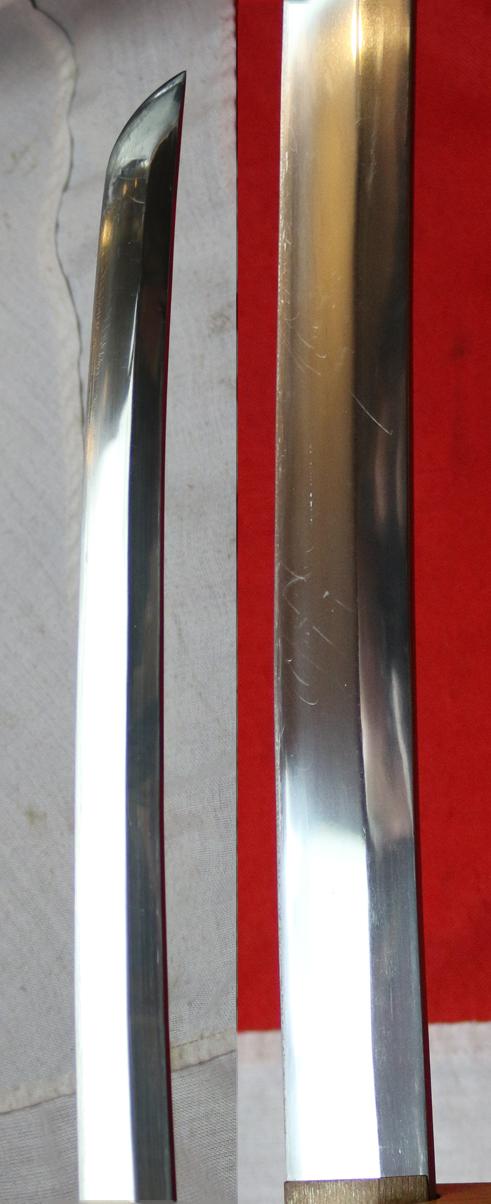
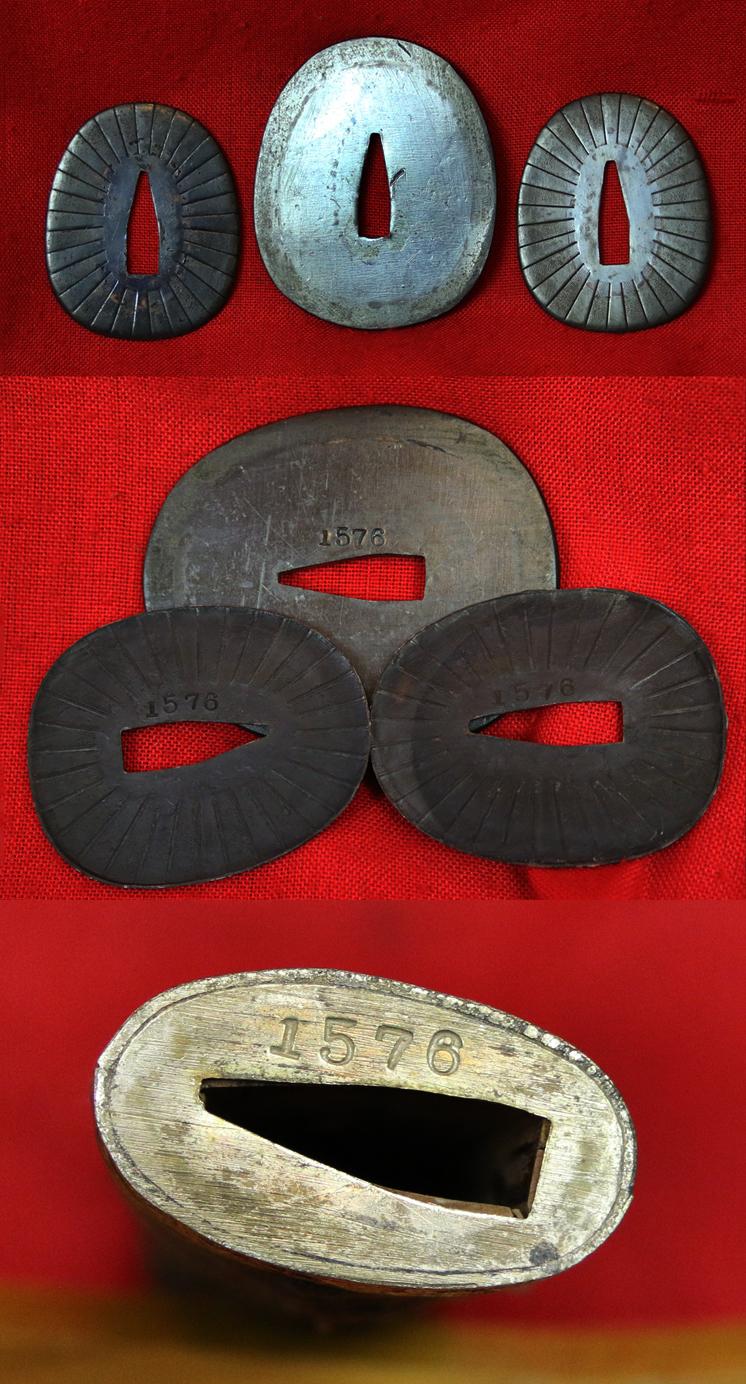
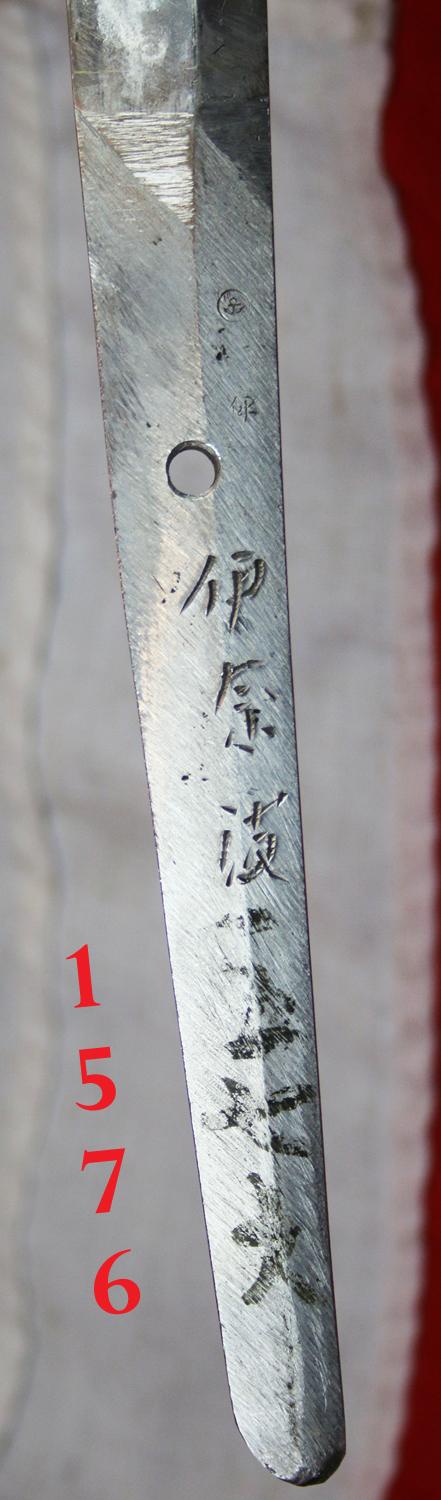
It has a superb naval stainless blade, and all the original koshirae are matching parts, all the mounts, the tsuba dai seppa, and the blade, that even the blades nakago, is assembly numbered 1576, to match all the other parts stamped numbers. The blade is very nicely signed 伊奈波 兼吉 Inaba Kaneyoshi, and also with his Naval arsenal stamp and Inaba kokuin. Some researchers believe he had a connection, reflected by his separate Inaba location stamp, with either Mount Inaba, or the Inaba Shrine
The tang is stamped with the "伊" of Inaba and the Anchor stamp of Toyokawa Navy Arsenal stamp, and Japanese Kai-Gunto naval officers swords are especially rare to survive, given that they so many usually went down with the ships, with their officers, that suffered badly from the continued {and well deserved} assaults and sinkings from the allied navies, though, to a degree, mostly from the US Navy, during 1942 and 1943, then with the British Pacific Fleet from 1944, with the Australian navy. From the beginning of the British Empire WW2 period, that lasted over two years longer than the combined Allied period when America joined, only the British and Australian navy faced and sank Japanese vessels, with able and heroic assistance from the Royal Netherlands Navy ships. {see below for details of the often forgotten heroic Royal Netherlands Navy WW2 service}
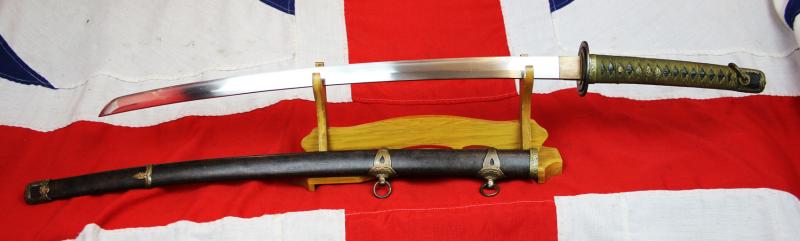
This particular example has the typical WW2 pattern naval fittings and deluxe grade samegawa giant rayskin saya {as opposed to the more standard grade black lacquer saya}.
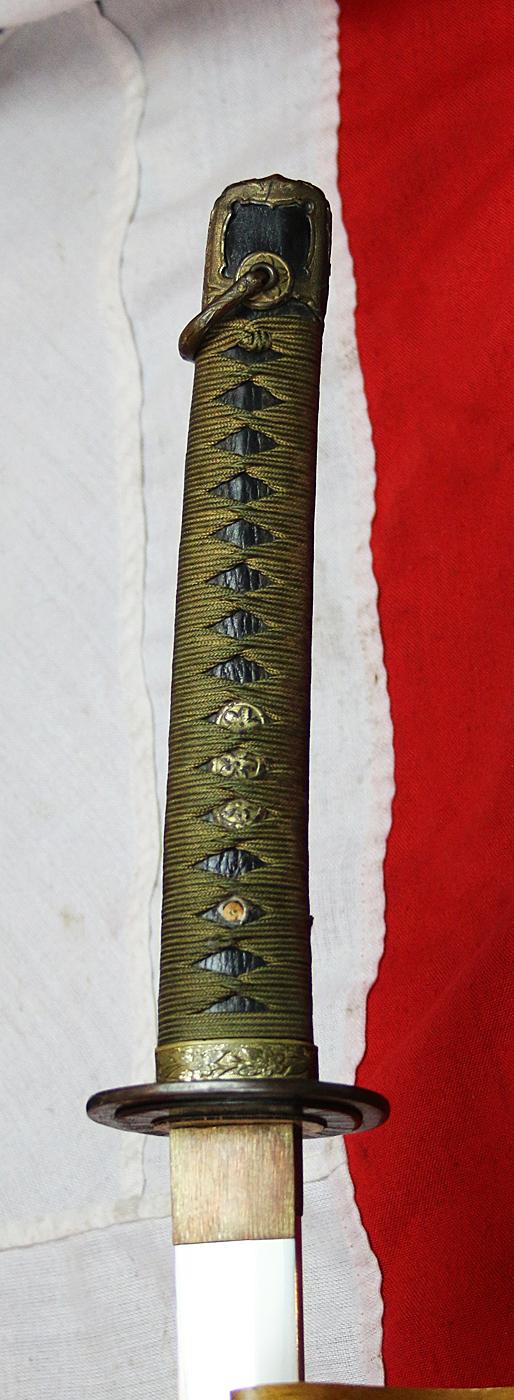
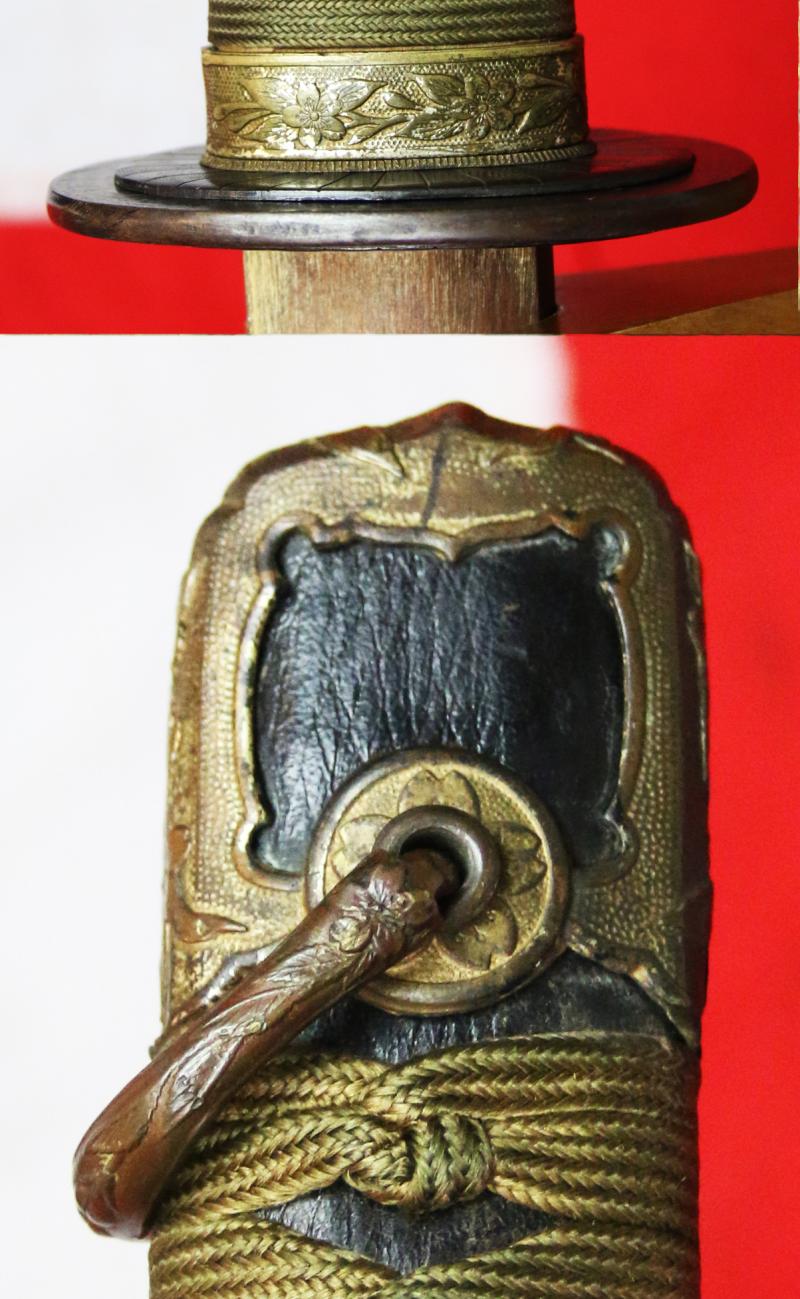
It has a typical, numbering, to all the mounts and blade and they are all matching, and a traditional three part naval oval tsuba {with two sunburst seppa dai} also numbered and matching, the tsuka (handle) has two menuki (grip decorations), and kabuto-gane (pommel end cap), with the wooden securing peg still present. Good original sea-green tsuka-Ito {hilt binding with a small wear area at one point} wrapped over coarse, black, crinkle finish leather with traditional Showa cherry-blossom decorative design to all the mounts.
The condition of the blade, is in super order, with areas of surface marks left to show its age, and signs wartime of pre-combat, field service, edge honing.
Fortunately, these beautifully crafted swords were used on board ship, so the army version was far more likely to bear considerable wear, through considerable marching and combat through jungle warfare etc
The scabbard is covered in deluxe naval service samegawa {giant rayskin}, and has gilt brass fittings, now with good gilding and all of the fittings are crisp and very good
The two original scabbard hanging mounts are present, and the condition is excellent plus.
Really it is once more a super example of an original, Imperial Japanese Navy Officer’s Kai-Gunto, now in pristine condition with clear signature.
Inaba Kaneyoshi (伊奈波兼吉) was a commissioned swordsmith (Kaigun Jumei Tosho) who forged kai-gunto (Japanese naval officer swords) during World War II. Operating out of Aichi Prefecture (often associated with the Seki tradition), his real name was Matsubara Shozo. His wartime blades are highly distinctive and identifiable through specific markings on the tang (nakago)
Often signed as Inaba (伊奈波) or his full smith name Inaba Kaneyoshi (伊奈波兼吉). Frequently features the stamp of the Toyokawa Naval Arsenal (an anchor inside a circle). Often bears an authenticity stamp (resembling the character 伊 or a specialized authentication mark). He is well known among militaria collectors for producing specialized stainless steel blades used during the war.Today, his blades serve as highly sought-after historical artifacts from the Pacific theatre, giving insight into wartime Japanese metallurgy and naval armament
Kaigun Jumei Tosho (海軍受命刀匠) translates to "Navy-commissioned swordsmith". In World War II Japan, these were certified swordsmiths exclusively contracted by the Imperial Japanese Navy to forge traditional katana (kaigunto) for naval officers.They were the naval equivalent of the better-known Rikugun Jumei Tosho (Army-commissioned swordsmiths). Certification & Quotas: To earn this title, smiths had to pass rigorous tests and quality evaluations. Once accepted, they were provided with regular allocations of tamahagane (traditional steel) or high-quality mill steel by the Navy.
Unlike regular factory blades, the blades they produced were typically gendaito (traditionally handmade swords). Many of these smiths operated out of or near naval arsenals, such as the base at Miho.
To prevent low-quality mass-produced swords from tarnishing the military's reputation, these smiths subjected their pieces to strict inspection and impact testing prior to issue
It has been over one thousand years ago that the art of making swords appeared in Japan. The swordsmiths of the time may not have known it but they were creating a legendary sword. The Samurai sword has seen combat in many tens of thousands battlefields. From the early days of the Samurai warrior to the fierce battles in the South Pacific during WWII.
From the earliest days hand-made traditional the Samurai sword was unique because it was forged using the finest skills known to man. A tremendous amount of work was dedicated to creating these pieces. They were an instrument of war as much as a beautiful artifact to adorn any decor.
The Samurai sword has grown to be one of the most highly desired military antiques of all time.
The 1937 Pattern Japanese Naval Sword, known as the Kai-Guntō (海軍刀, Sea Military Sword), was formally enacted in October 1937 as the official sidearm for Imperial Japanese Navy officers. These mounts were designed to be more practical for combat than previous, more delicate dress swords, yet they retained traditional elements and were often fitted with high-quality stainless steel blades.
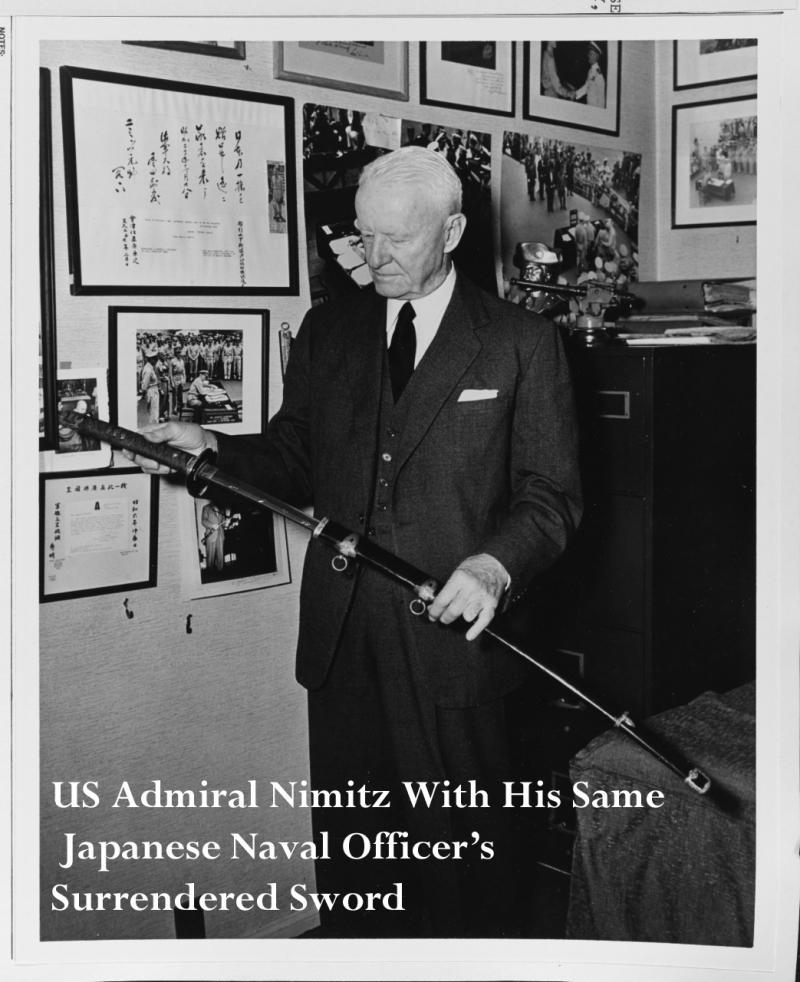
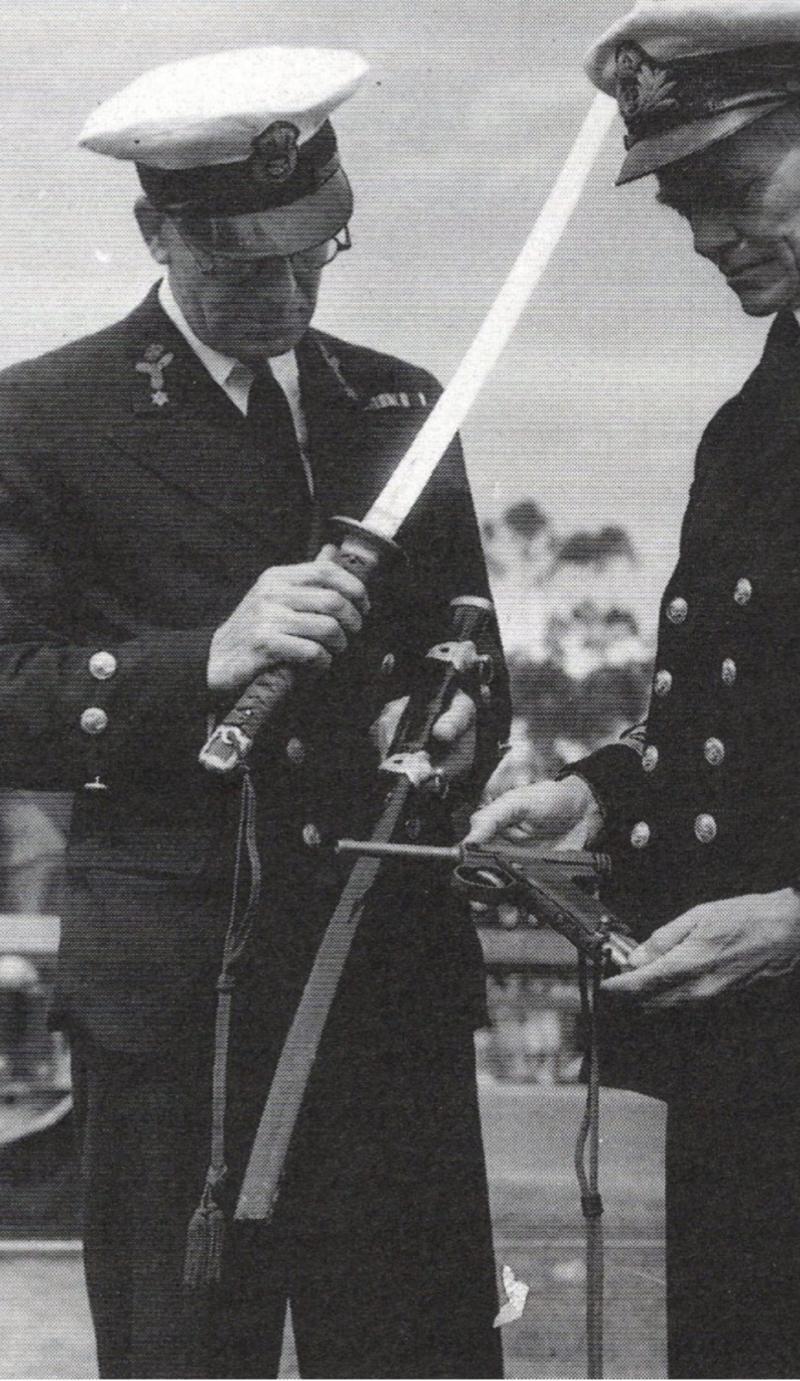
Photo of a Japanese naval captain’s sword, identical to this sword, and his Nambu pistol, examined by commonwealth naval officers, after the capture of the Japanese ship. Plus, another photo showing Admiral Nimitz after the war, admiring his war trophy sword, a Japanese Admiral's sword, identical to this sword we offer..
The British Pacific Fleet (BPF) was a Royal Navy formation that saw action against Japan during the Second World War. It was formed from aircraft carriers, other surface warships, submarines and supply vessels of the RN and British Commonwealth navies in November 1944.
After formation in Ceylon, the BPF began with operations against Japanese resources in Sumatra before moving to Australia where it made its headquarters at Sydney with a forward base at Manus Island off Papua New Guinea. The fleet supported the invasion of Okinawa in March 1945 by neutralising the Sakishima Islands. Though subjected to heavy attacks by Japanese aircraft, their well-armoured carriers and modern fighter aircraft gave effective protection. Submarines attached to the fleet sank Japanese shipping, and in July 1945 the fleet joined in the bombardment of the Japanese home islands. By the time Japan surrendered in August 1945, the fleet included four battleships, six fleet carriers, fifteen smaller carriers and over 750 aircraft.
All original matching parts koshirae tsuba and nakago, numbered 1576. Signed 伊奈波 兼吉Inaba Kaneyoshi
The tang is stamped with the "伊" of Inaba and the Anchor stamp of Toyokawa Navy Arsenal stamp.
The Royal Netherlands Navy fought the early phases of WWII in both European waters (1940) and the Pacific against the Japanese advance (1941–1942). The fleet suffered heavy casualties but achieved notable successes, particularly with its submarine and minelayer divisions. Light Cruisers HNLMS De Ruyter: Served as the flagship for the joint Allied fleet (ABDA) and was sunk during the Battle of the Java Sea in February 1942. HNLMS Java & HNLMS Sumatra: Java was lost alongside De Ruyter in the Java Sea. Sumatra was evacuated to the UK and later scuttled as a breakwater off Normandy during the 1944 D-Day landings. HNLMS Tromp: Survived the early Pacific battles, including the Battle of Badung Strait, and continued service throughout the war.
DestroyersAdmiralen-class: Included Van Ghent, Kortenaer, Piet Hein, Evertsen, Witte de With, and Banckert. These ships actively engaged Japanese forces in the Java Sea and Sunda Strait campaigns; several were sunk in early 1942.
SubmarinesHNLMS O 21 & HNLMS Dolfijn: Achieved significant success in the Mediterranean, where Dutch submarines sunk multiple Axis warships.
HNLMS O 16 & HNLMS K XVI: Both successfully engaged and sunk Japanese transport ships in the Pacific before being lost to mines and torpedoes in late 1941.
Minelayers / EscortsHNLMS Abraham Crijnssen: Famous for successfully evading Japanese forces by camouflaging itself as a tropical island and safely escaping to Australia.
HNLMS Willem van der Zaan: Escorted Allied convoys and operated in both the Pacific and the Atlantic.
It must always be remembered, all the above ships were crewed by Netherlanders whose families were in the NAZI occupied Netherlands, or as POWs of the Japanese. It must have clearly been particularly fraught time for those men.
Code: 26232