
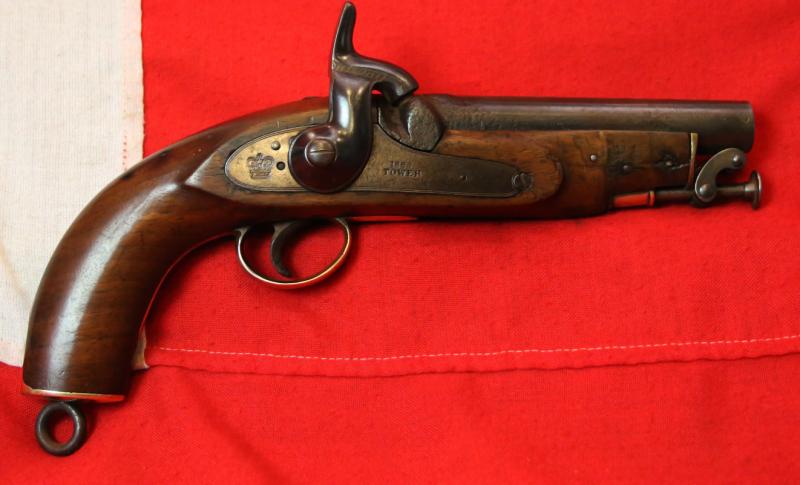
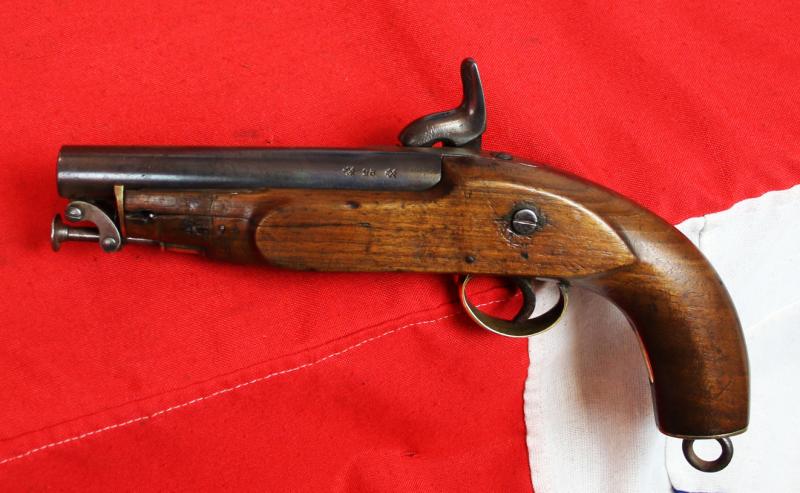
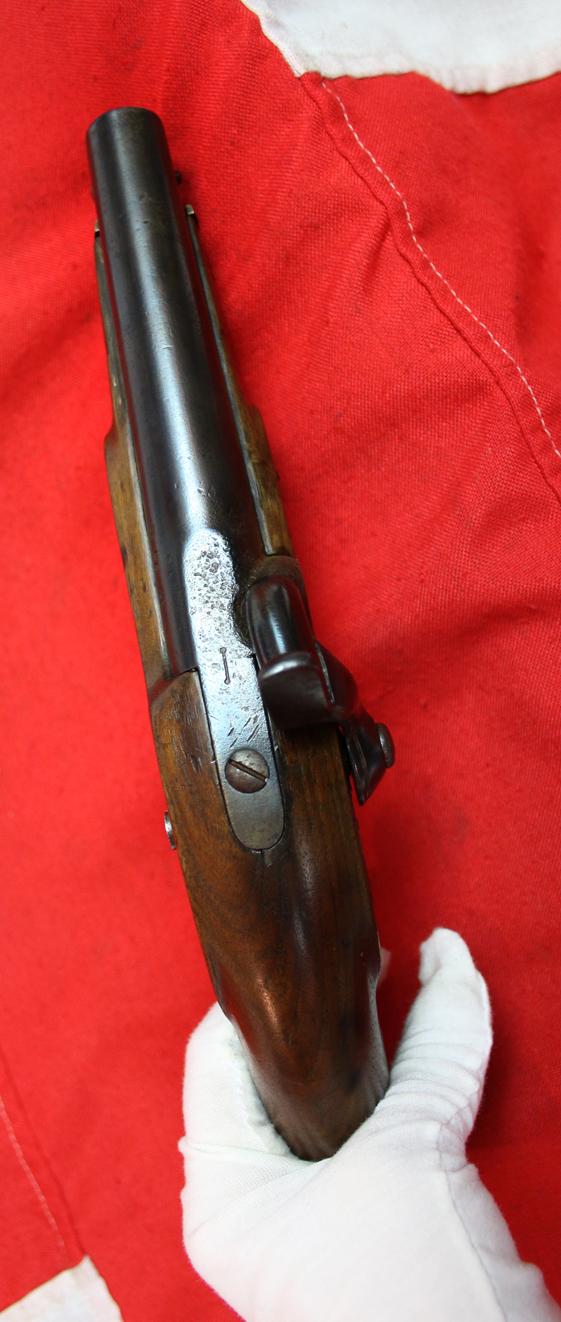
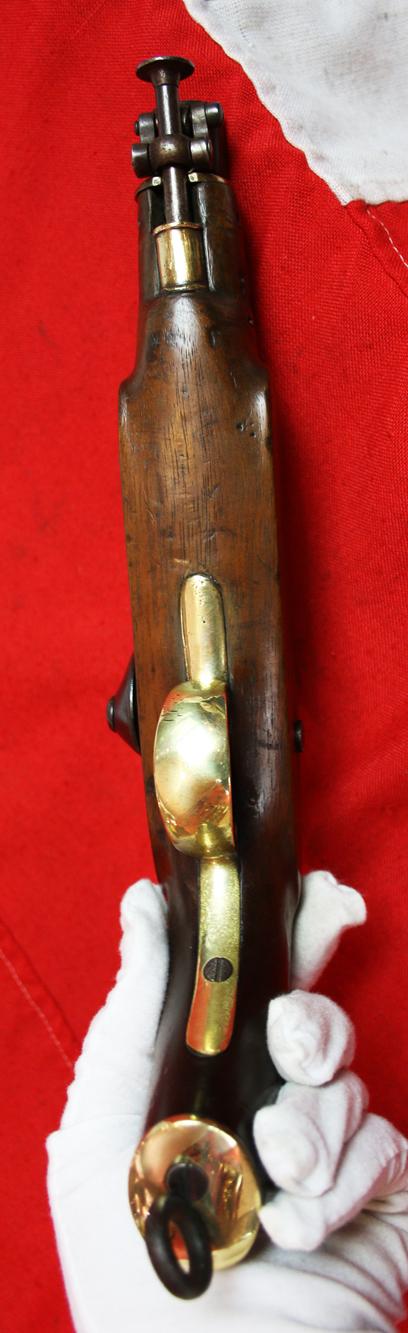
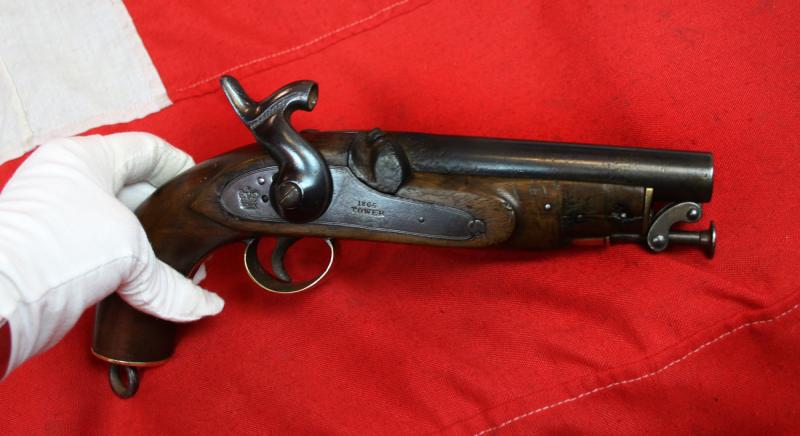
A Very Good Victorian, 'Tower Of London' Issue, Coast Guard, Royal Naval Maritime Service Percussion Pistol, 1839 Pattern, With Captive Swivel Ramrod. Dated 1865 Lock
Coast Guard Pistol took the form that resembles the Pattern 1842 Lancer’s Pistol, which is a more commonly encountered British percussion military pistol from the same period.
Just returned from three days intensive hand cleaning and conservation.
The Pattern 1839 Royal Naval Coast Guard Pistol retained the same flat butt design of the previous Pattern 1831 Coast Guard pistol, but utilizes a slightly longer 6” pinned round barrel, with captive swivel ramrod. The lock is percussion using New Land Pattern Lock plates and internal components, and a percussion hammer.
The hammer has with a rounded percussion nose. The walnut stock is mounted with brass furniture, including the butt cap, trigger guard, ramrod pipe and side nail cup (lock screw escutcheon). The pistol has blued barrel, colour casehardened locks and hammers, with the swivel ramrods. Like the Pattern 1831, no belt hook was utilized, and a musket style sling swivel was mounted on the butt. These new Coast Guard Pistols were “set up” by the various contractors, the Tower Armoury and the Royal Small Arms Factory at Enfield.
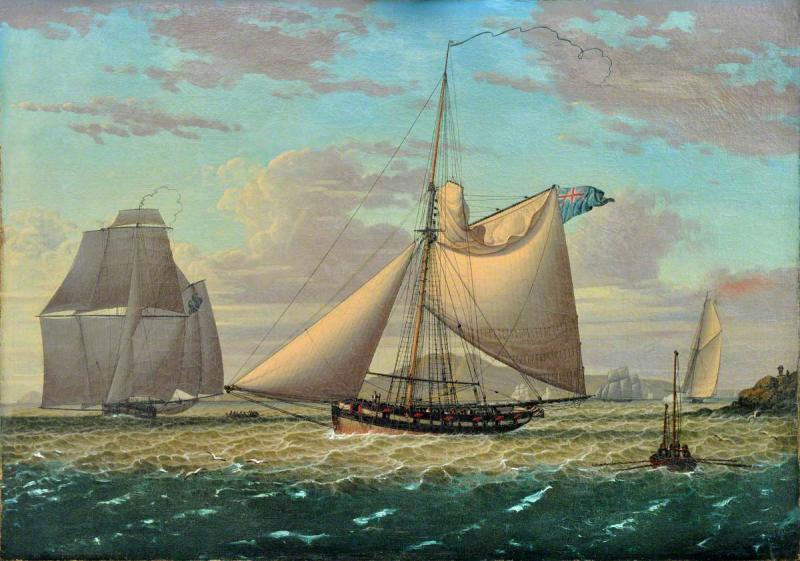
The English Coastguard (now HM Coastguard) was formally established in 1822 to curb the rampant smuggling of contraband like tea and spirits. Staffed largely by former Royal Navy personnel, the force evolved during the century into a vital national life-saving organization and an official naval reserve. Origins and Anti-Smuggling (1822)
In the late 18th and early 19th centuries, high taxation led to a boom in violent and lucrative smuggling operations along the English coast. To combat this, the British government brought together various existing maritime enforcement bodies—including Riding Officers on patrol and the Preventive Water Guard—to form a unified Coast Guard of about 3,000 men.
Because these officers were stationed in remote spots, they were constantly rotated to prevent them from becoming too friendly or colluding with local smuggling communities. Strict rules were implemented; they were forbidden to engage in trade, own a pub, or possess private boats, and instead were financially incentivized by receiving "prize money" for capturing smugglers.
During the Victorian era, the Coast Guard was placed directly under the control of the Admiralty. Serving as a vital coastal defense force and a ready reserve for the Royal Navy, its primary responsibilities included preventing smuggling, monitoring the shoreline for shipwrecks, and operating life-saving rocket apparatuses.
Very good and tight working action, overall in nice condition and just light early surface pitting in small areas, and the fine walnut stock has some old useage cracks in the forestock under the barrel {see photographs in the gallery} all the brass work is in good condition. Pinned brass fore end cap
Code: 26242
945.00 GBP