
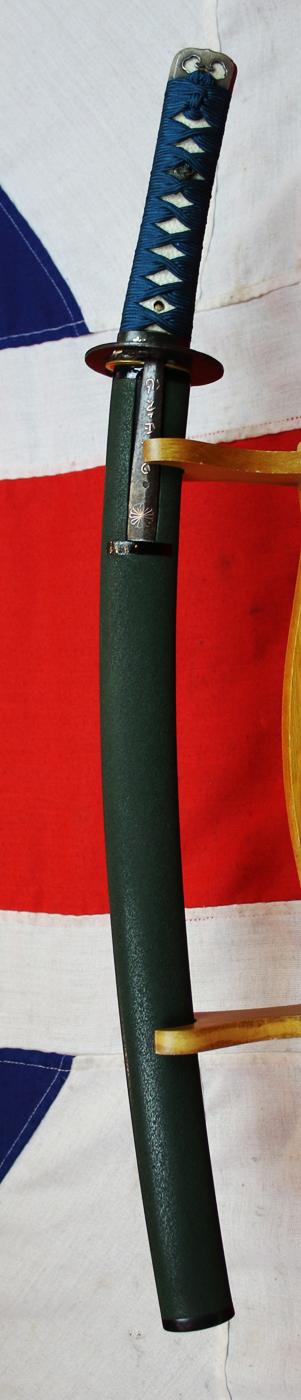
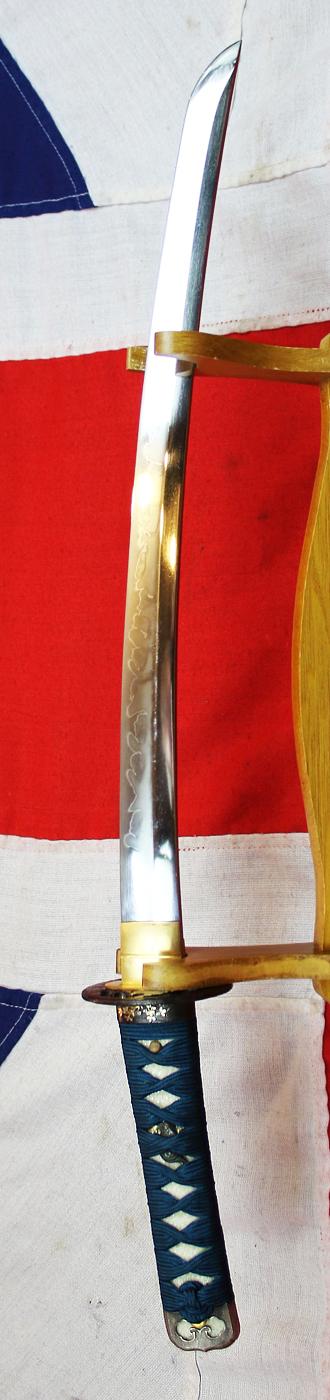


A Shinto Period, Circa 1650, Samurai Wakazashi, Of Extraordinary Beauty, Encompassing Numerous Contrasting Features. A Multitude Of Traditional Samurai Sword Koshirae Of The Finest Artistic Merit & Combined With A Magnificent Blade
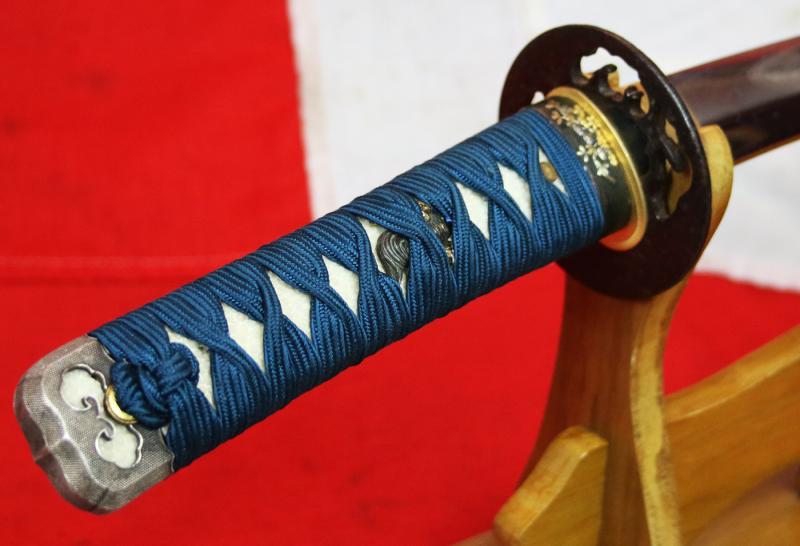
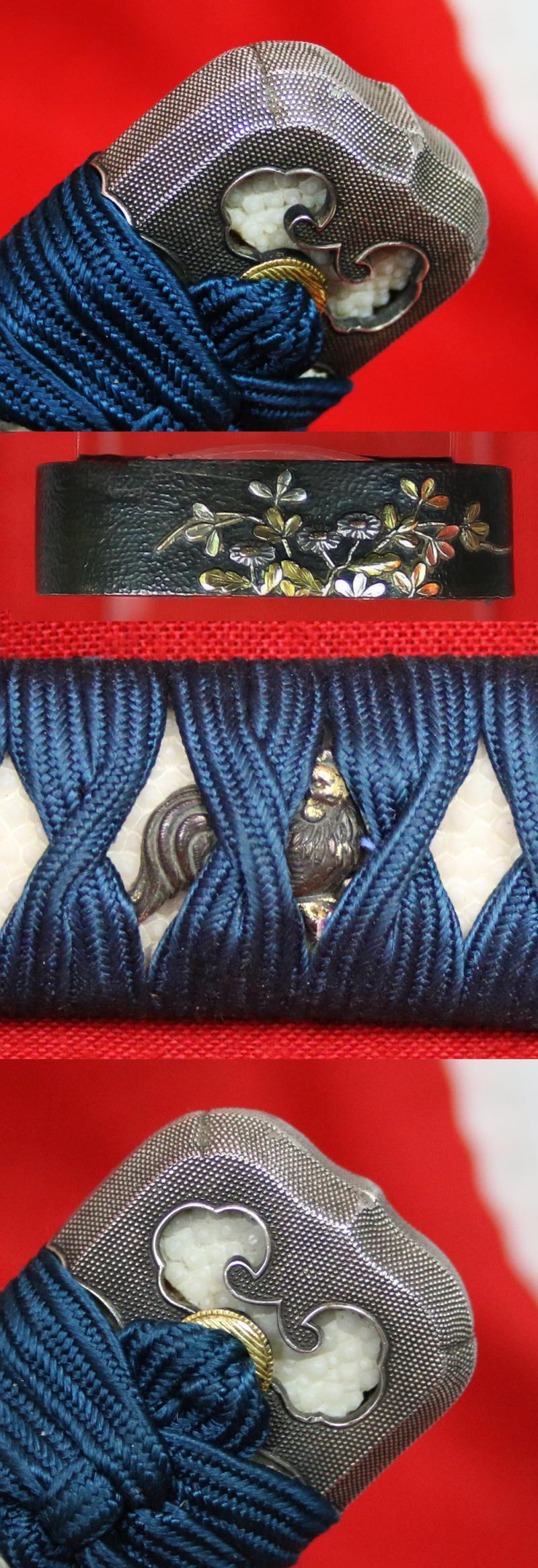
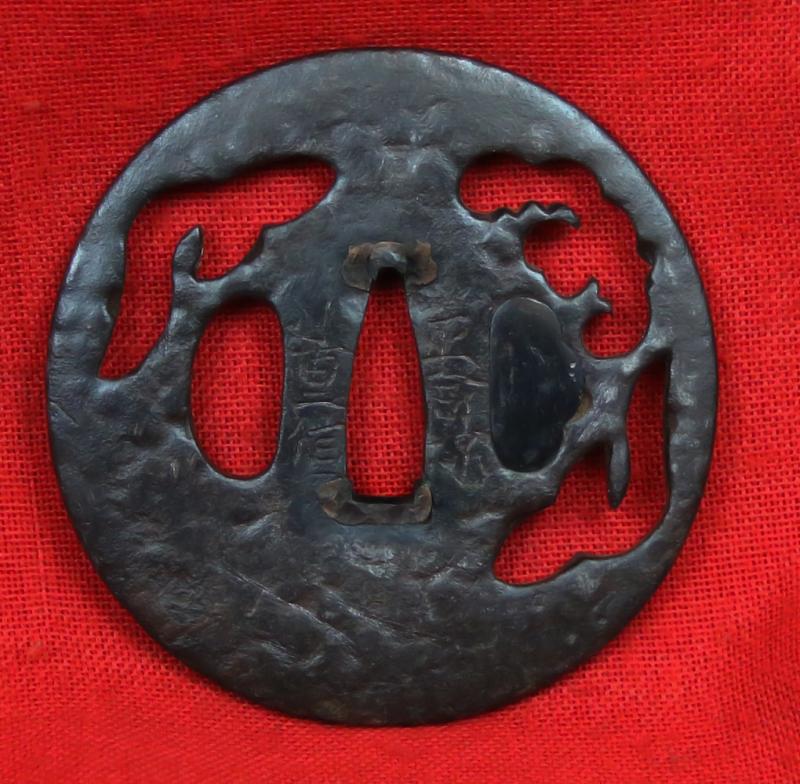
A stunning colour combination of blue-green silk tsukaito hilt binding, with an amazing sea green ishime stone finish urushi lacquer saya. The hilt is mounted with a silver and gold handachi style kabuto-gane mount decorated throughout with a profuse hand-punched nanako ground, and a round, gold ito shitodome. Beneath the ito wrap are a pair of gold and shakudo cockerals {niwatori} a Bird of Virtue, above samegawa {giant rayskin}. The fuchi is of hammered takebori gold and silver prunus flowers and leaves on shakudo ground. The signed, round iron tsuba is Sukashi-bori (透かし彫り),
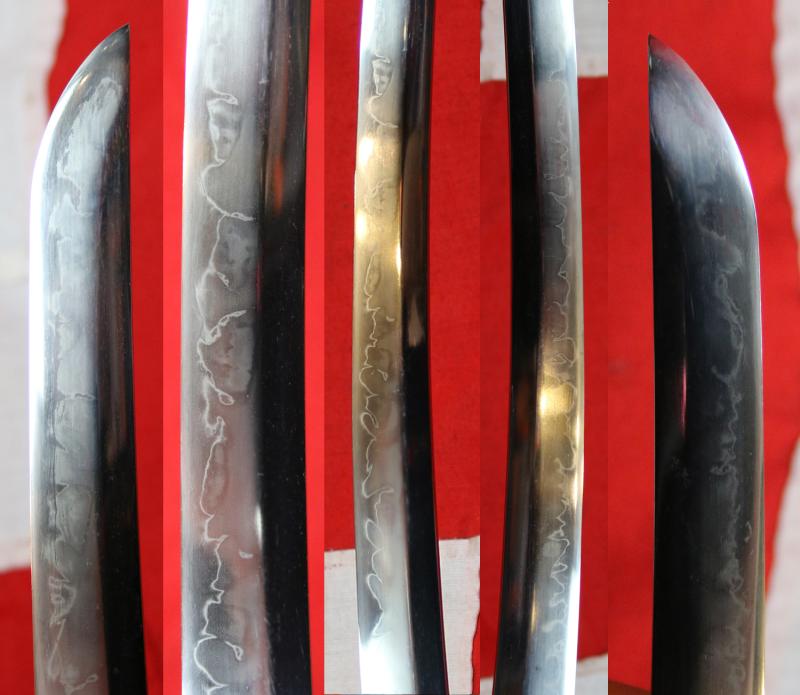
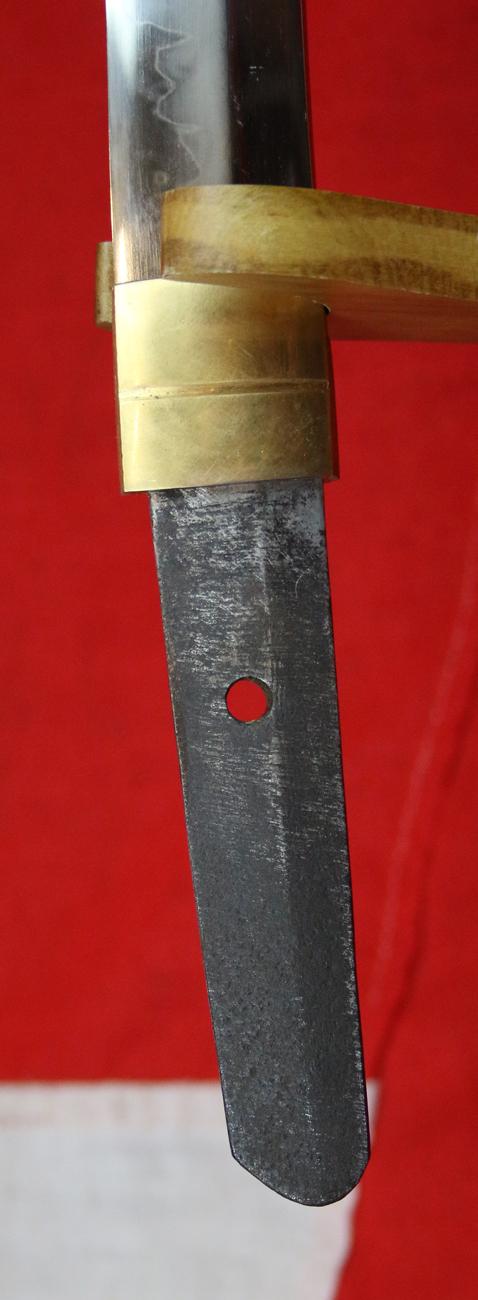
The iconic blade is an absolute wonder, its hamon, Ō-midare, is extraordinarily complex and incredibly beautiful. A statement piece worthy of any museum grade collection. One might conclude that the master smith who created this blade wished to emulate the style of hamon of the greatest sword maker of all history,
Gorō Nyūdō Masamune {五郎入道正宗}
Ō-midare translates to "large irregular." It is a dynamic, chaotic, and undulating tempering pattern featuring large, sweeping waves, peaks, and valleys.
While it first appeared in earlier Koto periods, it became a defining signature of the Soshu tradition. Pioneered by legendary masters like Masamune and Sadamune, this school is renowned for its aggressively tempered, complex, and beautiful blades.
No private collection can sadly boast a sword by the worlds most famous and arguably greatest samurai sword smith Masamune, but if one wanted to say this blade could be a representation of what one might look like, this is it
Later Soshu (Nanbokucho period onward): When referring to later Sagami or subsequent smiths influenced by the school (such as the Hasebe or later Sue-Soshu smiths), the Ō-midare became even more pronounced and varied.Hataraki: Later Soshu-style Ō-midare heavily features dynamic temper activities (hataraki) within the steel. You will often find vigorous crystals (nie), flowing lines of steel (sunagashi), and glowing golden streaks (kinsuji).
Unlike the straight, rigid Suguha hamon, the undulating valleys of an Ō-midare pattern act as multiple structural relief points, helping absorb impacts and reducing the odds of the sword breaking. It is somewhat reminiscent to us of the hamon on the missing national treasure, the Kokuhô Honjo Masamune sword, thankfully, its hamon is very well known, and was previously recorded by artistic representation at least four times.
The Honjo Masamune was passed down through generations of Japanese shoguns, symbolizing the power and prestige of its owners. It is believed to have been in the possession of Tokugawa Ieyasu, the founder of the Tokugawa shogunate.
The sword's whereabouts have been a subject of intrigue since the end of World War II. It was last seen in 1945 when it was surrendered to an American officer during the occupation of Japan. Its current location remains unknown. If found it would likely be valued in the many tens, or even hundreds of millions of pounds.
The surviving blades forged by the legendary 14th-century smith Goro Masamune are exclusively classified as National Treasures or Important Cultural Properties owned by museums, public institutions, or the Imperial Family.
Other verified Masamune blades are safely housed in public institutions, The Harry S. Truman Presidential Library and Museum (Independence, Missouri) Houses a Masamune blade gifted to President Harry S. Truman by General Walter Krueger following World War II. The Kyoto National Museum (Kyoto, Japan) Houses the "Shimazu Masamune," an authenticated masterpiece that was brought in for appraisal and confirmed by experts. The Tokyo National Museum (Ueno, Japan): Holds several designated National Treasures by the smith, including the famous "Kanze Masamune". The Victoria and Albert Museum (London, UK) Features a distinguished long sword with a gold-inlaid signature attributing it to Masamune
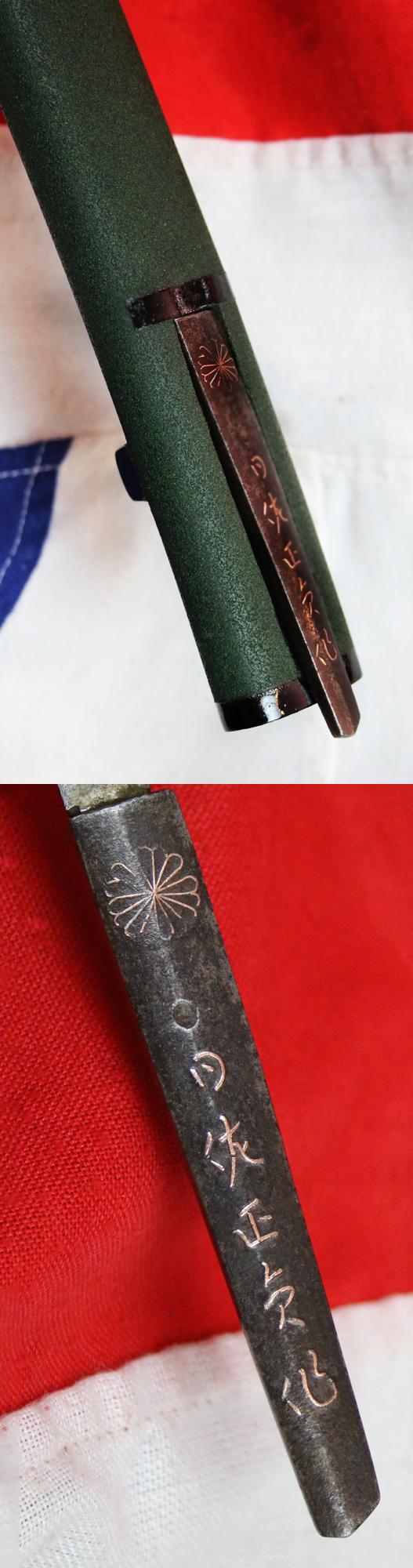
It has a very good Edo period Shinto era 'Nakago Form' Kodzuka utility biknife.
Iron body inlaid with copper kanji, with the signature kanji of a famous sword smith, and the Imperial chrysanthemum mon. Kodzuka have been collectable items for many centuries, simply as works of art, even though they were functional knife handles, for the utility blades that fitted into wakizashi, tanto and katana saya. They can vary in quality, and this is a most fine example, inlaid with pure copper. What is particularly scarce is that it is shaped like the tang of the sword, complete with simulated mekugi ana, and signed in much the same way. This type is rare and very collectable and represent very famous swords made by master swordsmiths in samurai history. It has a long thin blade that slotted into it's opening, and the blade was often considered to be almost of a disposable nature, with the handle itself being the prized part.
The tsuba is an o-sukashi form, and signed. It is a traditional Maru-gata (rounded/circular) shape. The main style is Sukashi-bori (透かし彫り), which is the Japanese art of openwork or negative-space stencilling. It incorporates both positive and negative elements to carve a pictorial scene out of the iron plate. The fluid, nature-inspired openwork, hammered rustic background texture, and prominent chiseled signature (mei) alongside the centre opening point toward the Shoami (正阿弥) or Kyo-Shoami tradition. Shoami craftsmen were famous for pioneering natural motifs—such as pine trees, branches, and vegetation—rendered in heavy, organic ironwork across the classic circular plate
Along with their practical purpose, sword guards served a symbolic function and were often decorated with a design that had particular meaning to the owner, reflecting their strength, personality and family background. As such the sword guard became an important status symbol to the samurai. The late 1400s through to the mid 1500s were marred by a period of warfare and many warriors, regularly facing death, found spiritual strength in Zen Buddhism. Religious script featured commonly in tsuba inscriptions, offering protection and spiritual guidance to the warrior.
As Japan entered the more peaceful Edo Period (1603-1868), tsuba became increasingly elaborate and decorative in design and function, and their manufacture became highly specialised and technically advanced. Different schools of makers developed their own styles, often influenced by the culture and environment of the region, and the role of the tsuba extended to become an elaborate piece of art. Subjects for decoration included Japanese mythology, history and nature. Since the 16th century, it was customary for the guard to feature the signature of the maker.
The gold and shakudo cockerel menuki may tell us more about a former samurai owner of this sword.
In Japanese culture, the cockerel (or rooster, niwatori) primarily represents courage, sacred divine intervention, and the triumph of light over darkness. As a sacred bird deeply rooted in Shinto mythology, its morning call is viewed as a herald of the sun.
According to the Kojiki (Japan's ancient chronicle), when the sun goddess Amaterasu hid in a cave and plunged the world into darkness, it was the loud crowing of roosters that helped lure her back out, restoring light to the world.
Because of their connection to the sun goddess, roosters are considered sacred animals. They are permitted to roam freely on the grounds of many Shinto shrines to ward off evil spirits and usher in good fortune.
Occupying the tenth position in the 12-year Japanese Zodiac (jūnishi), the rooster stands for order, precision, and diligence. In commerce, it is widely regarded as a symbol of financial luck and business prosperity. This is highlighted annually during November at Tori no Ichi (Festival of the Rooster) fairs held at Shinto shrines, where business owners purchase decorated bamboo rakes to figuratively "rake in" wealth and success for the upcoming year
As once told to us by an esteemed regular visitor to us here in our gallery, and the same words that are repeated in his book;
“In these textures lies an extraordinary and unique feature of the sword - the steel itself possesses an intrinsic beauty. The Japanese sword has been appreciated as an art object since its perfection some time during the tenth century AD. Fine swords have been more highly prized than lands or riches, those of superior quality being handed down from generation to generation. In fact, many well-documented swords, whose blades are signed by their makers, survive from nearly a thousand years ago. Recognizable features of the blades of hundreds of schools of sword-making have been punctiliously recorded, and the study of the sword is a guide to the flow of Japanese history.”
Victor Harris
Curator, Assistant Keeper and then Keeper (1998-2003) of the Department of Japanese Antiquities at the British Museum. He studied from 1968-71 under Sato Kenzan, Tokyo National Museum and Society for the Preservation of Japanese Swords.
The wakizashi is a traditional Japanese short sword that served as a samurai's auxiliary weapon. Emerging in the 15th and 16th centuries, it evolved into a powerful symbol of status and honor, becoming the constant companion of the samurai class.
The wakizashi developed as an evolution of earlier short swords like the tanto (dagger). Its name translates to "sword thrust on the side," indicating its role as a secondary blade worn at the hip. During the Edo period, the Tokugawa shogunate required samurai to wear a pair of swords known as the daishō (meaning "big-little")—a katana and a wakizashi. This pair became the exclusive symbol of the warrior class.
Because the long katana was often required to be left at the door when entering, as a visitor or emissary, a castle or home, the wakizashi was allowed to be worn indoors as a symbol of trust, proffered to the visiting samurai. It served as vital self-defense and was highly effective in narrow, confined spaces.
Samurai famously used the wakizashi with the chisa-katana in dual-wielding styles, such as the Niten Ichi-ryū school pioneered by the legendary swordsman Miyamoto Musashi. In the chaos of the battlefield, it acted as a backup blade for close combat or finishing off a fallen foe.
The wakizashi also had a solemn role, frequently used to perform seppuku (ritual suicide) when a samurai needed to restore his honour.
The overall condition is superb with just a few near invisible minuscule age marks upon the blade surface.
Code: 26243
6950.00 GBP