

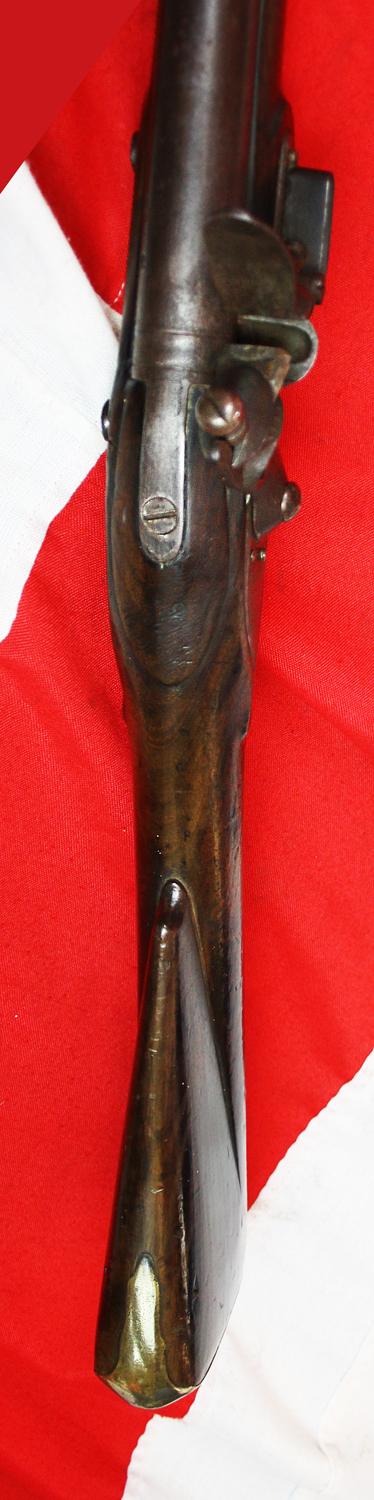
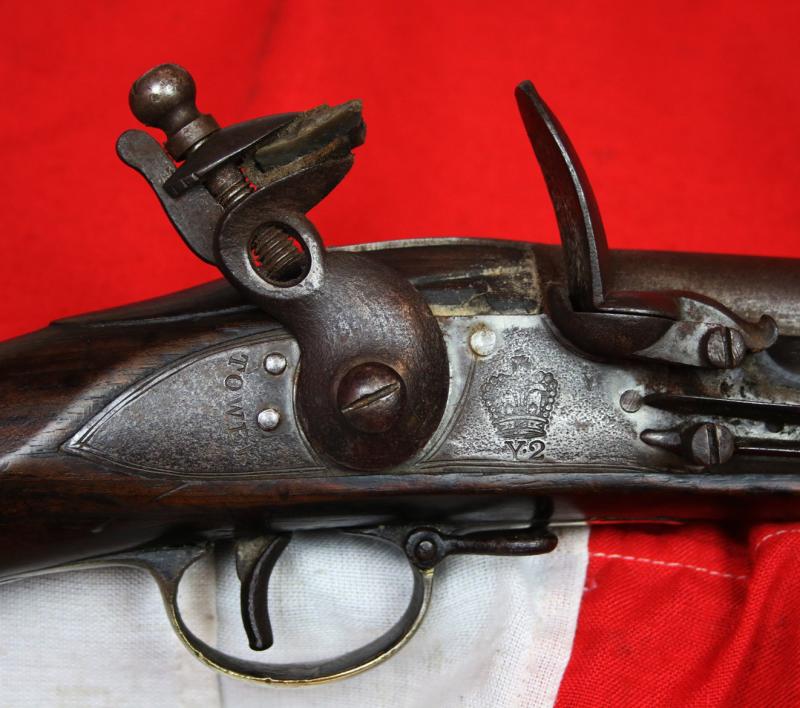
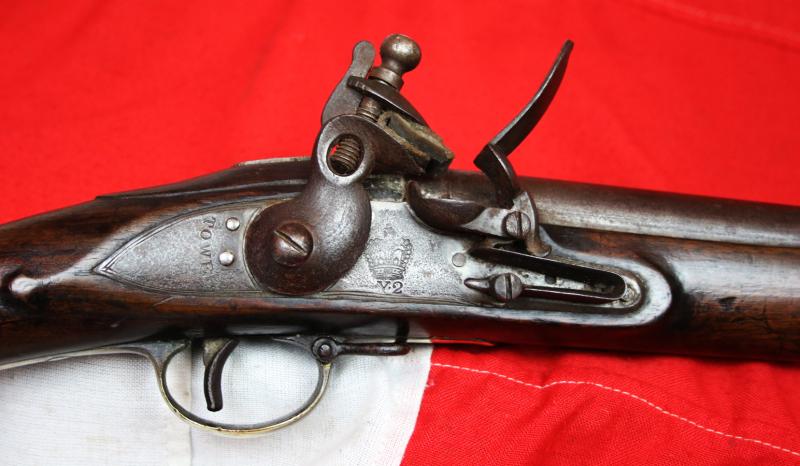
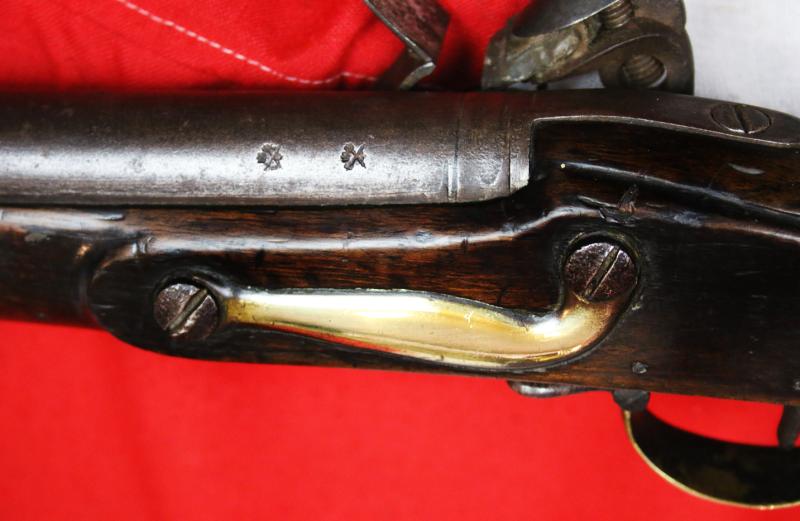
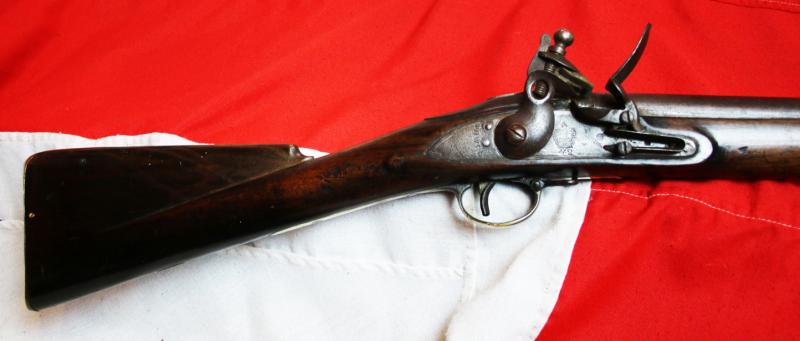
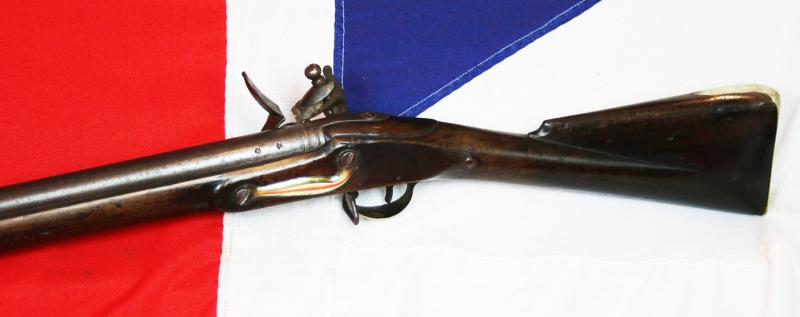
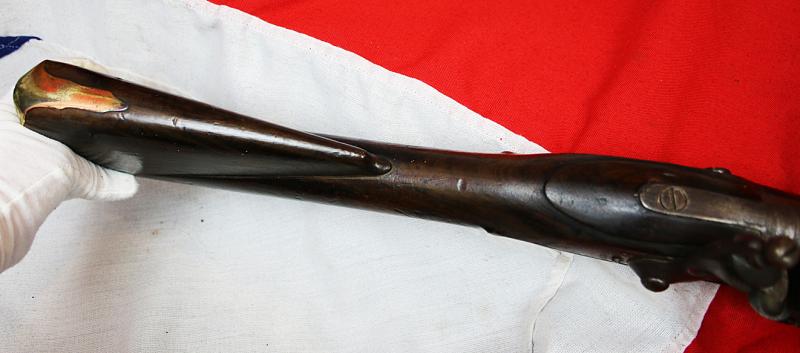
A, Original Napoleonic Wars ‘Tower of London’ Brown Bess Musket. Third Pattern, Napoleonic Wars Issue. 39 inch Barrel Regulation Lock, Stock, Mounts and Fittings. Circa 1808 With Ring Necked Cock
A very good regulation Brown Bess ‘Tower of London’ India Pattern Musket of The Napoleonic Wars, Waterloo etc. The standard musket issued to the British soldier throughout the late 18th and early 19th centuries was the India Pattern model, made in two variants and used against both Revolutionary and Napoleonic France. The first model was introduced in 1793 and the updated version in 1810
Probably the most famous military flintlock musket in the world today, and certainly one of the most historically important and desirable long guns of its type from the Napoleonic wars.
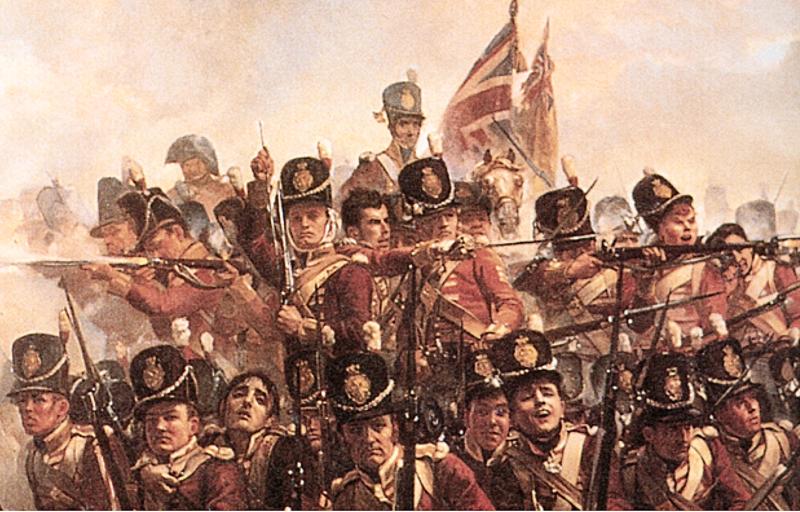
In one day alone, June 1815, at the Battle of Waterloo, it is estimated four million rounds were fired by the 50,000 infantry {estimated at 80 cartridges per man} with their India Pattern Brown Bess muskets, at Napoleon’s army.
A typical regulation example exceptional and excellent condition, with a stunning colour and patina.
A British Napoleonic Wars regulation, regiment of the line issue musket, Crown GR and Tower, ring neck cock lock with government GR Crown stamp, regulation brass mounts, iron ramrod replaced. Walnut stock with signs of combat use but still exceptionally fine. A musket that it would be difficult to improve upon to find a better example.
The Brown Bess musket began its life almost 300 years ago, and it helped in creating one of the greatest trading empires the world has ever seen and, among other achievements, made the 'British Square' the almost undefeated form of infantry defence throughout the world. Made in four distinct patterns it originally started life as a 46 inch barrel musket called the Long Land or Ist pattern Brown Bess. Then in around 1768 the gun evolved and the barrel was shortened to 42 inches as 46 was deemed unwieldy and renamed the Short Land or 2nd pattern. Although the Long Land was made continually for another 20 years. With the onset of the Napoleonic Wars in the 1790s, the British Board of Ordnance found itself woefully short of the 250,000 muskets it would need to equip its forces. It managed to produce around 20,000 short land pattern muskets but this was simply not sufficient. At that time the British East India Company maintained it own troops and had contracted with makers to produce a simplified version of the Brown Bess musket with a 39-inch barrel and less ornate furniture and stock work. It was generally felt that the standard of these "India pattern" muskets was not up to the standard of the earlier Besses, but necessity required action so the authorities convinced Company officials to turn over their stores to the Crown. By 1797 the urgencies of war ultimately created the demise of the Short Pattern, and all manufacture was turned to building the more simple 'India' pattern. For the most part, the gun underwent few changes from its introduction until Waterloo, with the exception of the cock, which was altered from the traditional swan-neck style to a sturdier, reinforced ringed version in around 1808.
The Brown Bess musket was the standard weapon of the British for more than a century. soldiers marched into battle with this musket—nicknamed “Brown Bess”—for more than 100 years. British redcoats used the Brown Bess to fight the War of Independence in the colonies, and many of their opponents in the Americans’ Continental army used it as well.
British soldiers fighting in the Napoleonic wars carried it into battle, and it was the principal firearm used by the infantrymen who fought the War of 1812.
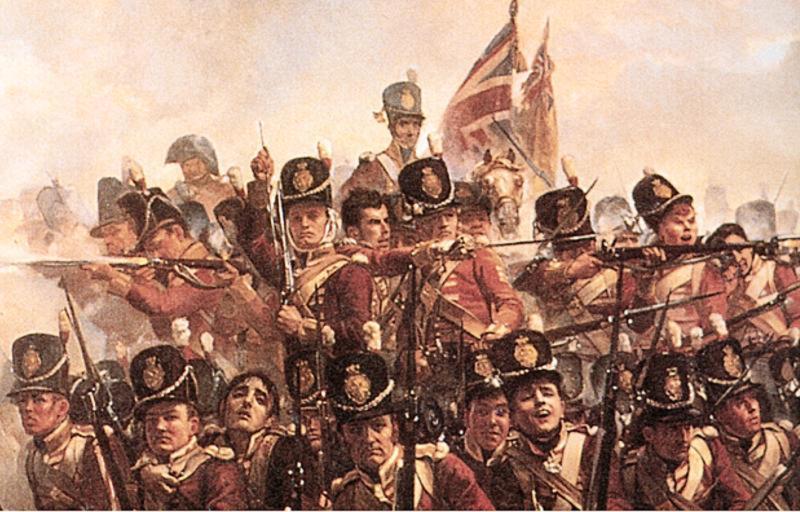
Because the weapon was slow to load and relatively inaccurate (experienced soldiers generally estimated its range between 50 and 100 yards), armies developed tactics that helped compensate for its shortcomings. The limitations of smoothbore muskets like the Brown Bess forced units employ “linear tactics,” in which a hundreds of soldiers stood in neat lines, shoulder-to-shoulder and out in the open. While such tactics appear decidedly unstealthy to twenty-first century eyes, they proved essential on the battlefields of all the conflicts which Britain was involved.
There, stealth was a low priority. Packing the men into blocks allowed officers to coordinate their troops’ fire into synchronized volleys. Firing a hundred guns in the same direction at once helped ensure that at least some, often most of the inaccurate musket balls found their targets. And grouping the men into neat lines out in the open helped commanders ensure that few of their troops gave in to the natural instinct to flee.
Of course, packing troops into blocks and fighting in the open required tremendous discipline from the individual soldiers. Infantrymen had to stand exposed to enemy fire as they loaded and fired their own muskets. And in some situations, soldiers learned the grisly dangers of fighting in lines—as at the Battle of New Orleans in the 1812 war, where American artillery attacked the exposed British formations with devastating effect.
Engagements for the infantry were traditionally at relatively close distances, often the result of closely controlled battlefield management. In 1811 a soldier of the 71st Regiment of Foot, writing of fighting the French at Fuentes de Onõro, recorded: “… during our first advance a bayonet went through between my side and clothes, to my knapsack, which stopped its progress. The Frenchman to whom the bayonet belonged fell, pierced by a musket ball from my rear-rank man. Whilst freeing myself from the bayonet, a ball took off part of my right shoulder wing and killed the rear-rank man, who fell upon me. We kept up our fire until long after dark. My shoulder was black as coal from the recoil of my musket; for this day I had fired 107 round of ball cartridge.”
This was not an uncommon account and it would have been just as true of Waterloo. If we were to take an average of 80 cartridges fired by about 50,000 allied infantry at Waterloo the expenditure of ammunition would have amounted to more than four million cartridges. Although not scientific, it does give a flavour of the ferocity of battle that Sunday in June 1815.
Barrel 39inch overall 54.75 inches long.
Action has a very good and strong mainspring. As with all our antique guns no license is required as they are all unrestricted antique collectables
Code: 26254
3450.00 GBP