
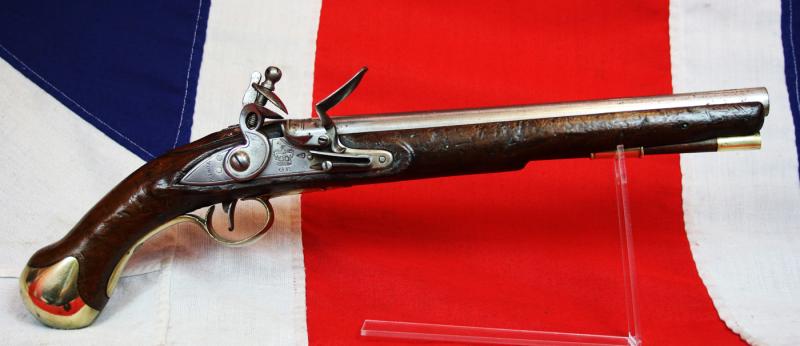
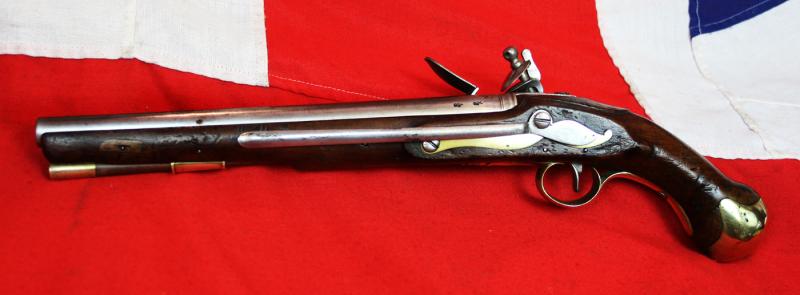
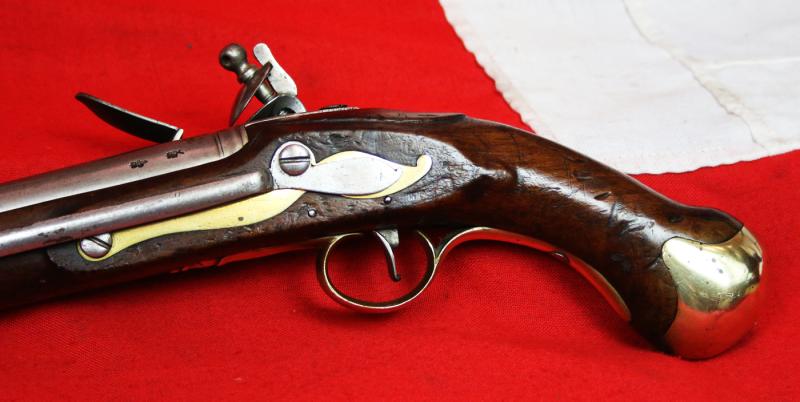
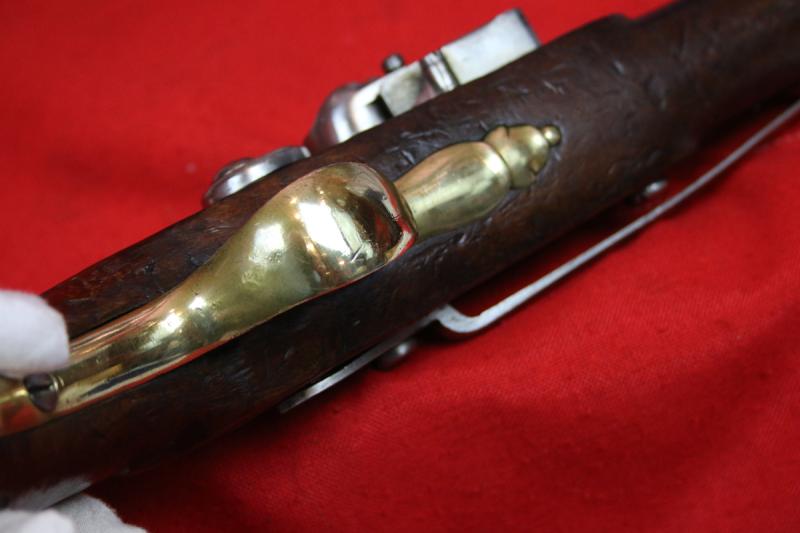
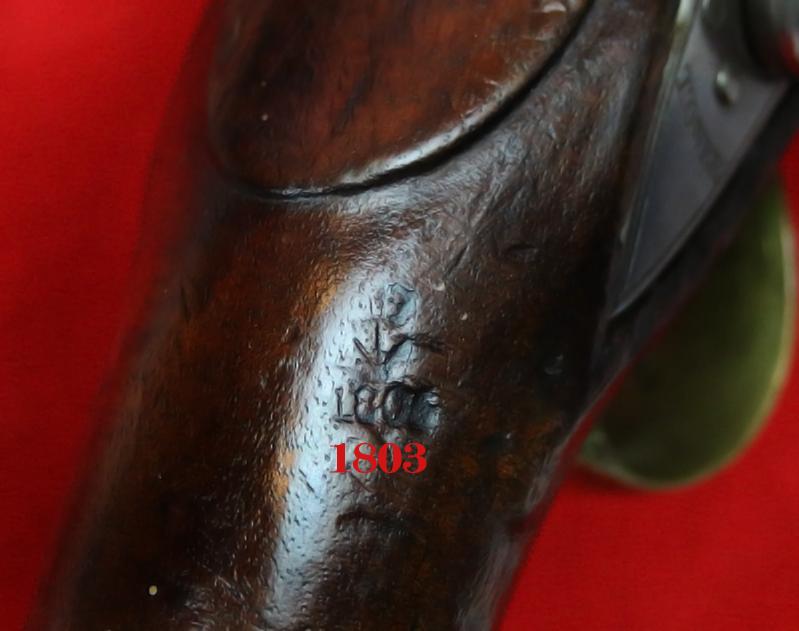
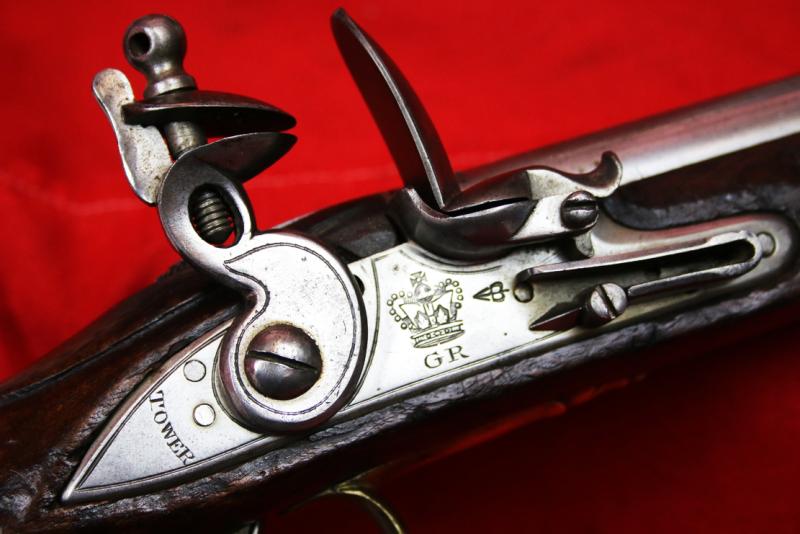
An 1801 Pattern, Tower of London, Royal Navy Issue, Long ‘Sea Service Pistol’, With Original Belt Hook, Tower of London GR Crown Lock, Fine Stock & 'Skull Crusher' Butt Cap, From The Battle Of Trafalgar Historic Nelson Period, Stock Dated 1803
A very fine example indeed, profusely stamped.
Probably one of the best complete and original examples of a Royal Navy Sea Service pistol that we ever have seen for quite a while.
Profusely struck with numerous ordnance and inspectors marks, fairly clearly issue date stamped 1803 into the stock, with its original belt hook. Some hooks were removed in service. The 'Skull Crusher' butt cap was so called as once the shot was discharged at the enemy, in close hand-to-hand combat, there was no time to re-load, so the pistol was turned around, and firmly held in the left hand, by the barrel, and thus used as a stout club, and used for exactly the same purpose. The right hand, once free, could then hold a cutlass or sword, simultaneously.
Fantastic patina to the stock. The King George IIIrd issue British Royal Naval Sea Service pistol has always been the most desirable and valuable pistol sought by collectors, but this example, like our previous 1801 sea service pistol, {sold last year} is truly exceptional.
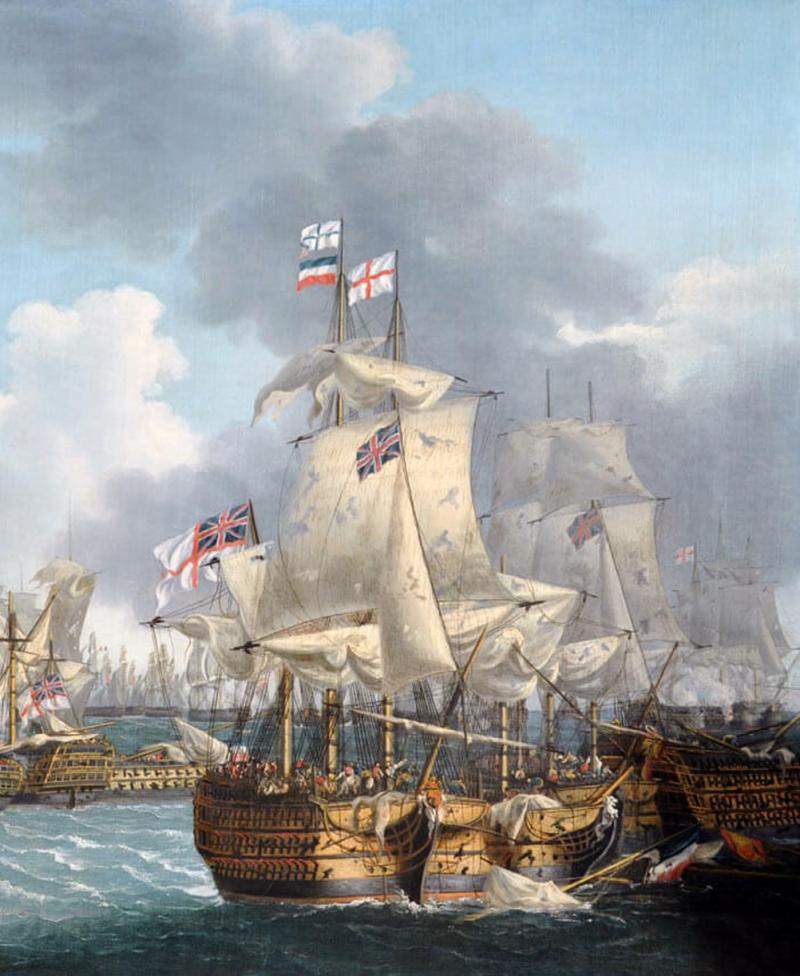
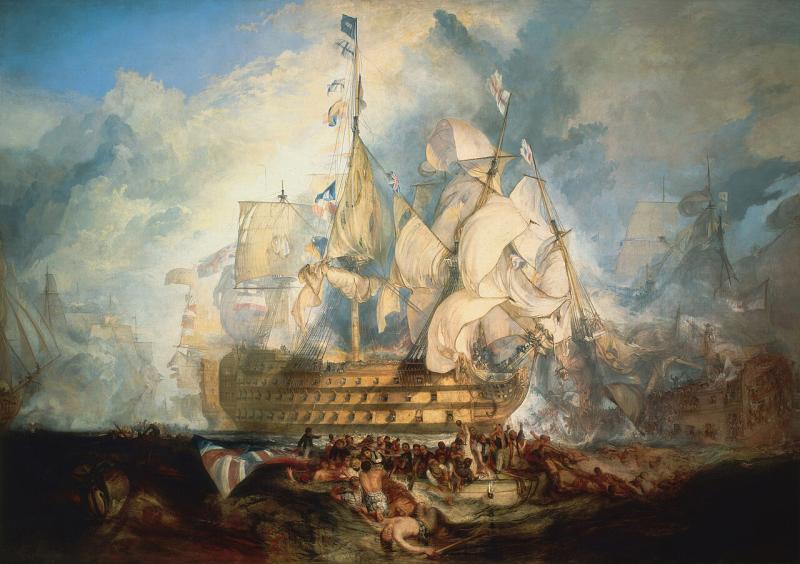
Exactly as issued and used by all the British Ship's-of-the-Line, at the Battle of Trafalgar in 1805.
Such as;
HMS Victory,
HMS Temeraire,
HMS Dreadnought,
HMS Revenge,
HMS Agamemnon,
HMS Colossus
HMS Leviathan &
HMS Achilles.
Some of the most magnificent ships, manned by the finest crews, that have ever sailed the seven seas.
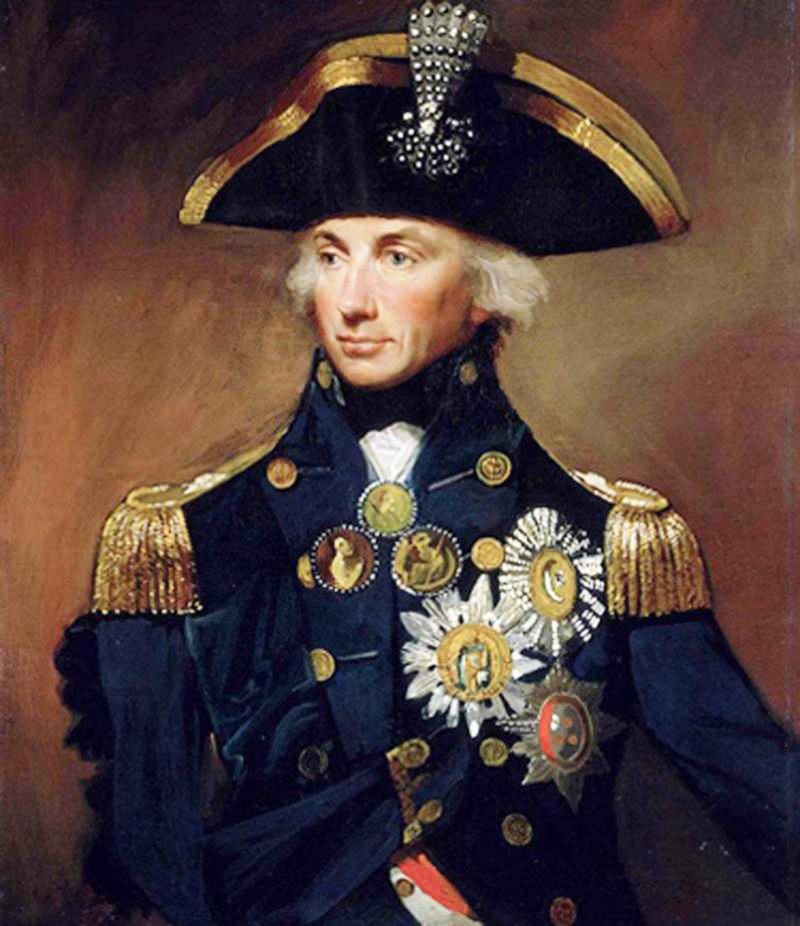
Battle of Trafalgar, (October 21, 1805), naval engagement of the Napoleonic Wars, which established British naval supremacy for more than 100 years; it was fought west of Cape Trafalgar, Spain, between Cádiz and the Strait of Gibraltar. A fleet of 33 ships (18 French and 15 Spanish) under Admiral Pierre de Villeneuve fought a British fleet of 27 ships under Admiral Horatio Nelson.
At the end of September 1805, Villeneuve had received orders to leave Cádiz and land troops at Naples to support the French campaign in southern Italy. On October 19–20 his fleet slipped out of Cádiz, hoping to get into the Mediterranean Sea without giving battle. Nelson caught him off Cape Trafalgar on October 21.
Villeneuve ordered his fleet to form a single line heading north, and Nelson ordered his fleet to form two squadrons and attack Villeneuve’s line from the west, at right angles. By noon the larger squadron, led by Admiral Cuthbert Collingwood in the Royal Sovereign, had engaged the rear (south) 16 ships of the French-Spanish line. At 11:50 AM Nelson, in the Victory, signaled his famous message: “England expects that every man will do his duty.” Then his squadron, with 12 ships, attacked the van and centre of Villeneuve’s line, which included Villeneuve in the Bucentaure. The majority of Nelson’s squadron broke through and shattered Villeneuve’s lines in the pell-mell battle. Six of the leading French and Spanish ships, under Admiral Pierre Dumanoir, were ignored in the first attack and about 3:30 PM were able to turn about to aid those behind. But Dumanoir’s weak counterattack failed and was driven off. Collingwood completed the destruction of the rear, and the battle ended about 5:00 PM. Villeneuve himself was captured, and his fleet lost 19 or 20 ships—which were surrendered to the British—and 14,000 men, of whom half were prisoners of war. Nelson was mortally wounded by a sniper, but when he died at 4:30 PM he was certain of his complete victory. About 1,500 British seamen were killed or wounded, but no British ships were lost. Trafalgar shattered forever Napoleon’s plans to invade England.
Obviously this arm has signs of combat use and the stock has minor dings. But when taken into consideration its service use, it is of little consequence compared to it's condition, which is truly exceptional, with, incredibly, absolutely not a trace of rust or corrosion on the more usually heavily pitted, steel, lock and barrel.
It still has it's original 12" barrel, which is very scarce as the barrels were shortened by official order, to 9", before the Napoleonic wars. The rammer is present and in place, but swollen en situ, so we have not attempted to remove it.
Code: 26266