

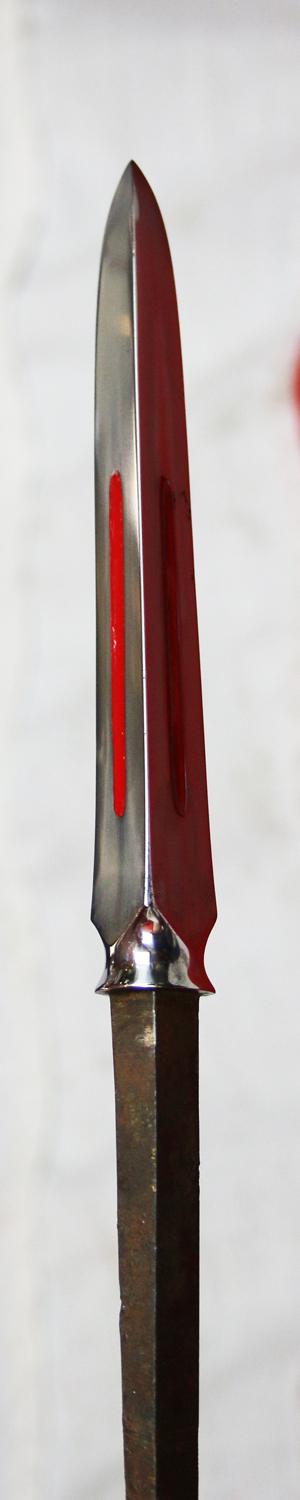
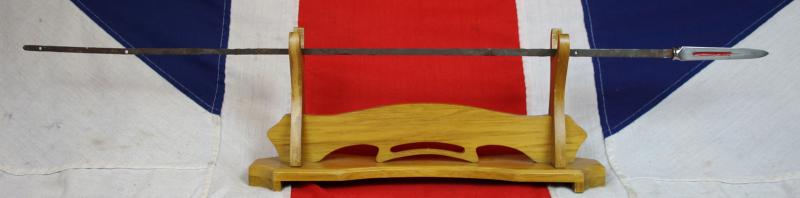
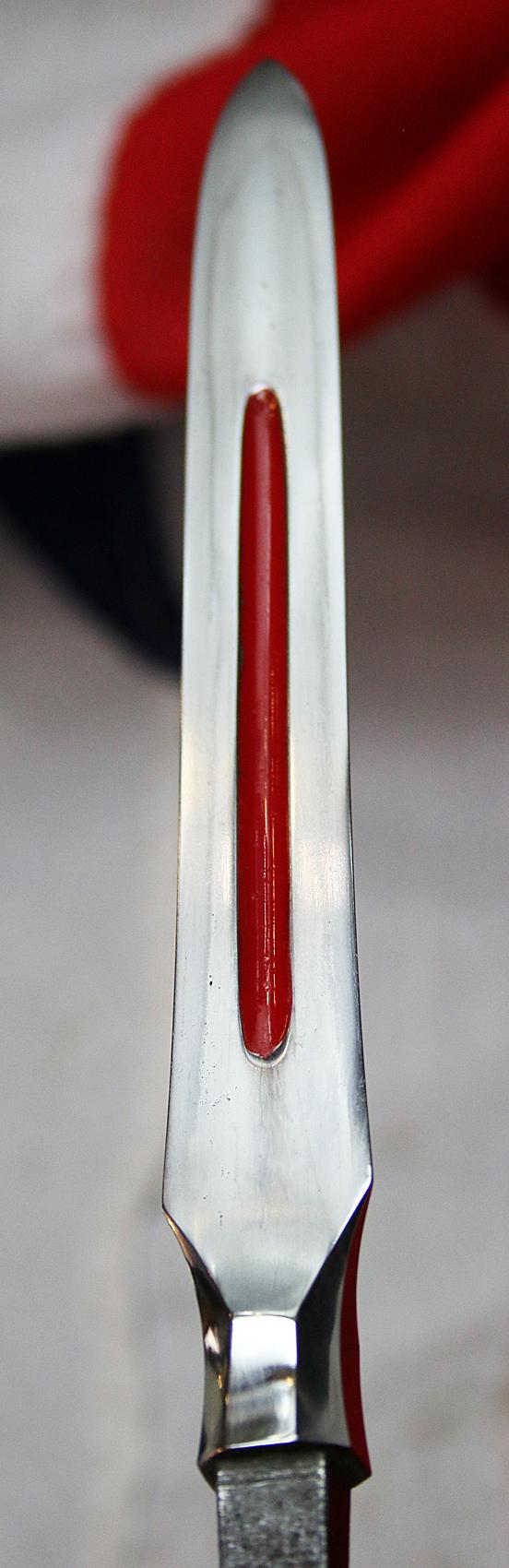
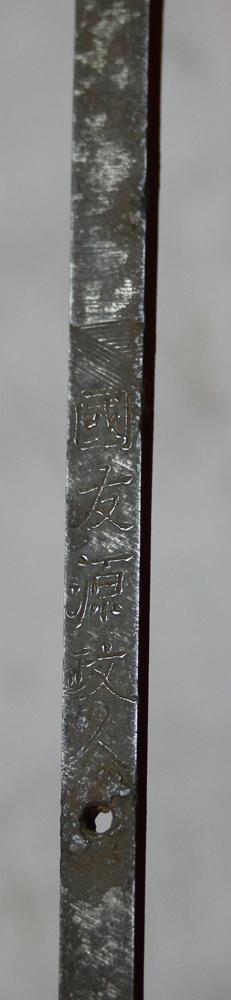
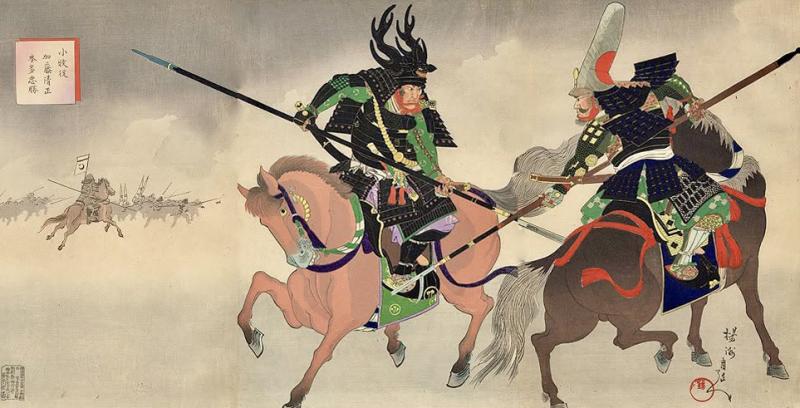
From the Roald Knutsen Collection. A Shinto Horseman's Yari Long Spear Blade By Kunitomo Minamoto No Masahisa Circa 1660 to 1680. in Superb Condition with fine Suguha Hamon, and Three, Horimono Cut Bo-Hi {Fullers} Decorated with Red Lacquer
A super antique samurai's combat pole arm blade Hira Sankaku Yari with a three sided bo hi blade in the form of an Isosceles triangle with a very sharp point and two sharp edges on a sockle, in beautiful polish, with narrow suguha hamon, and its very long, signed, full, extra length tang especially designed as a samurai horseman's yari, for additional strength, and to stop a sword from cutting through its haft. With three mounting ana {peg holes}
Ideal for use by samurai both on foot and horseback, but especially effective as a horseman's yari, with armour piercing blade.
Yari is the Japanese term for a spear, but technically it is actually a lance, or more specifically, the straight-headed lance.
Red Painting (Lacquer): Historically, the deep recessed grooves of Bo-hi and Triple-hi on a Yari were often lacquered in bright red (shu-urushi). This prevented rust in areas that were hard to clean and provided a striking, aggressive visual accent on the battlefield.
The martial art of wielding the yari is called sojutsu. A yari can range in length from one metre to upwards of six metres (3.3 to 20 feet). The longer versions were called omi no yari while shorter ones were known as mochi yari or tae yari. The longest versions were carried by foot troops (ashigaru), while samurai usually carried a shorter yari , up to around 8 feet long, such as this example. Yari are believed to have been derived from Chinese spears, and while they were present in early Japan's history they did not become popular until the thirteenth century.
The original warfare of the bushi was not a thing for "commoners"; it was a ritualized combat usually between two warriors who may challenge each other via horseback archery and sword duels. However, the attempted Mongol invasions of Japan in 1274 and 1281 changed Japanese weaponry and warfare.
The Mongol-employed Chinese and Korean footmen wielded long pikes, fought in tight formation, and moved in large units to stave off cavalry. Polearms (including naginata and yari) were of much greater military use than swords, due to their much greater range, their lesser weight per unit length (though overall a polearm would be fairly hefty), and their great piercing ability. Swords in a full battle situation were therefore relegated to emergency sidearm status from the Heian through the Muromachi periods. Around later half of sixteenth century, ashigaru holding pikes (naga yari) with length of 4.5 to 6.5 m (15 to 22 feet) or sometimes 10 m became main forces in armies. They formed lines, combined with harquebusiers and short spearmen. Pikemen formed two or three row of line, and were forced to move up and down their pikes in unison under the command.Yari overtook the popularity of the daikyu for the samurai, and foot troops (ashigaru) used them extensively as well
Various types of yari points or blades existed. The most common blade was a straight, flat, design that resembles a straight-bladed double edged dagger. This type of blade could cut as well as stab and was sharpened like a razor edge. Though yari is a catchall for spear, it is usually distinguished between kama yari, which have additional horizontal blades, and simple su yari (choku-so) or straight spears. Yari can also be distinguished by the types of blade cross section: The triangular sections were called sankaku yari and hira sankuku, the latter for Isosceles of two equal sides as opposed to three.
It was formerly part of the collection of sensei Roald Knutsen, likely the worlds foremost expert and author on samurai polarms and their use in combat, with various pieces acquired with, or from, Henry Russell Robinson's private collection. (7 May 1920, Hackney, London - 15 January 1978) He became Keeper of Armour at The Tower Of London The Japanese armour exhibition in 1965, which featured samurai artefacts arranged to demonstrate evolving defensive technologies and cultural contexts, drawing thousands of visitors to the Tower.
He was a British military armourer and historian.He served in the RAF during the Second World War making models interpreting aerial photographs. This was when he met Sir James Mann, Master of the Armouries at the Tower of London. Robinson joined the staff of the Tower Armouries in 1946 as a Temporary Assistant, before rising to Assistant Keeper and finally, in 1970, Keeper of Armour.
Robinson was a founder member and president of the Arms and Armour Society. In 1965, he was elected a Fellow of the Society of Antiquaries of London. In 1977, he was awarded an honorary MA by the University of Newcastle upon Tyne.
Between 1967 and 1969, he (a practical armourer) worked with Charles Daniels to interpret and reconstruct the Roman armour nowadays known as 'lorica segmentata'. He produced a series of reconstructions of the two sub-types of armour from the Roman site at Corbridge and one from Newstead in time for them to be exhibited at the 1969 Congress of Roman Frontier Studies held in Cardiff.
His work on the armour featured in one of his best-known books, The Armour of Imperial Rome. Published in 1975 by Lionel Leventhal at the Arms and Armour Press, it included line illustrations by his friend, Peter Connolly. Robinson's system of categorizing Roman helmets has been widely adopted in the UK and USA but never really found favour in Europe.
Robinson was not only known for Roman armour, since he worked on an exhibition of Japanese armour at the Tower Armouries and subsequently wrote two books on the subject. He was also an authority on Native American artefacts and was responsible for the production of the replica of the revised reconstruction of the Sutton Hoo helmet and wrote a guide to the Stibbert Museum.
32.25 inches long overall, blade 4.5 inches long
Code: 26267
1895.00 GBP