

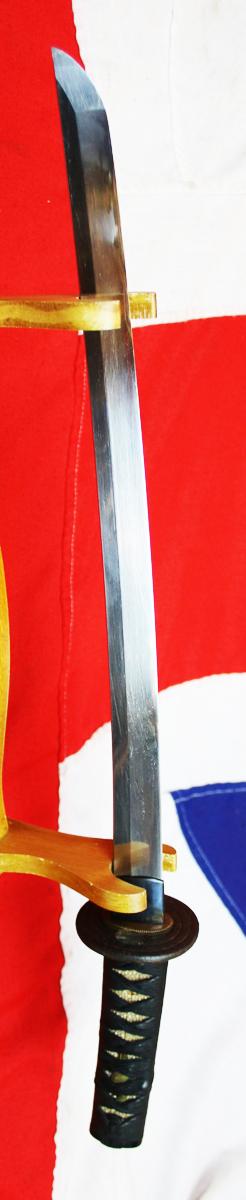
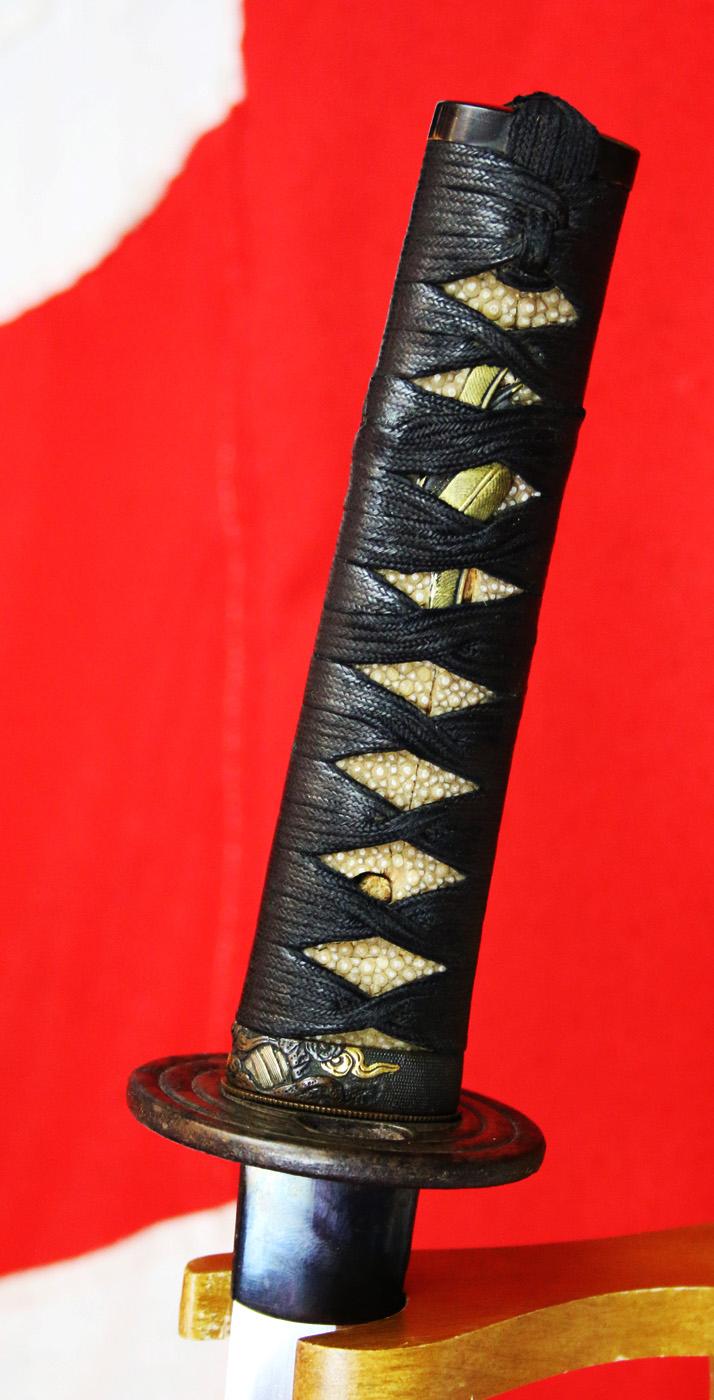
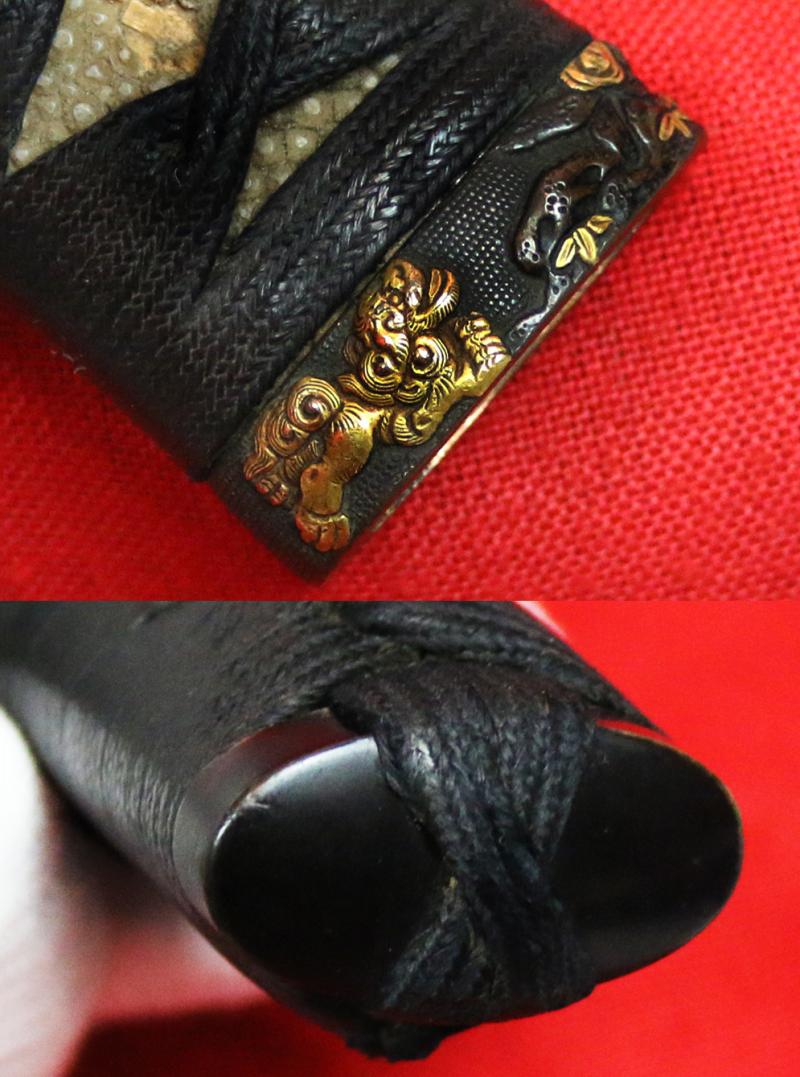
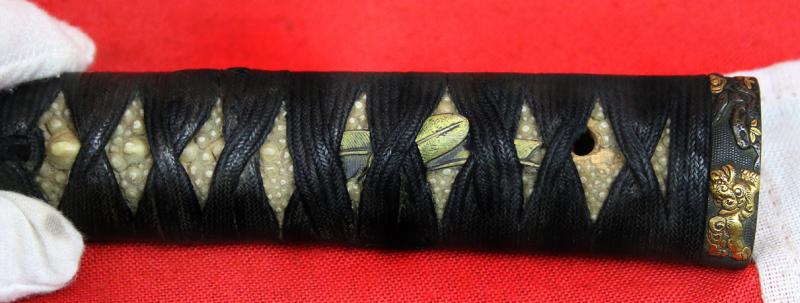
A Good Koto Period Circa 1500 Wakazashi Mounted In All Original Edo Period Koshirae {Mounts} With Gold and Shakudo Fuchi of a Lion Dog. Higo School Tettsu Tsuba, of a Coiled Rope Design Kanshirō's Style & Superb Pine-Needle Urushi Lacquer Saya
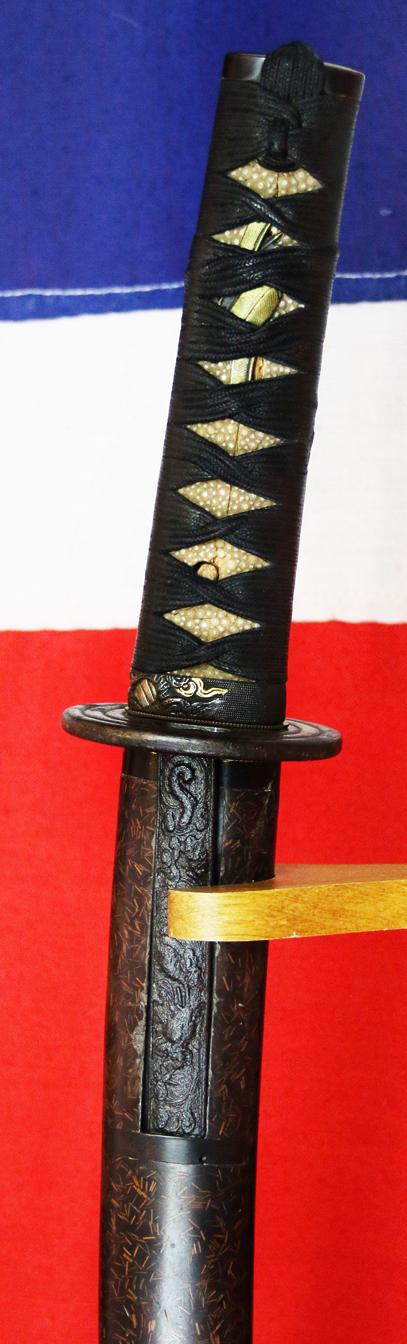
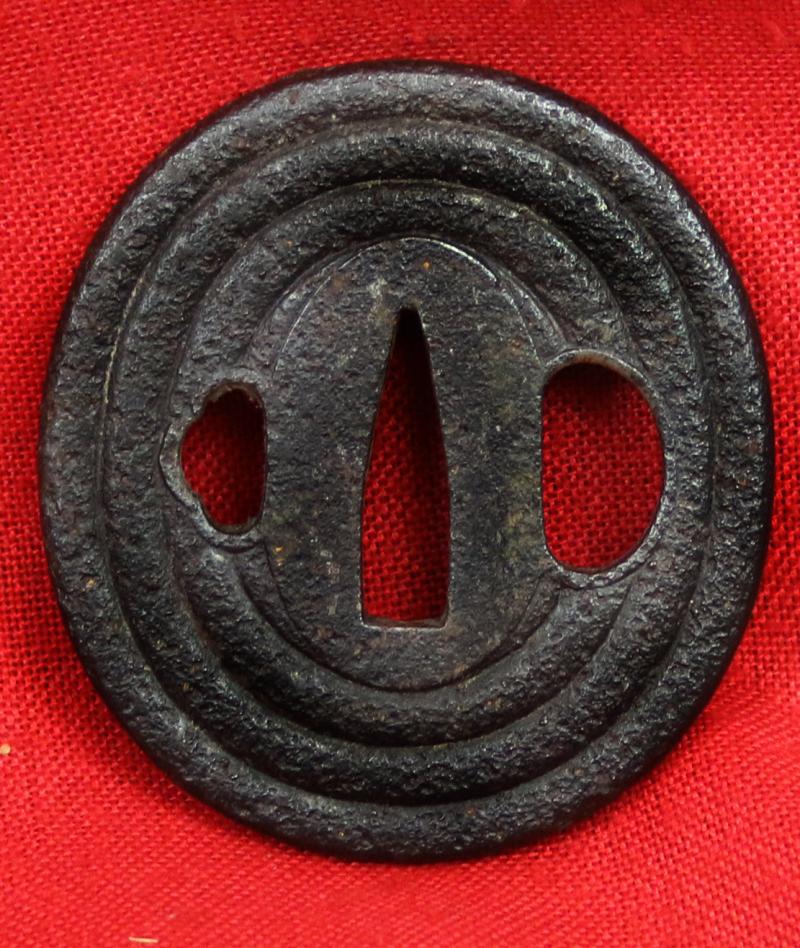
A fine wakizashi, mounted in all original Edo koshirae including a 17th century Higo School iron tsuba, with a distinct Kanshiro influence, carved with three tekebori circles representing coiled rope, and under the original Edo black tsuka-ito, wrapped over traditional samegawa {giant rayskin} are a pair of menuki, representing gold feathers. Carved buffalo horn kashira and a superb Edo shakudo and gold fuchi with takebori Shi-shi {lion dogs} and billowing clouds over a fine nanako ground of shakudo. A good Edo kozuka (utility side knife) of a takebori dragon, in iron, Higo school
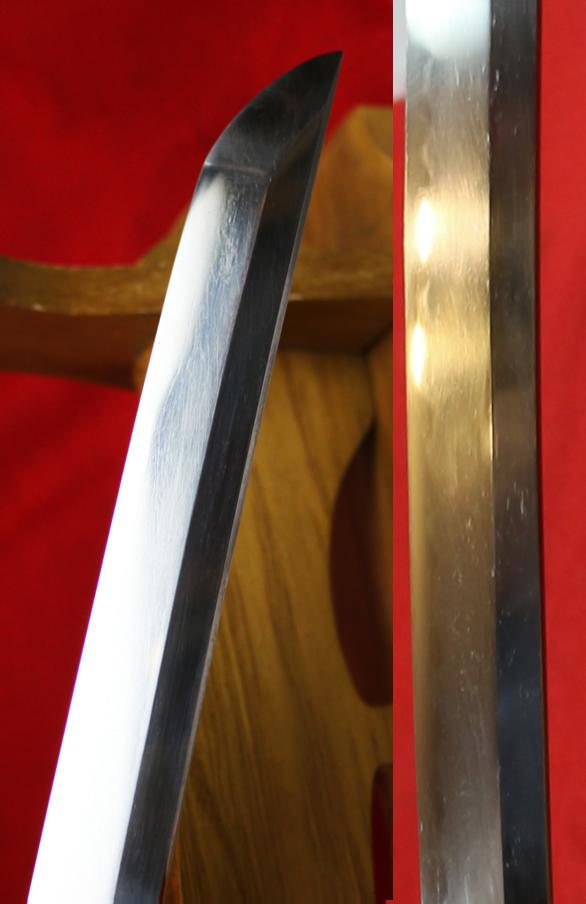
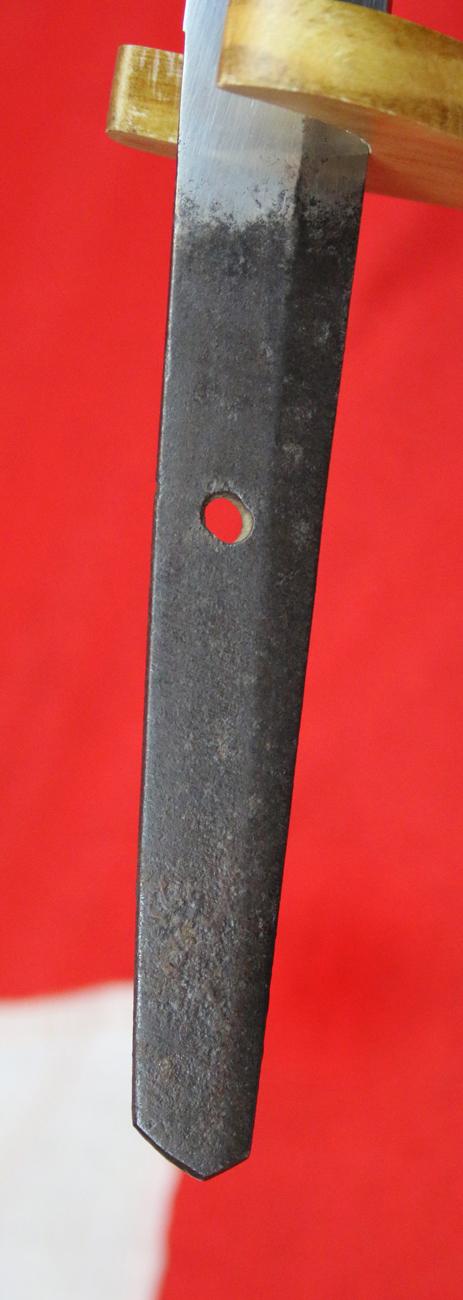
A good early 500 year old blade, with, as to be expected, natural age surface wear, and light elements of the usual surface thinning prevalent with ancient blades, with an undulating notare gunome hamon and a fine patinated shakudo habaki.
The saya is stunning highest quality pine-needle urushi lacquer with buffalo horn fittings {kurigata}
The saya is created with a base of black lacquer, applied with a highly complex decorative design pattern of fallen pine needles, laid upon the black urushi lacquer, in a seemingly random pattern. But, in reality each pine needle was strategically placed upon them, when creating the decorative finish, with a tweezer type instrument, and just a single needle, just one at a time, in order to give the impression they fell naturally upon the ground from a pine tree above.
The surface was then lacquered, with many coats, in clear, transparent urushi lacquer, in order to create a uniform smooth surface, in the Edo period it would take anything around a year or more to create a samurai sword saya, as the urushi lacquer coating would be anything up to 12 coats deep, and each would take a month to dry as they were made using on natural materials, not modern quick drying synthetic cellulose lacquers as used today.
The first-generation Kanshirō was the younger brother of a Shinto priest serving at the inner and outer shrines in Futamata village, Tango Province. During the Hosokawa family’s time in Buzen Kokura, he became a disciple of Hirata Hikozō. When the Hosokawa clan was transferred to Kumamoto, he accompanied Hosokawa Sansai and settled in Yatsushiro, Higo Province. After Sansai’s death, he moved to Kumamoto, where he received a stipend of twelve persons’ allowance from the Hosokawa family.
Born in Keichō 18 (1613), he died in Genroku 6 (1693) at the age of eighty-one. All of his works are unsigned, and he produced tsuba and fuchigashira using both iron and soft-metal alloys.
This tsuba represents one aspect of the first-generation Kanshirō’s style, employing a design in the manner of Hikozō. The hitsu-ana on one side is shaped in the suhama form, further revealing the influence of Hikozō.
It has been over one thousand years ago that the art of making swords appeared in Japan. The swordsmiths of the time may not have known it but they were creating a legendary sword. The Samurai sword has seen combat in many battlefields. From the early days of the Samurai warrior to the fierce battles in the South Pacific during WWII.
From the earliest days hand-made traditional the Samurai sword was unique because it was forged using the finest skills known to man. A tremendous amount of work was dedicated to creating these pieces. They were an instrument of war as much as a beautiful artifact to adorn any decor.
As once told to us by an esteemed regular visitor to us here in our gallery, Victor Harris {the most eminent sword expert in Europe, and sword curator of the British Museum} and his same words that are repeated in his book, see below;
“In these textures lies an extraordinary and unique feature of the sword - the steel itself possesses an intrinsic beauty. The Japanese sword has been appreciated as an art object since its perfection some time during the tenth century AD. Fine swords have been more highly prized than lands or riches, those of superior quality being handed down from generation to generation. In fact, many well-documented swords, whose blades are signed by their makers, survive from nearly a thousand years ago. Recognizable features of the blades of hundreds of schools of sword-making have been punctiliously recorded, and the study of the sword is a guide to the flow of Japanese history.”
Victor Harris
Curator, Assistant Keeper and then Keeper (1998-2003) of the Department of Japanese Antiquities at the British Museum. He studied from 1968-71 under Sato Kenzan, Tokyo National Museum and Society for the Preservation of Japanese Swords
For those that have interest in original Japanese swords, to acquire one of our original historic samurai swords is a perfect way to have a superbly made original hand made sword, ancient or antique, that it mounted in original Japanese fittings of the early samurai form of katana.
Compared to a modern day, original blade made today in Japan; Authentic, currently, modern hand-made nihonto (Japanese sword blades) from licensed swordsmiths in Japan today, typically start around $10,000–$25,000 for a katana, with prices often exceeding $60,000 for renowned top-tier sword masters or customized commissions.
These blades, forged from tamahagane steel, require 12+ months to create due to strict legal limits on production, with some high-end, custom pieces from master smiths such as Yoshindo Yoshihara exceeding $10,000 for smaller tanto blades.
A brand new, katana blade from a reputable but lower ranked smith usually starts around $7,500–$10,000.
Every single item from The Lanes Armoury is accompanied by our unique Certificate of Authenticity. Part of our continued dedication to maintain the standards forged by us over the past 100 years of our family’s trading, as Britain’s oldest established, and favourite, armoury and gallery
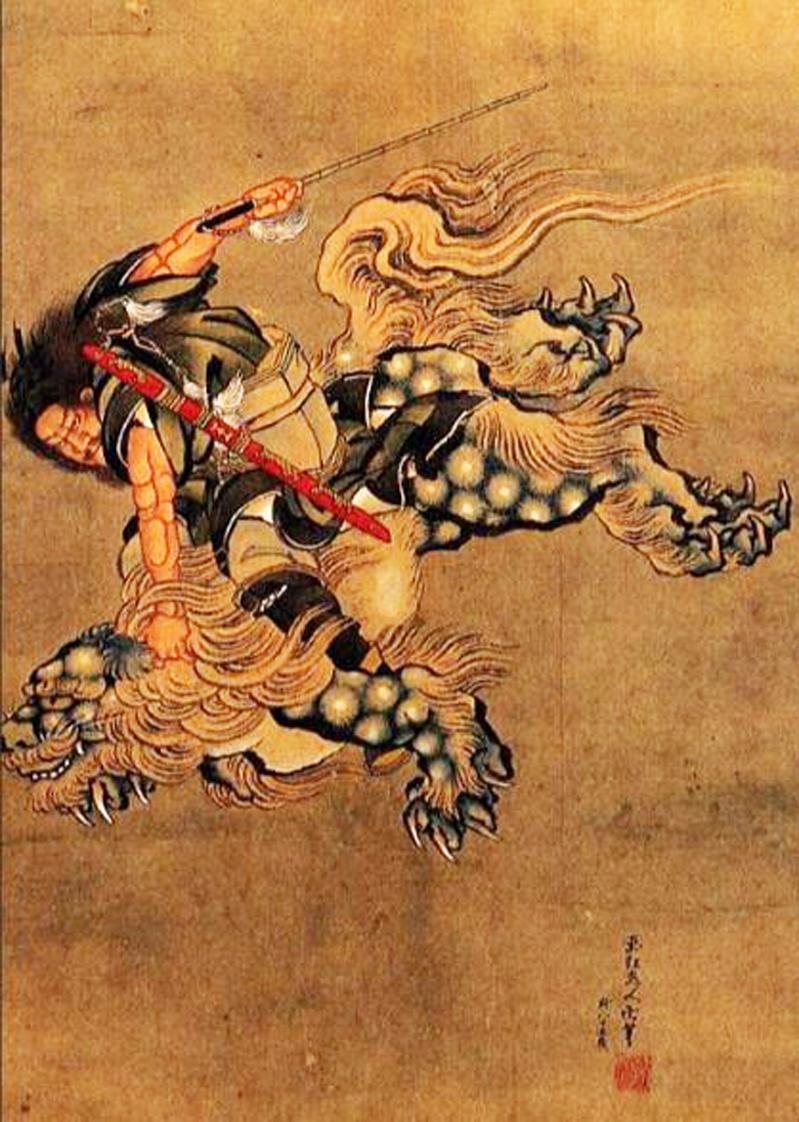
Ukiyo-e Japanese woodblock art print of Hokusai Shoki Riding A Shishi Lion
blade 16.75 in.,
Code: 26270
4695.00 GBP