
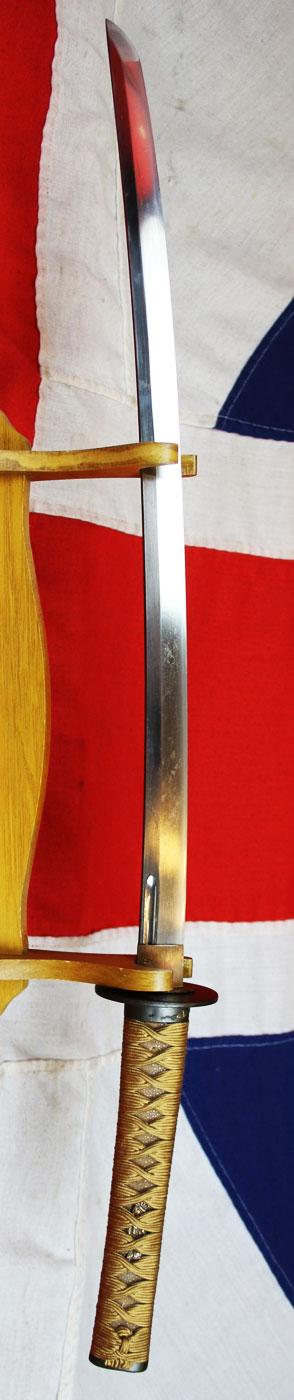

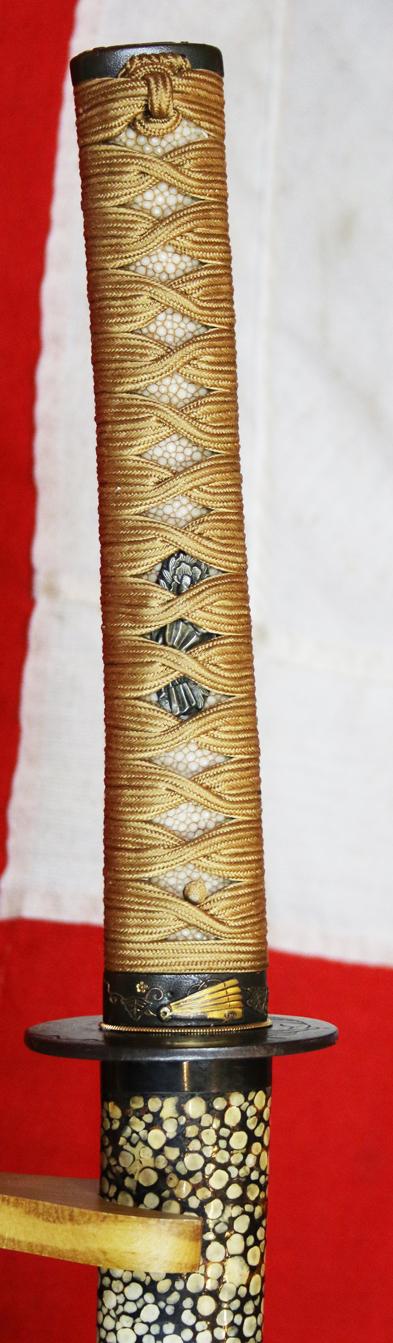
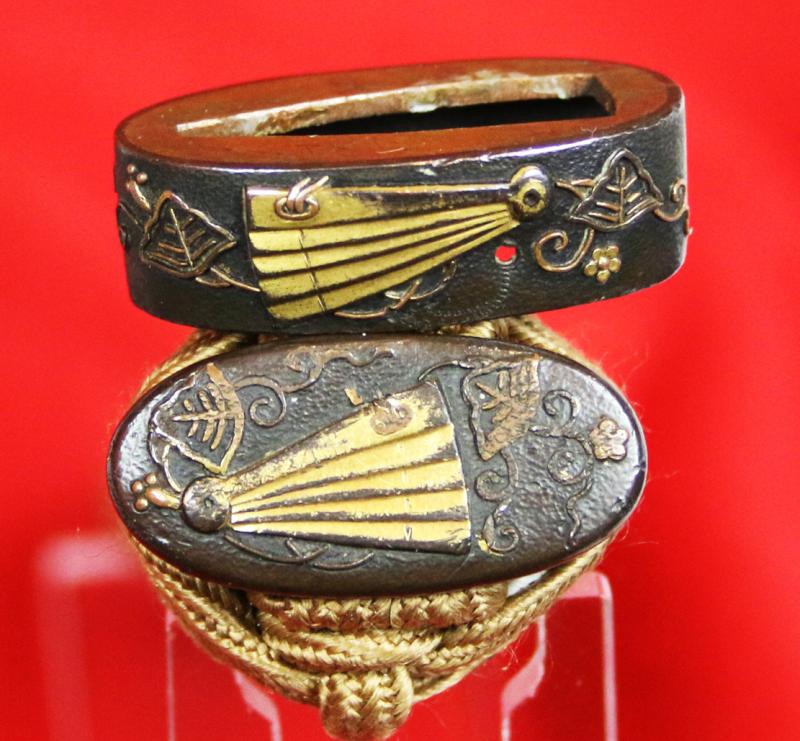
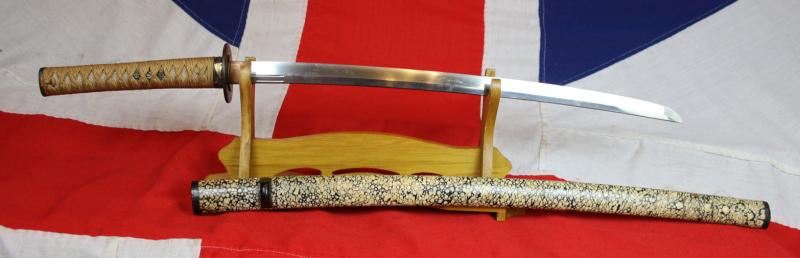


A Beautiful 15th Century Chisa Katana Sword, Around 600 Years Old, Signed Nobukuni. From The Japanese Warring States Period. Gold Fan & Shakudo Fuchigashira and Polished Samegawa Saya.
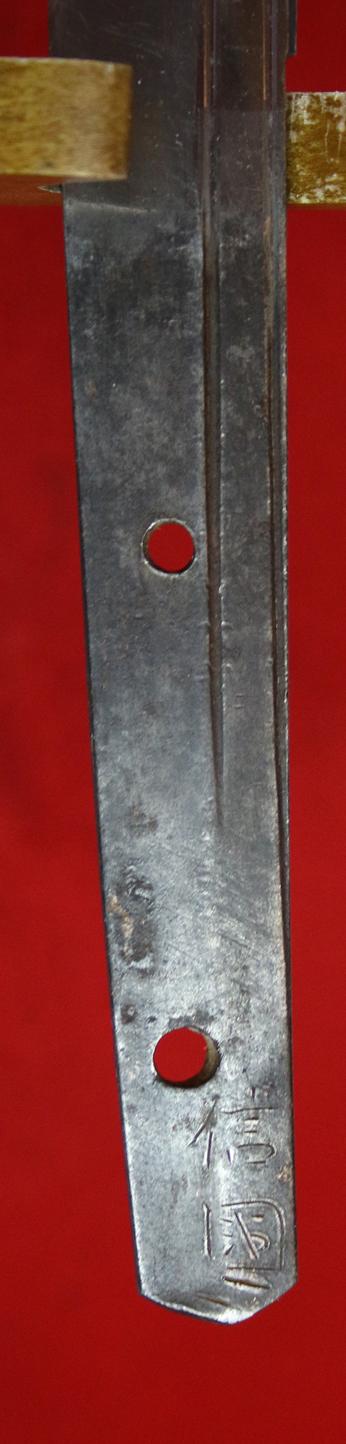
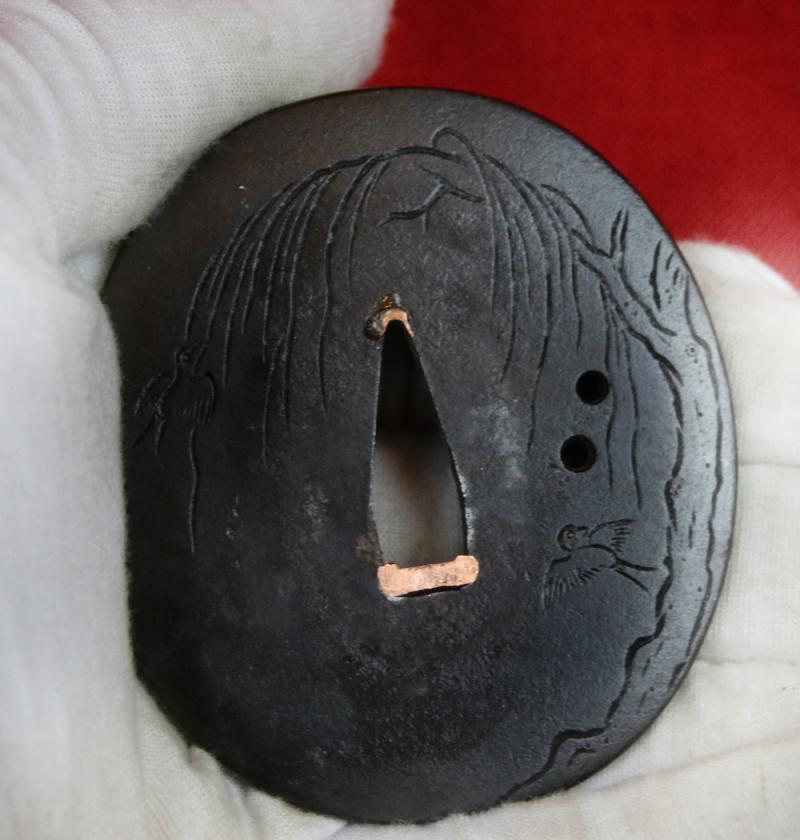
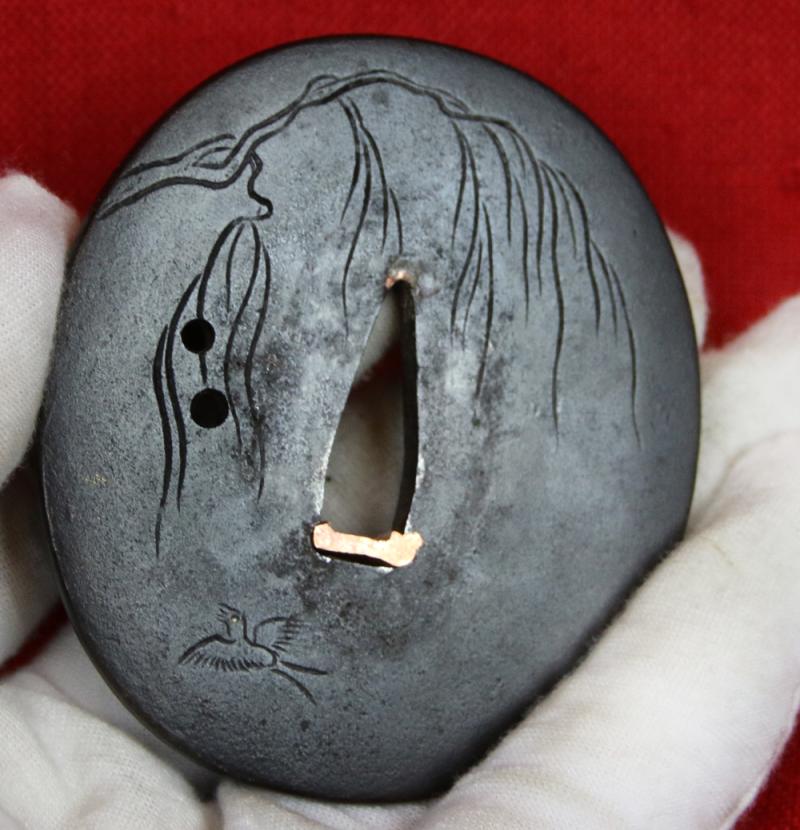
Circa 1430. A samurai sword chisa-katana, with an early signed blade, on-zukuri, o-suriage nakago with two-character mei (Nobukuni), with a fine suguha hamon typical of the Koto era, in old polish, with usual light wear marks. A beautiful Edo fuchi kashira of gold and shakudo, depicting folded fans of pure gold onlaid to shakudo. A large dark round tettsu tsuba likely Yokoya School, 19th century of circular form, engraved in katakiri and kebori with flying cranes beneath a willow tree.
Nobukuni Sadamitsu who is a son of third generation of Kyo Nobukuni(Saemon-no-jo) had moved to Buzen, Kyushu province during Nanbokucho period. Chikushi Nobukuni school had prospered long period till the Shinto era where master- smith Yoshida and his son Yoshisada, serving the Kuroda-han, was active.
This work was possibly made by Nobukuni-a son of Nobukuni Sadamitsu who was a master of the of Chikushi Nobukuni school. Many of his works are of the highly useful smaller sized such as chisakatana and wakazashi
The Hand Polished Giant Rayskin {Samegawa} Saya {Scabbard} is a unique feature of some of the finest antique Japanese swords. The saya was hand made and bespoke fitted to the blade, and it was then covered in the preserved skin of the giant ray, which was extremely hard and course, made up of thousands of nodules. This surface was then hand polished to create a very hard, highly polished, flat, but uneven surface, that was then over lacquered, within the separate gaps between each nodule, with purest black urushi lacquer, and then polished once more, to create a perfectly flat hardened surface of extraordinary beauty. This remarkable hand finished work, unmatched throughout the world, could take over a year of supreme expert artisan skill, in order to create.
The Chisa Katana samurai sword;
The most common blade cutting edge lengths for Chisa katana was approximately eighteen to twenty-four inches. They were most commonly made in the Buke-Zukuri mounting (which is generally what is seen on katana and wakizashi). The chisa katana was able to be used with one or two hands like a katana (with a small gap in between the hands) and especially made for double sword combat a sword in each hand.
It was the weapon of preference worn by the personal Samurai guard of a Daimyo Samurai war lord clan chief, as very often the Daimyo would be more likely within his castle than without. The chisa katana sword was far more effective a defence against any threat to the Daimyo's life by assassins or the so-called Ninja when hand to hand sword combat was within the Castle structure, due to the restrictions of their uniform low ceiling height. The hilt was usually around ten to eleven inches in length, but could be from eight inches or up to twelve inches depending on the Samurai's It has been over one thousand years ago that the art of making swords appeared in Japan. The swordsmiths of the time may not have known it but they were creating a legendary sword. The Samurai sword has seen combat in many battlefields. From the early days of the Samurai warrior to the fierce battles in the South Pacific during WWII.
The earliest samurai, that carried this beautiful masterpiece, fought in the Japan's Warring States Period, or Sengoku Jidai (c. 1467–1603) It was a tumultuous era of intense civil war, political upheaval, and social change, marked by the collapse of central authority and the rise of powerful regional lords (daimyo) fighting for control over fractured Japan.
Triggered by the Ōnin War (1467), it saw constant conflict, the introduction of firearms, castle building, and eventually, the emergence of three great unifiers—Oda Nobunaga, Toyotomi Hideyoshi, and Tokugawa Ieyasu—who gradually reunified the country after the Battle of Sekigahar
As once told to us by an esteemed regular visitor to us here in our gallery, Victor Harris, in order to study and discuss our extensive collection, and he used the same words that are repeated in his book below;
“In these textures lies an extraordinary and unique feature of the sword - the steel itself possesses an intrinsic beauty. The Japanese sword has been appreciated as an art object since its perfection some time during the tenth century AD. Fine swords have been more highly prized than lands or riches, those of superior quality being handed down from generation to generation. In fact, many well-documented swords, whose blades are signed by their makers, survive from nearly a thousand years ago. Recognizable features of the blades of hundreds of schools of sword-making have been punctiliously recorded, and the study of the sword is a guide to the flow of Japanese history.”
Victor Harris
Curator, Assistant Keeper and then Keeper (1998-2003) of the Department of Japanese Antiquities at the British Museum. He studied from 1968-71 under Sato Kenzan, Tokyo National Museum and Society for the Preservation of Japanese Swords
One of the greatest joys of sword collecting is the opportunity to learn about the history and culture of different civilisations. Swords have been used by warriors for millennia, and each culture has developed its own unique sword designs and traditions. By studying swords, collectors can gain a deeper understanding of the people who made and used them.
Another joy of sword collecting is the sheer variety of swords that are available. There are swords in our gallery from all over the world and from every period of history. Collectors can choose to specialize in a particular type of sword, such as Japanese katanas or medieval longswords, or they can collect a variety of swords from different cultures and time periods. No matter what your reasons for collecting swords, it is a hobby that can provide many years of enjoyment. Swords are beautiful, fascinating, and historically significant objects.
Collecting antique swords, arms and armour is not merely an acquisition of objects; it’s an engagement with the historical and cultural significance that these pieces embody. As collectors, we become custodians of history, preserving these heritage symbols for future generations to study and appreciate.
We are now, likely the oldest, and still thriving, arms armour and militaria stores in the UK, Europe and probably the rest of the world too. We know of no other store of our kind that is still operating under the control its fourth successive generation of family traders
Blade of 21.75, total length including saya 36 inches
Code: 26272
5450.00 GBP