
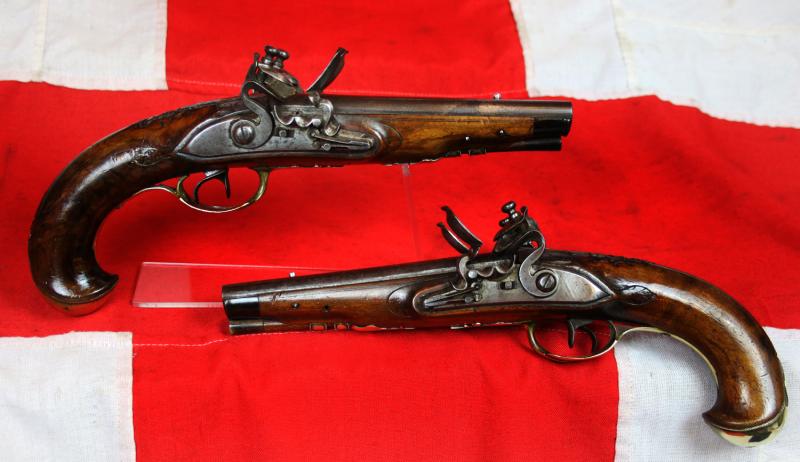
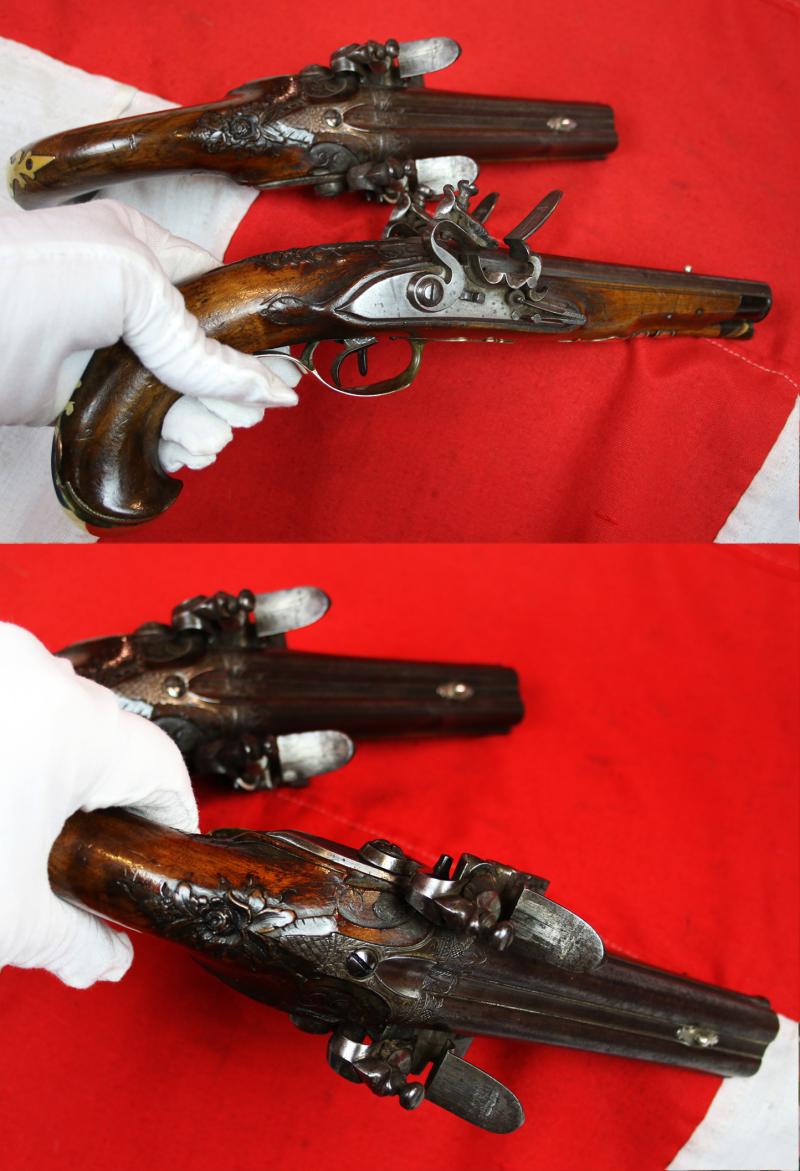
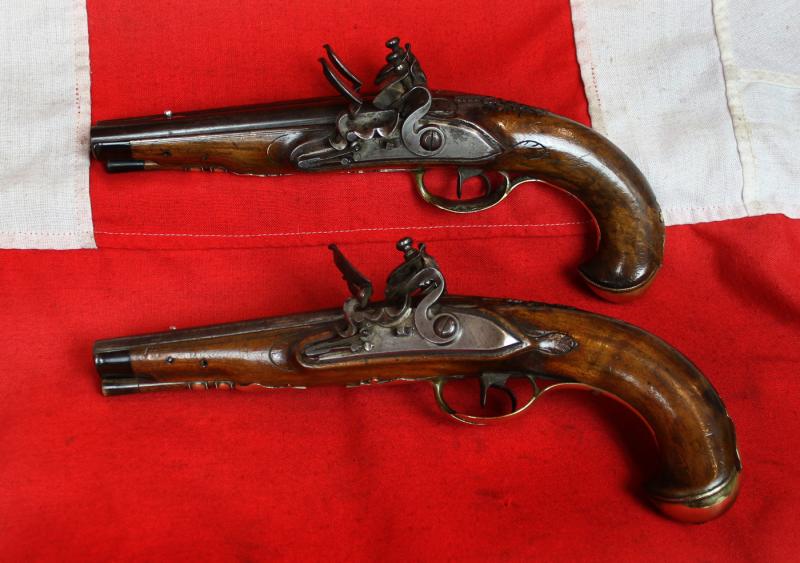
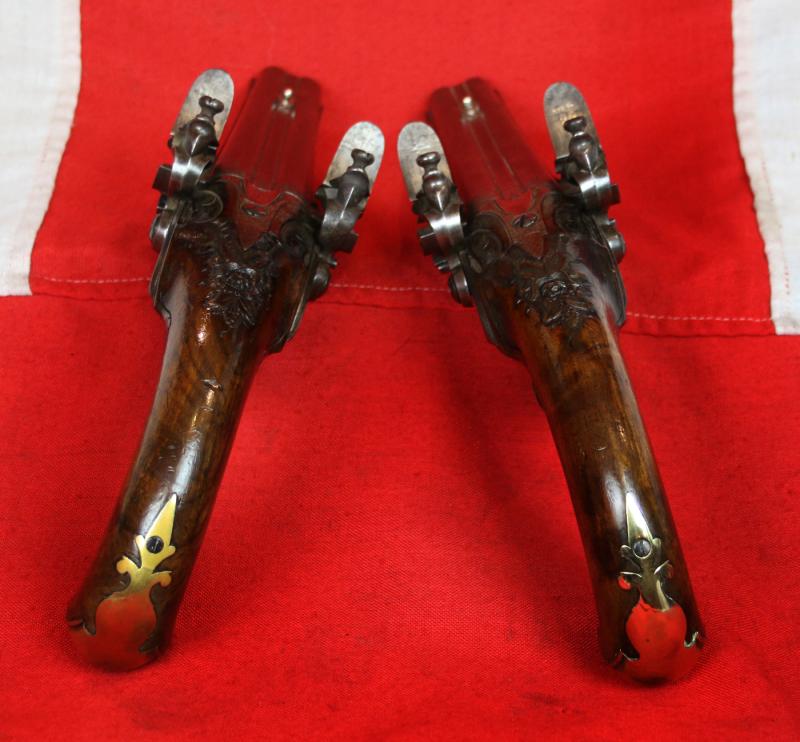
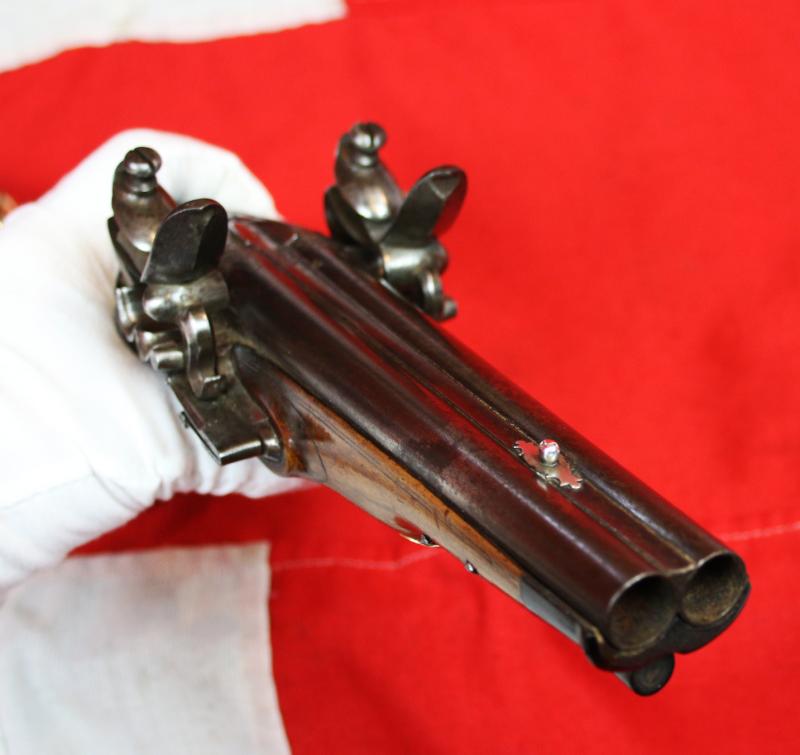
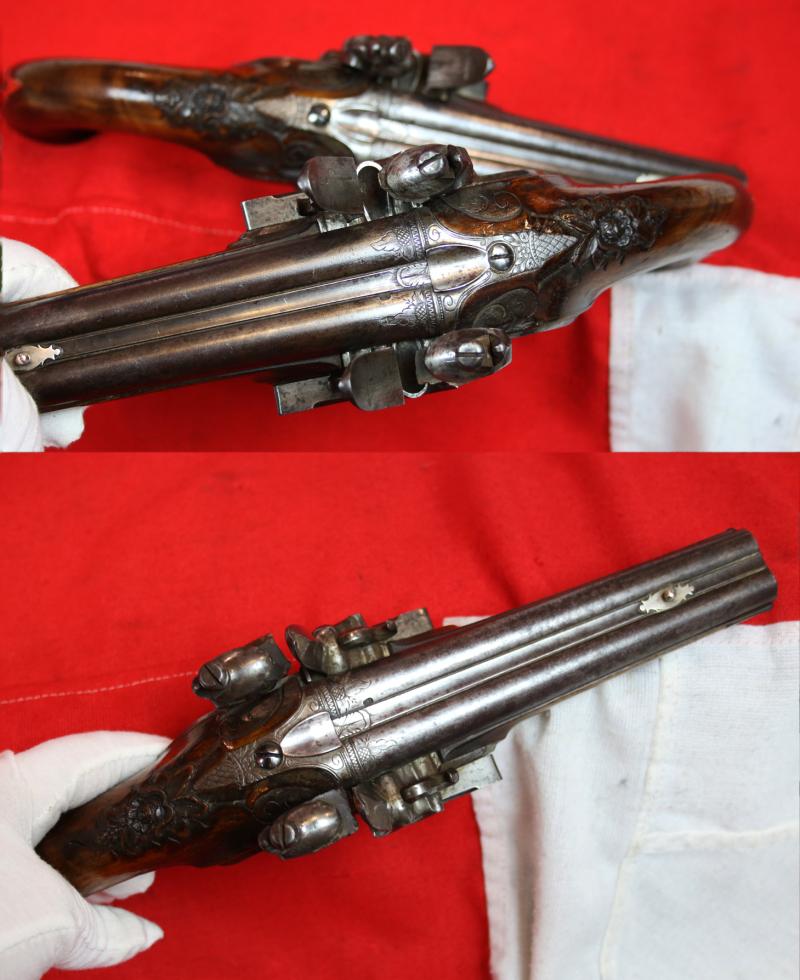
A Simply Stunning Quality 18th Century Pair of Double Barrelled Side By Side Flintlock Pistols, Most Often The Preserve of Generals During The American Revolutionary War in the 1770’s, and Generals Into the Napoleonic Period
They are truly magnificent, in superb condition for age. Made and used from the revolutionary period right through the Napoleonic Wars.
The ideal way to be armed with the firepower of a pair of pistols, in a single hand. However, with a pair of double barrelled pistols, one in each hand, one was the most formidably armed combatant, in hand to hand combat, for both attack, or defence.
The most famous historical military commander in history, Napoleon Bonaparte carried such a pair of double barrelled flintlocks, and was renowned for presenting such pairs to his great marshals and allies.
Very similar to the double barrel pistol once belonging to General Richard Montgomery, hero of the American Revolution. Similarly commissioned and created by a finest gunmaker.
There are several very fine, early, similar quality pairs of double pistols in the Metropolitan Museum, Les Invalides Napoleonic War Museum in Paris, and the Royal Collection
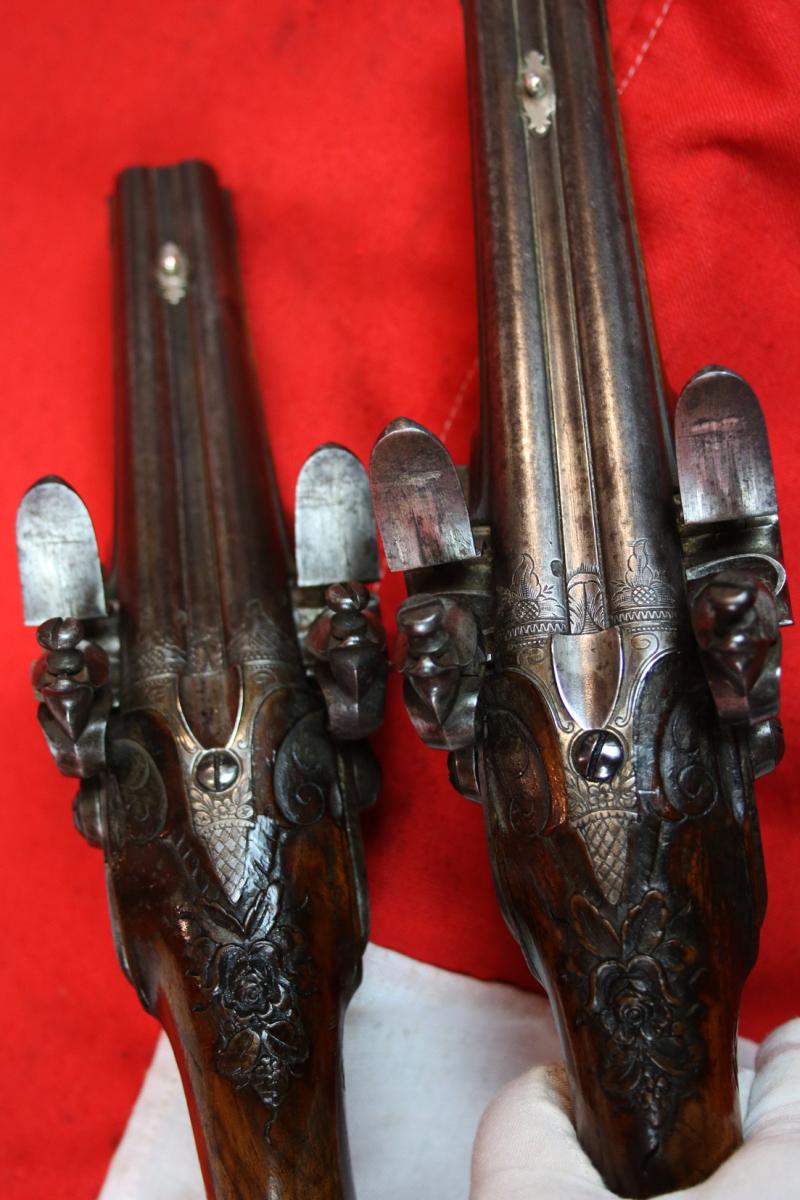
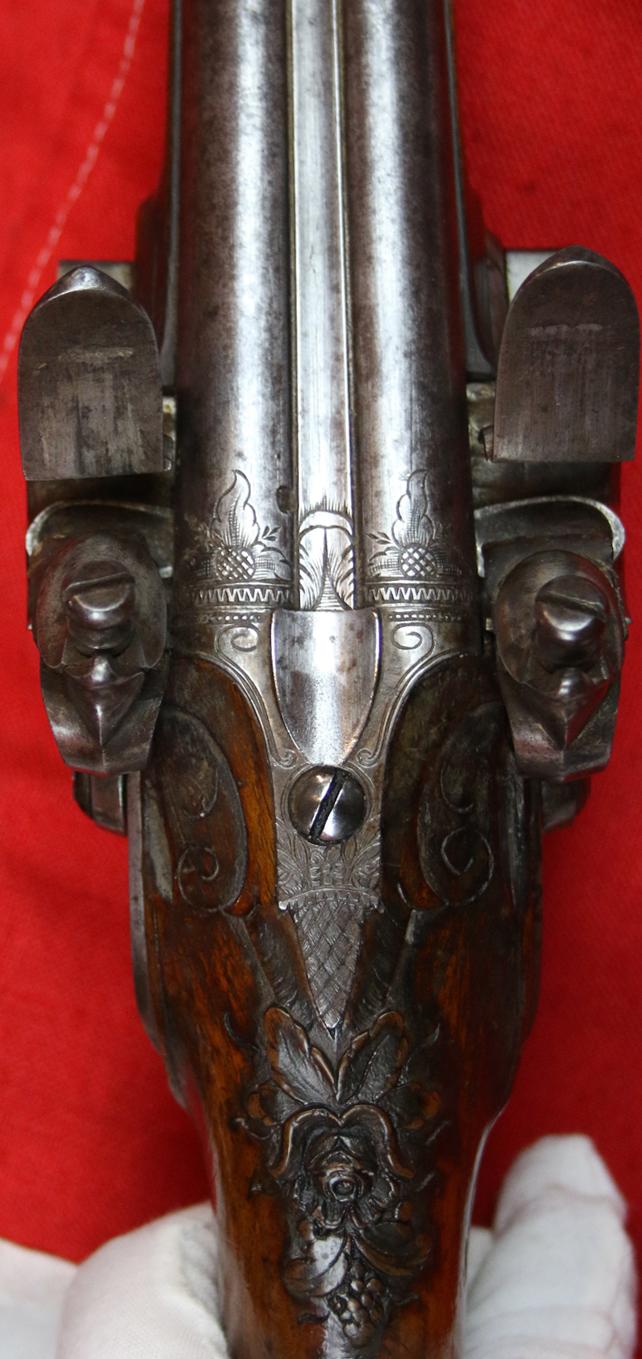
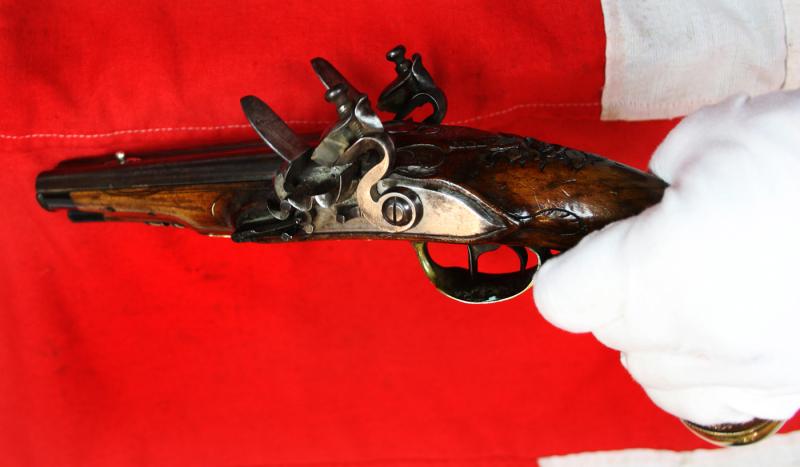
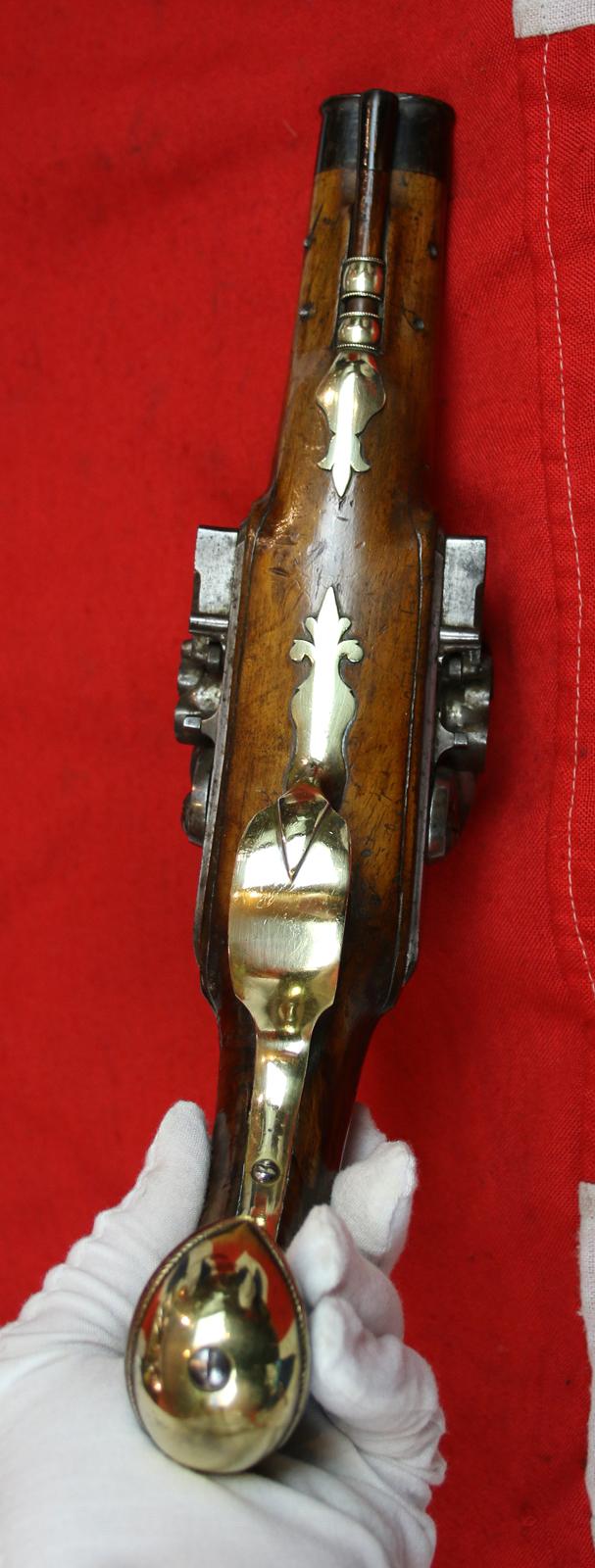
A most fine quality pair of pistols, with a fabulous carved walnut stock and brass mounts. The juglans Regis walnet had superb hand carved florid touches at the barrel breech, in the wondrous Chinoiserie style, made most famous in England by its finest cabinetmaker and designer, Thomas Chippendale.
The wonderful Chinoisserie style influenced everything from architecture, to furniture, to paintings, gun fittings, silver, and clocks.
Twin individual steel barrels. Finest flintlock actions in the most crisp and tight order. Finest scroll Chinoiserie engraving, to match the stock embellishing the steel breech mounts.
This is a stunning pair of double barrelled pistols was a form that were often chosen by the most senior or high status officers, such as the wealthiest and most influential figures, of distinguished families of the 18th century, in both England, France and America.
Such as, for example, General Sir John Cope who had similar such pistols, but decades before. He was one of the commanders of British forces fighting Charles Stuart the so-called Pretender, Bonnie Prince Charlie in Scotland. General Cope was defeated at the Battle of Prestonpans, with a force of around 2500 men, by the army of Prince Charles.
The famed possessor of a pair of double barrel flintlocks, was the aforementioned General, Richard Montgomery, who was a hero of the American Revolutionary War of 1775.
He was a gentleman of Anglo Irish descent who first served in the British Army in the Americas, but through his Whig ideals went on to become one of Washington's loyal Generals. He was on the committee that drafted the Declaration of Independence and led the army into the Invasion of Canada. He died at the Battle of Quebec, in December 1775, after capturing Montreal.
Yet another historic pair, in the fine Queen Anne style, were presented by Captain Hardy to no less a world renowned hero, Admiral Nelson, and they are in the National Maritime Collection (exhibit number E857).
They are inscribed on the silver escutcheon ‘
To Adm. Nelson from his Friend Cpt. Hardy, June 1801.’
Fine quality good size,18th century twin barrel pistols are the most highly collectable of all pistols, and highly scarce.
Chinoiserie, from 'chinois' the French for Chinese, was a style inspired by art and design from China, Japan and other Asian countries in the 18th century. At its height in Britain from 1750 to 1765, this fanciful style relied more on the designer's and craftsman's imagination than on accurately portraying oriental motifs and ornament. Chinoiserie entered European art and decoration in the mid-to-late 17th century; the work of Athanasius Kircher influenced the study of orientalism. The popularity of chinoiserie peaked around the middle of the 18th century when it was associated with the rococo style and with works by Francois Boucher, Thomas Chippendale, and Jean-Baptist Pillement. It was also popularized by the influx of Chinese and Indian goods brought annually to Europe aboard English, Dutch, French, and Swedish East India Companies.Though chinoiserie never fully went out of fashion, it declined in Europe by the 1760s when the neoclassical style gained popularity, though remained popular in the newly formed United States through the early 19th century.
As with all our antique guns no license is required as they are all unrestricted antique collectables
Code: 26292
5750.00 GBP