
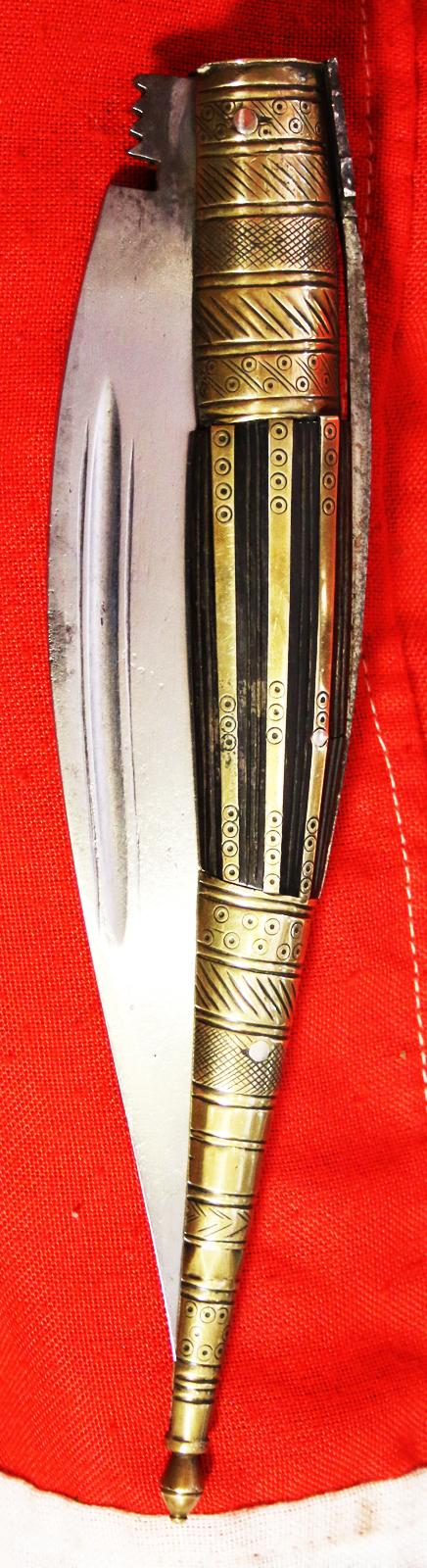
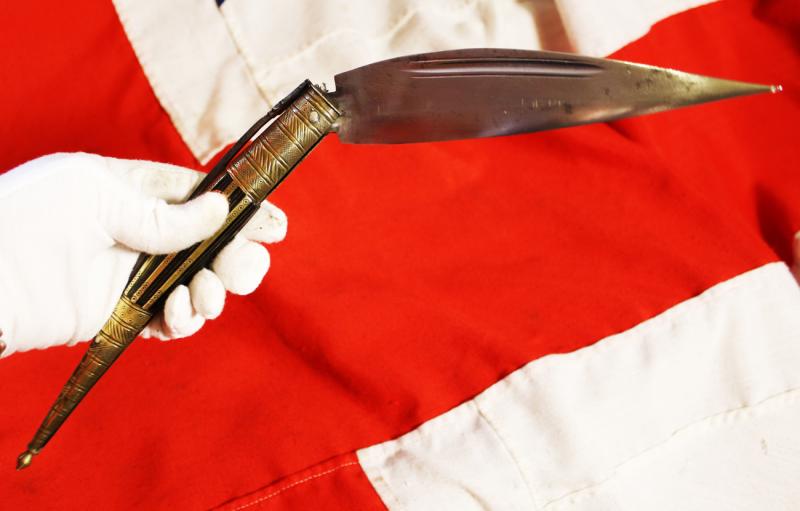
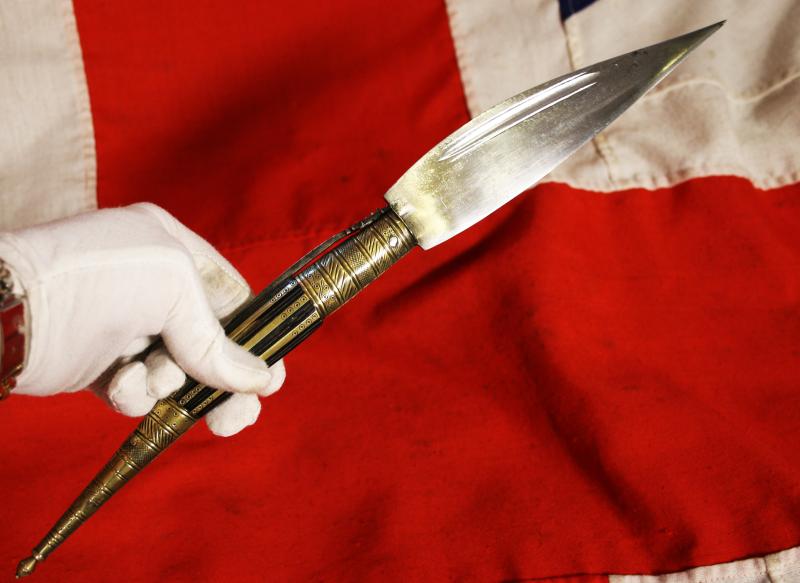
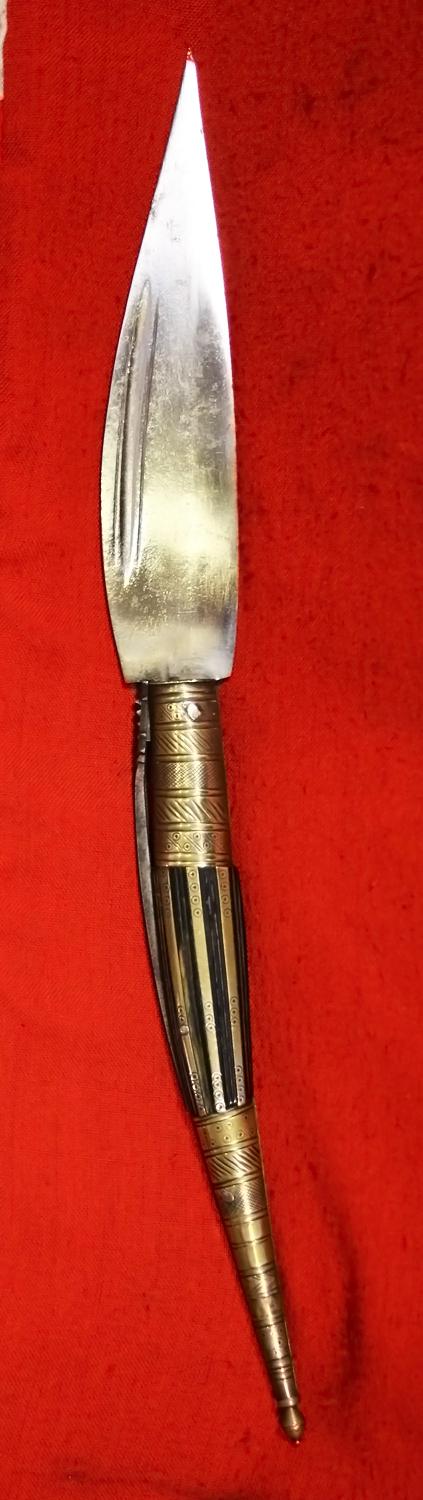
Exceptional Early 19th Century Navaja Folding Knife From Albacete. Of the Spanish Guerrilleros Who Faught Napoleon During His Invasion Of Spain In The Peninsular War. As Used In The Dos de Mayo Uprising, Madrid, Spain,1808. Against Napoleon's Occupation
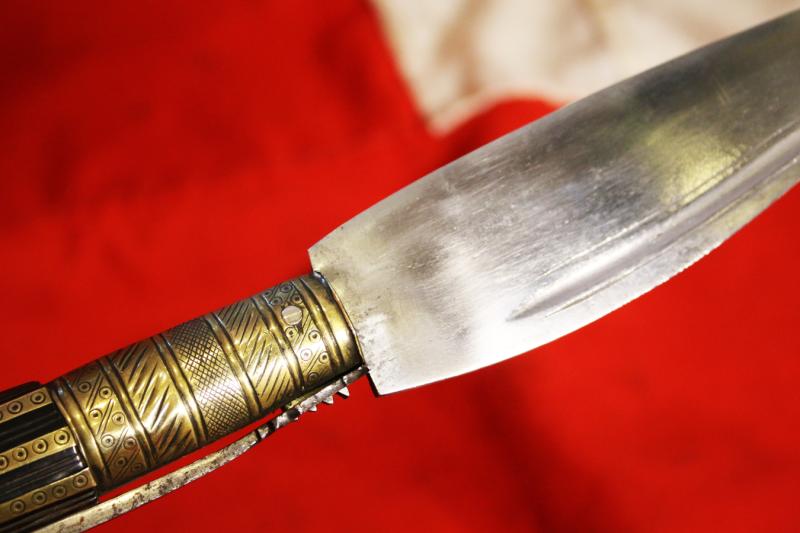
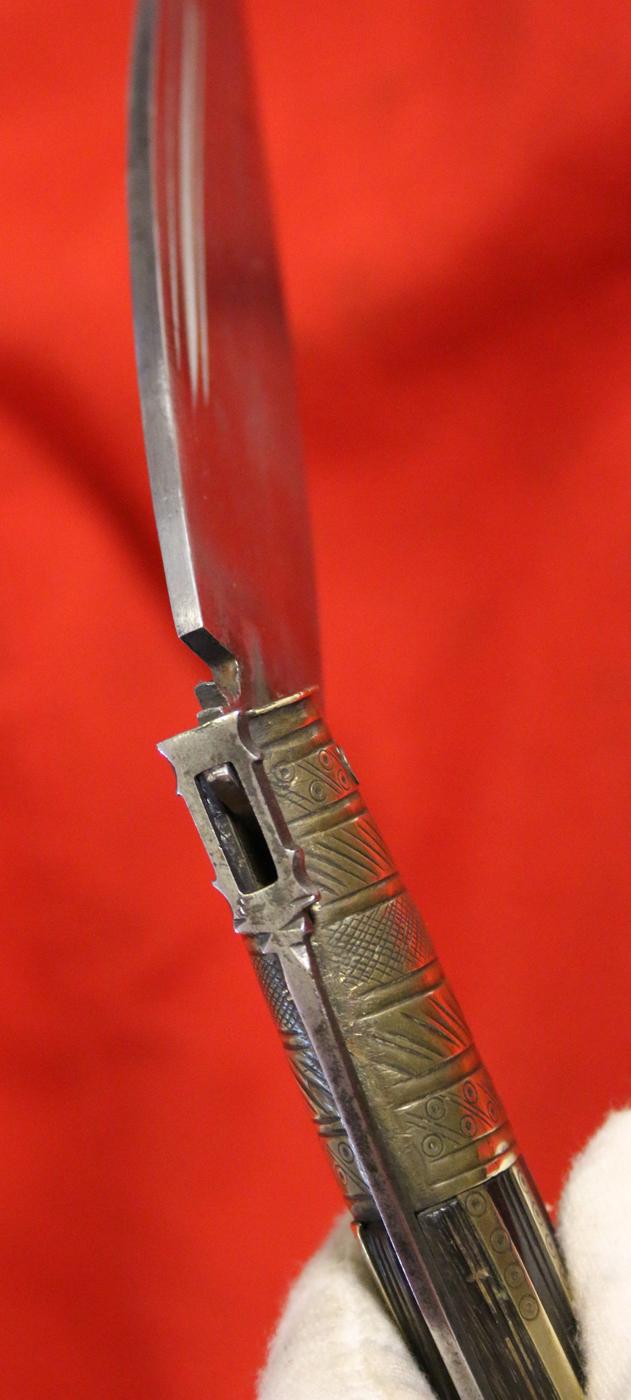
An absolutely stunning quality, original Spanish Napoleonic antique collectors item, and in great condition. With traditional elongated blade and decoratively stripe inlaid with polished black horn, swept curved grip with fine line decorated. The catch (Carraja) to be found on the authentic period pieces, features a distinctive ratchet or multiple-catch mechanism. Early 19th century. The locking spring is as good as it was when it was first made, with superbly crisp ratchets, and once locked the spring has to be manually, and strongly, lifted to release the blade for folding.
In Napoleonic Spain the carrying of the Navaja was punishable by Garotting and a pen and ink drawing by Francisco Goya is of an execution of a man, with his Navaja tied around his neck. Despite official disapproval, the navaja de muelles became popular throughout Spain as a fighting and general utility knife, and was the primary personal arm of the Spanish guerrilleros who opposed Napoleon during his invasion and subsequent occupation of Spain in the Peninsular War of 1808–1814.
Guerrilla warfare in the Peninsular War
Armed civilian actions were carried out by non-regular troops against Napoleon's French Imperial Army in Spain and Portugal during the Peninsular War. These armed men were a constant source of drain and harassment to the French army, as described by a Prussian officer fighting for the French: "Wherever we arrived, they disappeared, whenever we left, they arrived — they were everywhere and nowhere, they had no tangible centre which could be attacked."
The Peninsular War was significant in that it was the first to see a large-scale use of guerrilla warfare in European history and, partly as a result of the guerrillas, Napoleon's troops were not only defeated in the Peninsular War, but tied down on the Iberian Peninsula, unable to conduct military operations elsewhere on the European Continent. The strain the guerrillas caused on the French troops led Napoleon to dub the conflict the "Spanish Ulcer."
In the war, the Spanish Guerrillas were notorious for their torture and murder of captured French troops, demoralizing them. While folklore would often elevate the status of local heroes, many of the leading guerrilleros were actually regular army officers commanding irregular "troops".
Navajas crossed the hands and drew the blood of soldiers and sailors, rogues and ruffians, and diplomats and aristocrats both in and out of Spain's borders.
The use of the navaja fostered a mystique, not only from Seville's back streets, but also from the seedy waterfronts of Barcelona, and the cosmopolitan promenades of Madrid. Regardless of their original intent, the navaja represented the ultimate means for resolving disagreements, misunderstandings, and problems that arose in dockside bars, darkened alleys, and an untold number of places not found in any guidebook; places where there is little reliance on legal recourses; places where you either catch a glimpse of steel and live - or miss it, and never know why you died.
Defence with the navaja had been reduced to a science, which has its regular school of instruction. The teachers gave lessons with wooden knives, and the most noted among them have their private strokes, which are kept secret for cases of emergency. The arts of the most accomplished swordsman are worthless, when opposed to those of an expert with the navaja. With his cloak or jacket wrapped about his left arm, his formidable weapon glittering in his right hand, and his lithe body poised for a spring, he is an interesting study for the spectator, as well as for his antagonist. The thumb is pressed tightly along the back of the blade, that every advantage may be taken of the flexibility of the wrist, in a struggle where the space of an inch is often a matter of life and death. The postures and guards are changed with bewildering rapidity, and, should the right hand be disabled, the cloak and knife are shifted in the twinkling of an eye, and the duel proceeds, until one or both the combatants are killed.
Albacete pocket and folding knives have been famous for centuries for their quality and large size. Their origins date back to the Muslim era, with the first written references appearing in the 16th century. To this day, they remain highly prized by experts and collectors.
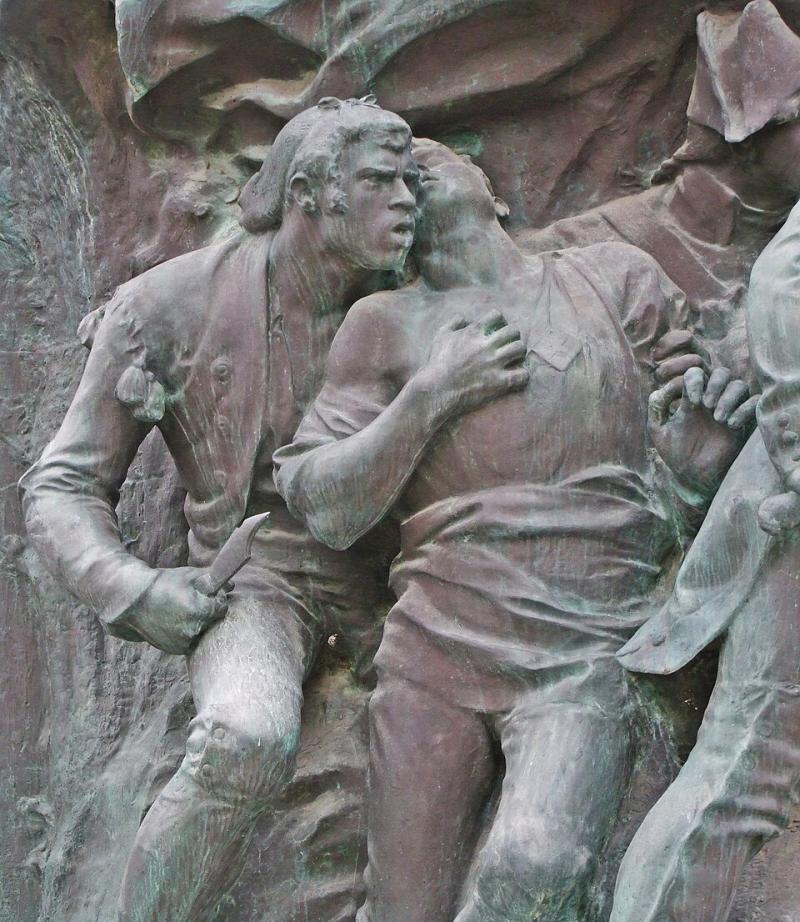
Detail view in the gallery of a war memorial statue in Jaén, Spain, depicting a dead irregular combatant held by his companion brandishing a navaja from Albacete.
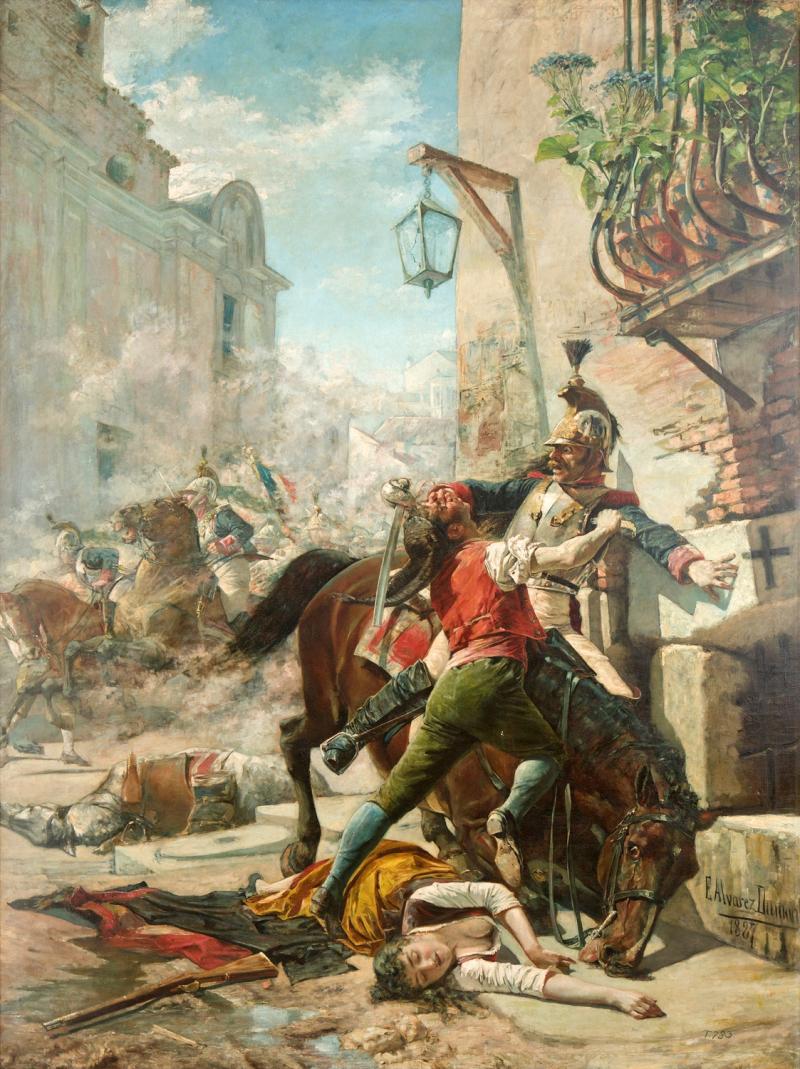
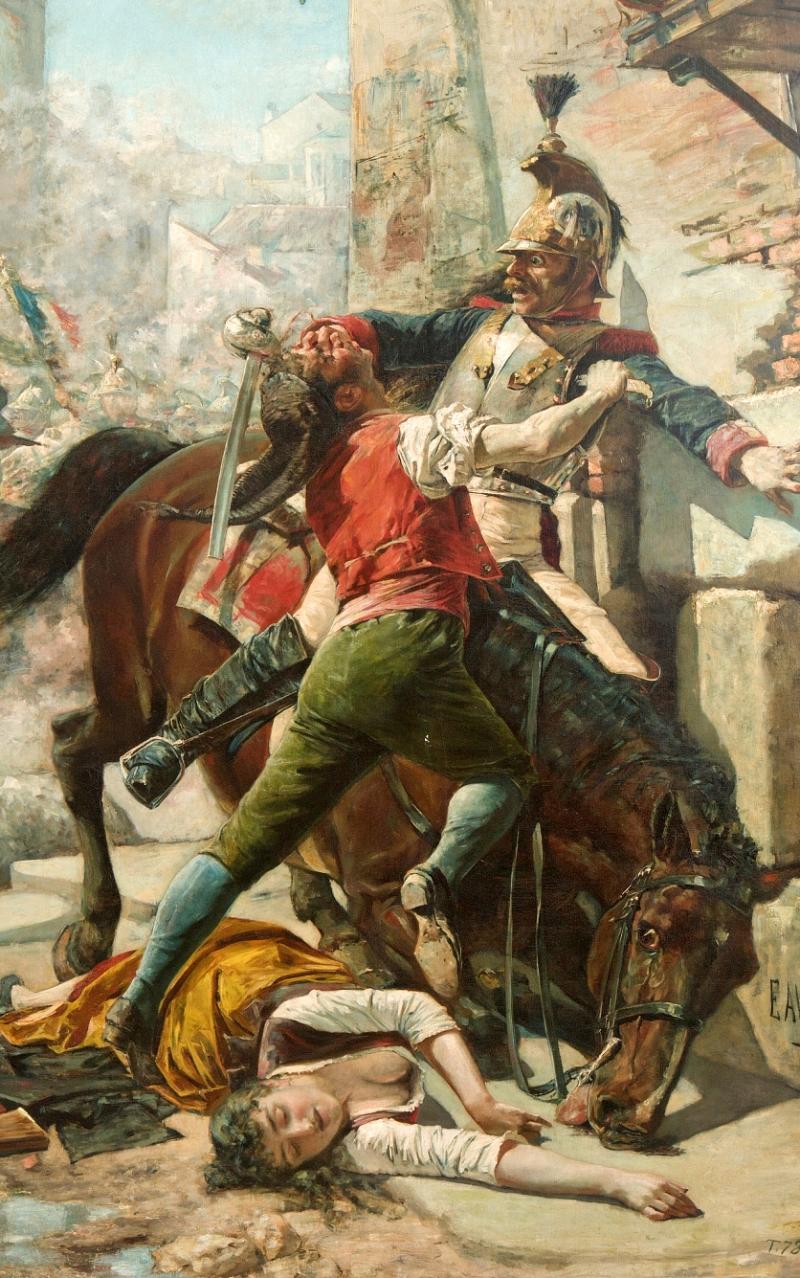
Also, the painting of Juan Malasaña avenging his daughter Manuela Malasaña on the streets of Madrid in 1808, during the Dos de Mayo uprising. Painted by Eugenio Álvarez Dumont
The Dos de Mayo or Second of May Uprising took place in Madrid, Spain, on 2–3 May 1808. The rebellion, mainly by civilians, with some isolated military action by junior officers, was against the occupation of the city by French troops, and was violently repressed by the French Imperial forces, with hundreds of public executions. These actions led to the Spanish people revolting against French occupation and outbreak of the Peninsular War, and ended the Franco-Spanish alliance in the Napoleonic Wars.
16 inches long overall, opened, blade 7.25 inches.
Code: 26346
795.00 GBP