
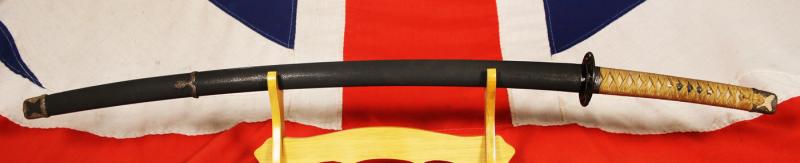


Early Shinto, Signed, Yamashiro Daijo Fujiwara Kunitsugu (山城大掾藤原国次) Handachi Sword With Full Suite Of Omori Teruhide School 'Omori Wave' Pattern of Handachi Koshirae Of Churning Water With Inlaid Gold Sea Spray Droplets. Kinai School Budou-sukashi Tsuba
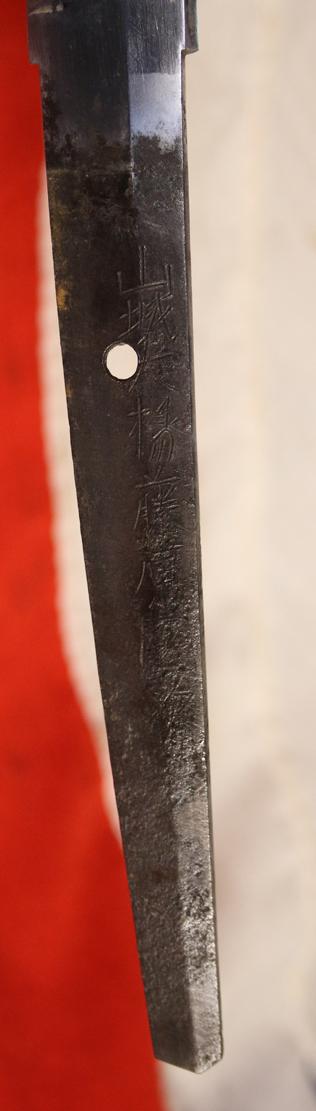
Samurai blade, Shinto period, circa 1620, of very strong and powerful form with substantial heft, signed Yamashiro Daijo Fujiwara Kunitsugu (山城大掾藤原国次). Black Stone finish lacquered saya handachi mounted Koshirae.
This is truly what one might call a ‘no nonsense’ blade of significant presence and power. A most serious blade meant for long lasting samurai warfare and truly impressive hand to hand combat in the crush of the melee..
A handachi koshirae featuring a crashing wave with gold sea spray motif represents a dynamic, high-status configuration for a Japanese sword mounting. The combination of crashing waves and gold sea spray is one of the most celebrated themes in classic Japanese sword fittings (tosogu), famously associated with the Omori School of metalworkers during the Edo period.
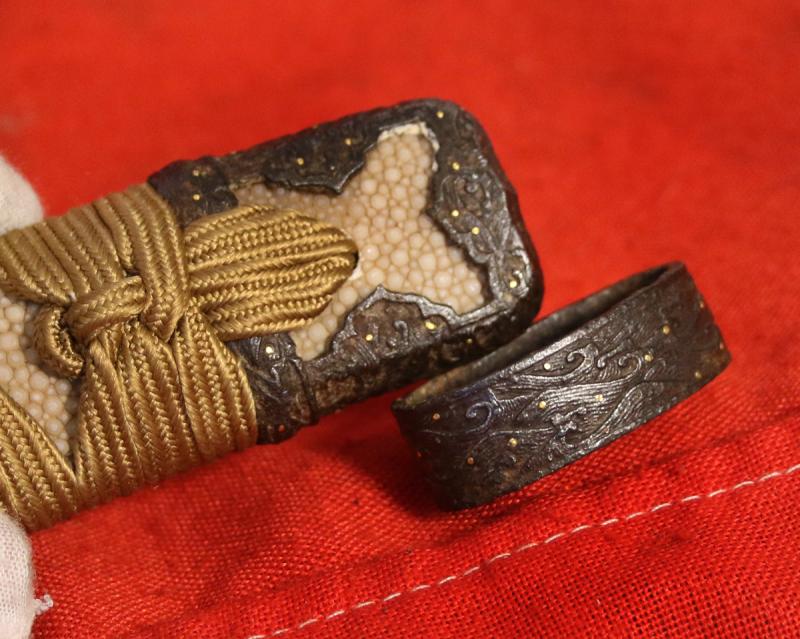
They pioneered the technique of embedding tiny, raised dots of pure gold alloy across the dark metal to represent crashing spray
The "Omori Wave": Unlike flat or highly stylized geometric waves, Omori artisans carved deeply undercut, three-dimensional, churning waves that look violently alive. Omori Teruhide (Omori-ryu). His signature style revolutionized the depiction of water
Handachi (meaning "half-tachi") style combines the styling and reinforced metallic components of a traditional tachi mount with the utility of an uchigatana, meaning it is worn edge-up tucked through the obi sash rather than slung edge-down
The kabuto-gane replaced the standard katana kashira. It features deeply carved churning water wrapped around the butt of the hilt
Fuchi (Hilt Collar): Adorned with matching ocean waves rising to crests gold sea spray droplets (Zogan / Iroie):
The "sea spray" (shibuki) is brought to life using precise pure gold inlay or gold overlay techniques, depicting individual glistening droplets scattered across the dark, turbulent waves.The distinguishing factor of a handachi is the presence of protective metal chassis bands wrapping around the scabbard
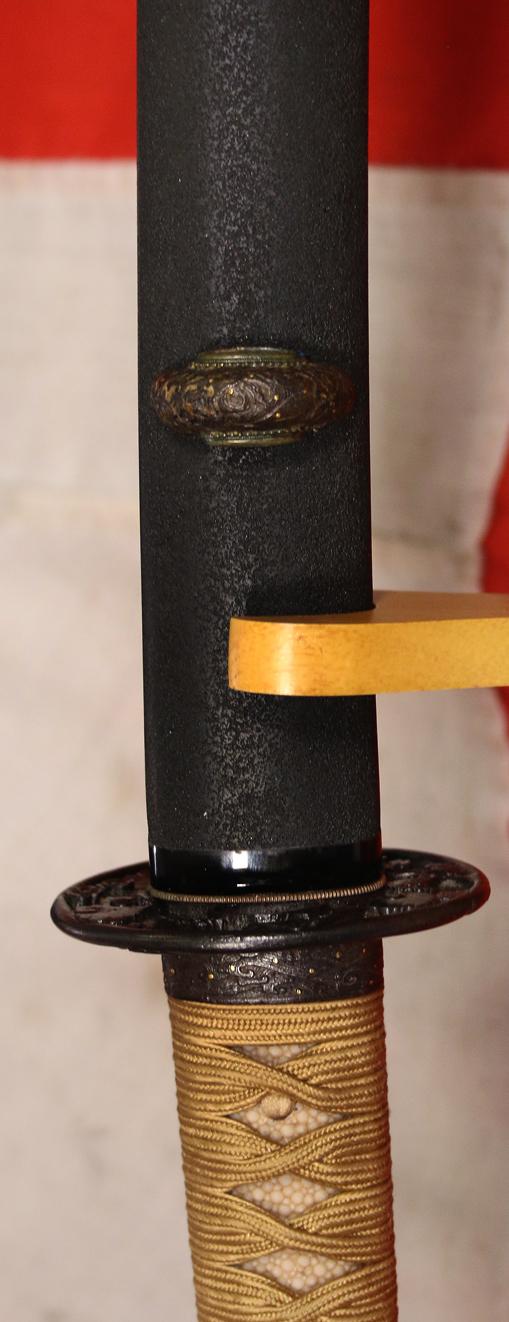
Semegane & Kashiwaba metallic bands that encircle the scabbard further up its length to prevent splitting. These echo the same ocean theme.
Kojiri is the long, protective metal cap at the very tip of the scabbard, matching the crashing wave and gold drop motif.
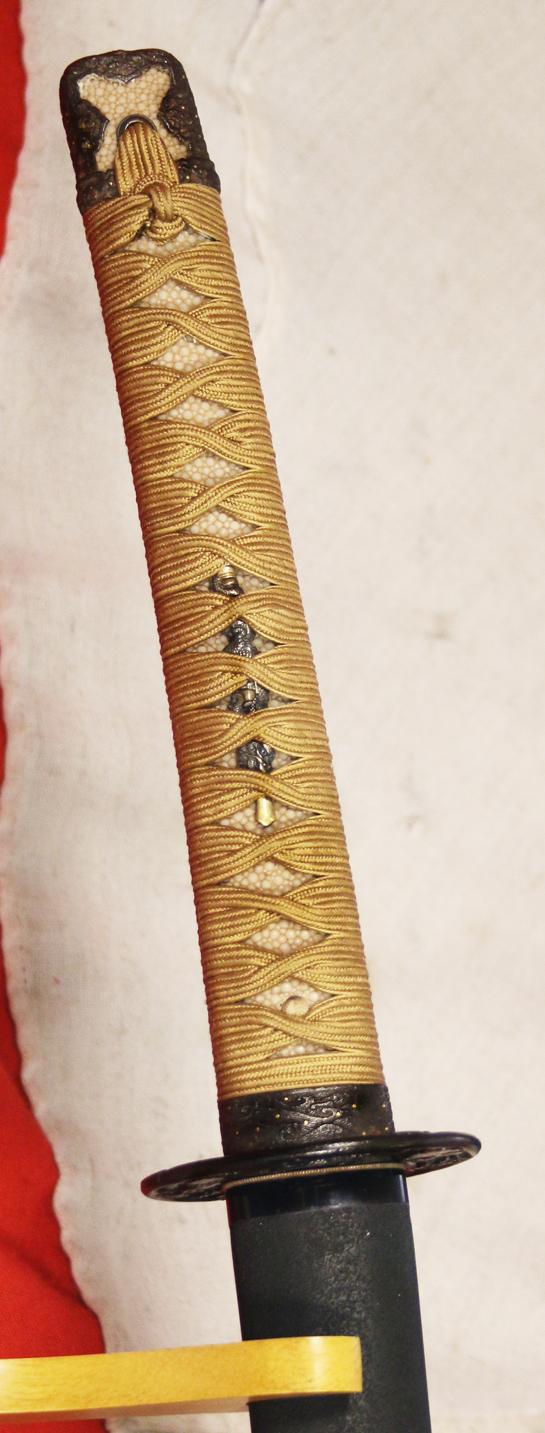
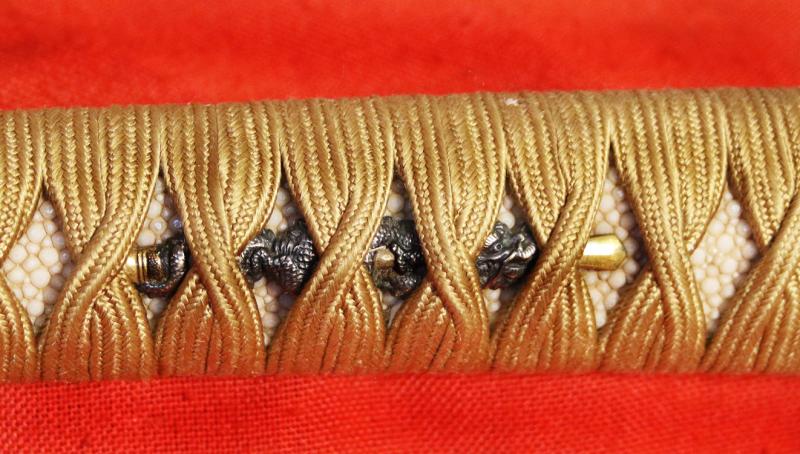
Menuki of ken wrapped around by dragon beneath golden silk tsuka-ito over samegawa giant rayskin.
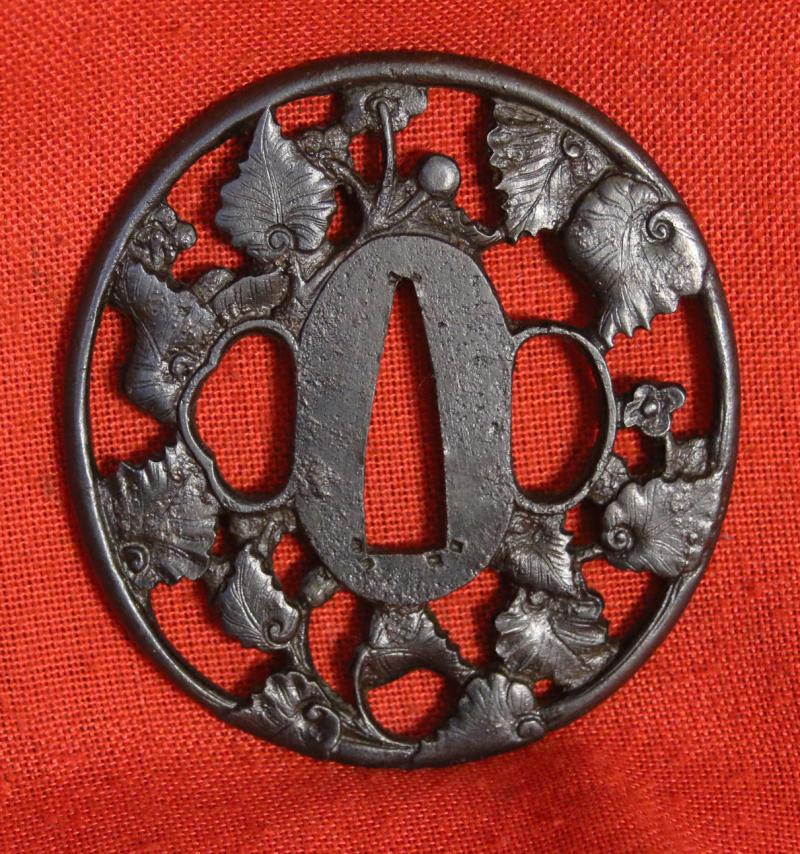
Iron maru-gata sukashi tsuba of Kinai school. This specific tsuba displays an organic, detailed grapevine design (Budou-sukashi) complete with leaves, tendrils. Kinai masters were highly celebrated for their fluid, deeply carved openwork (ji-sukashi) depicting natural motifs like plant life, flowers, and shells
This handachi is an antique Japanese sword crafted during the early Edo period (Shinto era), circa 1620, typically associated with the Echizen Shimosaka school in Echizen Province (modern-day Fukui prefecture): Early Edo period, with authenticated works recorded around the Kan'ei era (e.g., August 1629)
It is said that the first-gen Yasutsugu was the founder of the Echizen Shimoasaka school. He was born in Shimosaka town in Shiga prefecture at the end of the Muromachi period(Late 16 century ). He built his career there until the beginning of the Keicho era(1596). However, he moved to Echizen province due to the relocation of the lord he served. He eventually was noticed and supported by Matsudaira Hideyasu, the third son of Tokugawa Ieyasu, who was the founder of the Edo government.
Hideysu was the feudal lord of Echizen province during the early Edo period. With the support of Hideyasu, the first-gen Yasutsugu was able to establish the Echizen Shimosaka school. And his school’s fame became nationwide.
By Hideyasu’s recommendation, the first-gen Yasutsugu became Okakaekaji for the Tokugawa shogun family, meaning that he exclusively forged swords for the Shogun family. Yasutsu was acknowledged by the first and second Tokugawa Shoguns, Tokugawa Ieyasu, and Tokugawa Hidetada.
The first-gen Yasutsugu received 康(YASU) from Tokugawa Ieyasu and changed his maker’s name. He was also allowed to inscribe the holly oak symbol(family crest of Tokugawa) on the tang. The school flourished during the Edo period and trained many skilled apprentices. Echizen Province was famous for forging razor-sharp, practically designed swords.
The Edo government, run by the Tokugawa clan, ordered many blades from the swordsmiths in this province during the Edo period(1603-1868).
It has a superb blade with a stunning hamon, in great condition for age. It does have a fingerprint surface stain in the polish, so we are having it expertly removed and fully polished out. It will be photographed, looking like it last did in the 1860's, when it was already 240 years old, upon its return, probably by the 10th October
Code: 26383
6950.00 GBP