
Books


1st Edition Napoleon, by Hewiston W. B. The Life of Napoleon Bonaparte. In Two Volumes Printed in 1814
London: Printed & Published by J. Wallis, and sold by S. A. Oddy, J. Goodwin, and Davies & Eldridge, Exeter, c. 1810
London: Wallis, 1814. 1st Edition. Hardcover. Two volume set. Good condition.
Illustrated with numerous b/w engraved plates. A popular British life of Napoleon. The two volumes are the first edition which ends with Napoleon's abdication to Elba. Photos to add of both books on Monday 23rd. Each volume is 8.25 inches x 5.25 inches x 1.25 inches
Napoleon Bonaparte (1769-1821), also known as Napoleon I, was a French military leader and emperor who conquered much of Europe in the early 19th century. Born on the island of Corsica, Napoleon rapidly rose through the ranks of the military during the French Revolution (1789-1799). After seizing political power in France in a 1799 coup d’état, he crowned himself emperor in 1804. Shrewd, ambitious and a skilled military strategist, Napoleon successfully waged war against various coalitions of European nations and expanded his empire. However, after a disastrous French invasion of Russia in 1812, Napoleon abdicated the throne two years later and was exiled to the island of Elba. In 1815, he briefly returned to power in his Hundred Days campaign. After a crushing defeat at the Battle of Waterloo, he abdicated once again and was exiled to the remote island of Saint Helena, where he died at 51. Napoleon was, and remains, famous for his battlefield victories, and historians have spent enormous attention in analysing them. In 2008, Donald Sutherland wrote:
The ideal Napoleonic battle was to manipulate the enemy into an unfavourable position through manoeuvre and deception, force him to commit his main forces and reserve to the main battle and then undertake an enveloping attack with uncommitted or reserve troops on the flank or rear. Such a surprise attack would either produce a devastating effect on morale, or force him to weaken his main battle line. Either way, the enemy's own impulsiveness began the process by which even a smaller French army could defeat the enemy's forces one by one.
After 1807, Napoleon's creation of a highly mobile, well-armed artillery force gave artillery usage increased tactical importance. Napoleon, rather than relying on infantry to wear away the enemy's defences, could now use massed artillery as a spearhead to pound a break in the enemy's line. Once that was achieved he sent in infantry and cavalry. read more
750.00 GBP
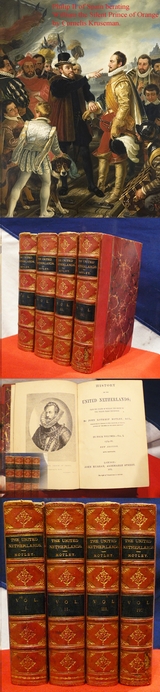
History of United Netherlands From The Death of William the Silent,To The Twelve Years Truce - 1609. by John Lothrop Motley. New Edition With Portraits. 4 volumes,
All in fine bindings with clean and polished calf in red, two gilted leather title labels on the spines of each, 5 raised bands. Marble cover and interior pages. Marbled edges.
Published 1875/6 by John Murray Albemarle St. London. Motley, who served as United States ambassador to Austria during the Civil War and later as ambassador to Great Britain, said of his affinity for the Netherlands: "I had not first made up my mind to write a history and then cast about to take up a subject. My subject had taken me up, drawn me on, and absorbed me into itself." Although he spent much of his life abroad, Motley was a member of the Boston literary circle that included Hawthorne, Lowell, Longfellow, and Motley's future biographer, Oliver Wendell Holmes. William I, Prince of Orange (24 April 1533 ? 10 July 1584), also known as William the Silent or William the Taciturn (translated from Dutch: Willem de Zwijger), or more commonly known as William of Orange, was the main leader of the Dutch Revolt against the Spanish Habsburgs that set off the Eighty Years' War (1568?1648) and resulted in the formal independence of the United Provinces in 1581. He was born in the House of Nassau as Count of Nassau-Dillenburg. He became Prince of Orange in 1544 and is thereby the founder of the branch House of Orange-Nassau and the ancestor of the monarchy of the Netherlands. Within the Netherlands he is also known as Father of the Fatherland (Dutch: Vader des Vaderlands).
A wealthy nobleman, William originally served the Habsburgs as a member of the court of Margaret of Parma, governor of the Spanish Netherlands. Unhappy with the centralisation of political power away from the local estates and with the Spanish persecution of Dutch Protestants, William joined the Dutch uprising and turned against his former masters. The most influential and politically capable of the rebels, he led the Dutch to several successes in the fight against the Spanish. Declared an outlaw by the Spanish king in 1580, he was assassinated by Balthasar G?rard (also written as "Gerardts") in Delft in 1584. A fine set, very collectable and much sought by collectors. Philip II of Spain berating William the Silent Prince of Orange by Cornelis Kruseman. read more
675.00 GBP

Rare 1st Edition 'Reveries or Memoirs Upon The Art of War', Printed in 1757
An important classic. First Edition in English. (8-1/4 x 10-1/2 inches) leather bound of 195 pages, and a page of advertisements for other books by the publisher. 40 copper plates, some fold out, on 34 pages. First edition in English of a classic 18th century military work by Saxe (1696-1750) the renowned soldier. The book is divided into 2 parts, the first examining the raising, feeding, clothing, exercising, paying, encamping, and moving of an army, and the 2nd covering the strategic aspects of combat, including attack and defence in various terrains. A nice rare copy with former owner's and name plate, Thomas Best of Park House, Boxley, Kent. Added some original Letters, upon various Military Subjects, wrote by the Count to the late King of Poland, and M. de Folard, which were never before made public: Together with His Reflections upon the Propagation of the Human Species. Translated from the French. This is the first edition in English of a classic military work by one of the world's most famous soldiers. At the age of twelve, Dresden-born Maurice de Saxe (1696?1750) entered the Saxon army, beginning a long and successful military career that culminated in his promotion to Marshal of France, where he retained full command of the main army in Flanders directly under Louis XV. Again and again, de Saxe achieved enormous victories over his enemies, becoming one of the greatest military leaders of the eighteenth century. Combining his memoirs and general observations with brilliant military thinking, Reveries on the Art of War was written in a mere thirteen days. Introducing revolutionary approaches to battles and campaigning at a time of changing military tactics and leadership styles, it stands as a classic of early modern military theory.
De Saxe's Reveries offered numerous procedural innovations for raising and training troops. His descriptions for establishing field camps were soon standard procedure. His ideas advanced weapon technology, including the invention of a gun specially designed for infantrymen and the acceptance of breech-loading muskets and cannons. De Saxe heightened existing battle formations by introducing a specific attack column that required less training, and he rediscovered a military practice lost since the ancient Romans ? the art of marching in cadence. He even delved into the minds and emotions of soldiers on the battlefield, obtaining a deeper understanding of their daily motivations.
Written by a military officer of great acumen, Reveries on the Art of War has deeply impacted modern military tactics. Enduringly relevant, this landmark work belongs in the library of anyone interested in the history, tactics, and weapons of European warfare. We show a wax miniature of the books owner, Thomas Best, in full military uniform. The miniature is held as part of the Victoria and Albert Museum Collection. read more
595.00 GBP

A Very Rare, Original Medeavil Book, Classifield, Alongside The Gutenberg Bible, as An Incunabule,Titled, Vitae Pontificum, Ist Edition, of 1479, By Bartolomaeus Platina, Vitae Pontificum (Lives of the Popes) and Personally Presented It To Pope Sixtus IV
Only the second example of such an incunabule we have ever seen in almost 60 years. Written by Bartolomeo Sacchi, the Pope's personally appointed, very first prefect of the Vatican library known as the 'Vatican Librarian'. He was also the author of the very first printed cookbook, a wildly popular tract , entitled '
De honesta voluptate et valetudine'
(“On Respectable Pleasure and Good Health”).
It is believed by some gastronomic historians that it is from his cookbook that all the world's recipes of pasta originated, as it was the very first record of the staple Roman Italian diet.
As for his cookbook, it would go down as one of Sacchi’s most important literary contributions, if only because of the insight it provides into the dietary habits of Italians at the time. For one thing, it marks a fascinating stage in the evolution of the dish that is undoubtedly Italy’s best-loved and most widely imitated contribution to global food culture: Pasta with sauce.
Written by Pope Sixtus IVth's Appointed Vatican Librarian. This remarkable tome, an Incunabule, is over 547 years old. It may have been taken from the Vatican library during the Sack of Rome in 1527 by the Mutinous imperial Army, where, apart from wholesale murder and pillaging, millions of gold ducats worth of art was stolen or destroyed and much of the Vatican library looted and sold partly for ransom. The sack of Rome was so prolific and devastating, the population of Rome was diminished from 55,000 to less than 10,000. To understand, by comparison, this radical reduction of Rome's fortunes and population {once the very centre of the world's greatest empire} the City of Alexandria in Egypt, during the Ptolemaic era, 1,500 years before, had a population of between five hundred thousand to a million
Pope Sixtus IVth accomplishments as pope included the construction of the Sistine Chapel and the creation of the Vatican Library. A patron of the arts, he brought together the group of artists who ushered the early Renaissance into Rome with the first masterpieces of the city's new artistic age.
When Bartolomeo Sacchi ('Platina', 1421-1481) wrote this Vitae Pontificum (Lives of the Popes) and personally presented it to Pope Sixtus IV in 1475, he surely could not have imagined how influential it would become over the centuries. This volume by Platina was the first ever printed book on Papal history, the lives of the popes from the time of Jesus Christ, to the reign of Sixtus IV, composed as a humanist Latin narrative, and, as such, marked a distinct breakthrough in relation to the Liber Pontificalis, the standard medieval chronicle of the papacy.
Whatever Platina's intentions for the book that was published in 1479, it soon came to be regarded as the official history of the Roman pontiffs, an icon of the earliest printing.
This book was part of the conclusion of the infamous Pazzi conspiracy, which was was a failed plot in 1478 to overthrow the Medici family's rule in Florence, Italy. The Pazzi family, rivals of the Medici, alongside Pope Sixtus IV and others, aimed to assassinate Lorenzo and Giuliano de' Medici during a Mass in Florence Cathedral. While Giuliano was killed, Lorenzo survived with a wound. The failed coup triggered a brutal backlash against the conspirators.
The conspiracy involved the Pazzi family (Francesco and Jacopo Pazzi), Archbishop Francesco Salviati, and others, with backing from Pope Sixtus IV and his nephew Girolamo Riario.
The Pazzi family sought to regain political power and influence, which had been eclipsed by the Medici. Pope Sixtus IV was also motivated by a desire to expand papal power in the Romagna region, which Lorenzo de' Medici opposed.
The assassination attempt took place on April 26, 1478, during a Mass in Florence Cathedral.
Consequences:
The Pazzi family faced severe repercussions, including executions and banishment. The Medici family's power was solidified in Florence, demonstrating their strong political and financial resources.
The Pazzi conspiracy is a significant event in Florentine history, highlighting the intense power struggles and political machinations of the Italian Renaissance. It also underscores the Medici family's dominance and their ability to survive and even thrive after facing such a serious threat
This fabulous and rare book, an incunabula just as is the Gutenberg Bible, was formerly from the library of the renown Abolishionist William Roscoe, sold by him at auction in 1816 for £1.13/-, due to the financial difficulties of his banking house, and acquired by order of the Library Committee of the City of Bath Reference Library.
This book was likely commissioned due to the influences of Pope Sixtus IV Francesco della Rovere upon his librarian, it's author, Bartolomaeus Platina.
We show in the gallery a painting of Pope Sixtus appointing Platina as the official Vatican Librarian.
An Incunable is a most rarest of books, pamphlet, or broadside (such as the Almanach cracoviense ad annum 1474) that was printed, not handwritten, before the year 1501 in Europe.
They are the earliest form of printed books. Incunabula include the Gutenberg Bible of 1455, probably the most valuable book in the world. This is a First Edition of Bartholomaeus Platina's great history of the lives of the Popes, the first systematic papal history, not only to create the first detailed history of the Popes but also to villify his mortal enemy Pope Paul IInd Pietro Barbo. This book was created in the era of the great Rennaiscance, in the time of the notorious Borgias and in the year of the notorious Pazzi conspiracy, which was a plot by members of the Pazzi family and others to displace the de' Medici family as rulers of Renaissance Florence. It was printed at the time that Leonado De Vinci drew the hanging of a Pazzi conspiritor Bernardo di Bandino Baroncelli. On 26 April 1478 there was an attempt to assassinate Lorenzo de' Medici and his brother Giuliano de' Medici. Lorenzo was wounded but survived; Giuliano was killed. The failure of the plot served to strengthen the position of the de' Medici. The Pazzi were banished from Florence. During the time the Platina served as the first librarian at the Vatican under its modern founder, Sixtus IV. Platina started his career as a soldier employed by condottieri, before gaining long-term patronage from the Gonzagas, including the young cardinal Francesco, for whom he wrote a family history. He studied under the Byzantine humanist philosopher John Argyropulos in Florence, where he frequented other fellow humanists, as well as members of the ruling Medici family.
Around 1462 he moved with Francesco Gonzaga to Rome, where he purchased a post as a papal writer under the humanist Pius II (Enea Silvio Piccolomini) and became a member of the pagan-influenced Roman Academy founded by Pomponio Leto. Close acquaintance with the renowned chef Maestro Martino in Rome seems to have provided inspiration for a theoretical treatise on Italian gastronomy entitled De honesta voluptate et valetudine ("On honourable pleasure and health"), which achieved considerable popularity and has the distinction of being considered the first printed cookbook.
Platina's papal employment was abruptly curtailed on the arrival of an anti-humanist pope, Paul II (Pietro Barbo), who had the rebellious Platina locked up in Castel Sant'Angelo during the winter of 1464-65 as a punishment for his remonstrations. In 1468 he was again confined in Castel Sant'Angelo for a further year, where he was interrogated under torture, following accusations of an alleged pagan conspiracy by members of Pomponio's Roman academy involving plans to assassinate the pope.
Platina's fortunes were revived by the return to power of the strongly pro-humanist pope, Sixtus IV (Francesco della Rovere), who in 1475 made him Vatican librarian an appointment which was depicted in a famous fresco by Melozzo da Forli. He was granted the post after writing an innovative and influential history of the lives of the popes that gives ample space to Roman history and pagan themes, and concludes by vilifying Platina's nemesis, Paul Iia paragraph from Platina's Vitae Pontificum first gave rise to the legend of the excommunication of Halley's comet by Pope Callixtus III,
Vitae Pontificum ("Lives of the Popes", 1479) "Incunable" is the anglicised singular form of "incunabula", Latin for "swaddling clothes" or "cradle", which can refer to "the earliest stages or first traces in the development of anything." A former term for "incunable" is "fifteener", referring to the 15th century. Vitae pontificum, FIRST EDITION, 239 leaves (of 240, lacking first leaf), 39 lines, roman (and a little Greek) letter, capital spaces with guide letters, a few early marginal ink annotations, tears repaired to 2 leaves, small worm trace in upper margin of approximately 30 leaves (touching letters on approximately 20), inner margins of final leaves strengthened at gutter margins and a few other small paper repairs, gnawing to some fore-corners, blindstamp on approximately 6 leaves, late seventeenth/early eighteenth century red morocco gilt, sides panelled with corner, side and central decorations, spine gilt-tooled (including title and publication date) in 7 compartments within raised bands, rebacked preserving most of original spine. Venice, Johannes de Colonia and Johannes Manthen, 11 June 1479. William Roscoe's copy of the first editon of Platina's history of the Popes.
Provenance: William Roscoe (1753-1832), historian and author of Lorenzo de Medici (1796) and The Life of Pope Leo X (1805), with a 10-line pencil note in his hand, above which an ink note reads "Notes by Wm. Roscoe vide infra. Coll. By him". One of this books former owners was the renown William Roscoe (8 March 1753 , 30 June 1831). He was an English historian, leading abolitionist, art collector, M.P. Lawyer, banker, botanist and miscellaneous writer, perhaps best known today as an early abolitionist. 11.25 inches x 7.5inches x 2.25 inches. read more
6950.00 GBP

1st Edition James Bond, On Her Majesty's Secret Service, by Ian Fleming. Part of The ‘Blofeld’ Sequence. The Most Infamous Villain In The James Bond Canon. Written By Fleming at ‘Goldeneye’ Whilst Sean Connery Was Filming His First Bond, “Dr. No” Nearby
Part of another small collection of James Bond First Editions that just arrived at the weekend, including James Bond’s Ist outing and rarest of them all, a stunning ‘Casino Royale’ 1st Edition, 1st impression. It sold within 10 minutes of going on sale!
1st Edition, 1st impression. Published by London: Jonathan Cape. 1963 original cover. (1963) On Her Majesty's Secret Service is the tenth novel in Ian Fleming's James Bond series, first published in the UK by Jonathan Cape on 1 April 1963. The initial and secondary print runs sold out, with over 60,000 books sold in the first month. Fleming wrote the book in Jamaica whilst the first film in the Eon Productions series of films, Dr. No, was being filmed nearby.
On Her Majesty's Secret Service is the second book in what is known as the "Blofeld trilogy", which begins with Thunderball and concluded with You Only Live Twice. The story centres on Bond's ongoing search to find Ernst Stavro Blofeld after the Thunderball incident; through contact with the College of Arms in London Bond finds Blofeld based in Switzerland. After meeting him and discovering his latest plans, Bond attacks the centre where he is based, although Blofeld escapes in the confusion. Bond meets and falls in love with Contessa Teresa "Tracy" di Vicenzo during the story. The pair marry at the end of the story but Blofeld kills Bond's wife, hours after the ceremony.
Fleming made a number of revelations about Bond's character within the book, including showing an emotional side that was not present in the previous stories. In common with Fleming's other Bond stories, he used the names and places of people he knew or had heard of and Blofeld's research station on Piz Gloria was based on Schloss Mittersill, which the Nazis had turned into a research establishment examining the Asiatic races.
On Her Majesty's Secret Service received broadly good reviews in the British and American press. The novel was adapted to run as a three-part story in Playboy in 1963 and then as a daily comic strip in the Daily Express newspaper in 1964–1965. In 1969 the novel was adapted as the sixth film in the Eon Productions James Bond film series and was the only film to star George Lazenby as Bond. On Her Majesty's Secret Service was written in Jamaica at Fleming's Goldeneye estate in January and February 1962, whilst the first Bond film, Dr. No was being filmed nearby. The first draft of the novel was 196 pages long and called The Belles of Hell. Fleming later changed the title after being told of a nineteenth-century sailing novel called On Her Majesty's Secret Service, seen by Fleming's friend Nicholas Henderson in Portobello Road Market.
As with his previous novels, Fleming used events from his past as elements in his novel. Whilst at Kitzbühel in the 1930s, Fleming's car, a Standard Tourer, had been struck by a train at a level crossing and he had been dragged fifty yards down the track. From that time on he had associated trains with death, which led to their use as a plot device not just in The Man with the Golden Gun, but also in Diamonds Are Forever and From Russia, with Love.
To demonstrate just how much all things original Bond are appreciated in the world of collectors, the Walther pistol used by Connery in the poster of From Russia With Love, in 1963, and also drawn in the man With The Golden Gun is in fact just an air pistol. A .177 (4.5mm) Walther 'LP MOD.53' Air Pistol, Serial No. 054159. That pseudo pistol was sold by Christies in 2010, with an estimate of £15,000 to £20,000, but for an incredible £277,000. {We dropped out of the bidding at a mere £22,000} Incredible in that it was never used in any film, it was just an air pistol, not a real automatic, and only ever used in promotional posters. It was 'said' to have been used by accident in fact as they couldn't find a correct Walther.
A full set of 1st edition Ian Fleming's 14 James Bond novels published by Jonathan Cape between 1953-1966 could now cost in the region of £90,000. plus Comprising: Casino Royale, Live and Let Die, Moonraker, Diamonds are Forever, From Russia with Love, Dr No, Goldfinger, For Your Eyes Only, Thunderball, The Spy Who Loved Me, On Her Majesty's Secret Service, You Only Live Twice, The Man with the Golden Gun and Octopussy and the Living Daylights.
The dust jacket has a few small tears, and a water stain, with first page opening at the hinge seam, but a nice rare copy considering it is over 50 years old.
Out of interest, our last example of this super Ist edition James Bond, in around the same condition, we sold as a gift for an American megastar, who is now, apparently, the most famous and biggest selling movie actor in the world. read more
1150.00 GBP
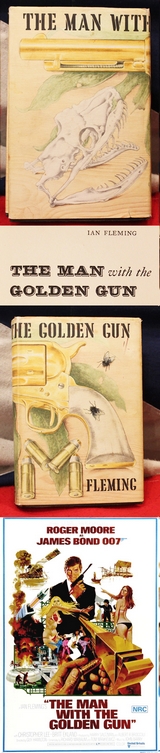
1st Edition James Bond, Man With the Golden Gun, by Ian Fleming. Bond Sent to the Caribbean To Find & Kill Francisco Scaramanga, The Titular "Man With the Golden Gun".
London: Jonathan Cape 1965. 1st Edition 1st Impression. Flemings 12th outing for Commander Bond. Minor spotting as to be expected. With dust jacket. Cover artist Richard Chopping (Jonathan Cape ed.). The Man with the Golden Gun is the twelfth novel (and thirteenth book) of Ian Fleming's James Bond series. It was first published by Jonathan Cape in the UK on 1 April 1965, eight months after the author's death. The novel was not as detailed or polished as the others in the series, leading to poor but polite reviews. Despite that, the book was a best-seller.
The story centres on the fictional British Secret Service operative James Bond, who had been posted missing, presumed dead, after his last mission in Japan. Bond returns to England via the Soviet Union, where he had been brainwashed to attempt to assassinate his superior, M. After being "cured" by the MI6 doctors, Bond is sent to the Caribbean to find and kill Francisco Scaramanga, the titular "Man with the Golden Gun".
The first draft and part of the editing process was completed before Fleming's death and the manuscript had passed through the hands of his copy editor, William Plomer, but it was not as polished as other Bond stories. Much of the detail contained in the previous novels was missing, as this was often added by Fleming in the second draft. Publishers Jonathan Cape passed the manuscript to Kingsley Amis for his thoughts and advice on the story, although his suggestions were not subsequently used.
The novel was serialised in 1965, firstly in the Daily Express and then in Playboy; in 1966 a daily comic strip adaptation was also published in the Daily Express. In 1974 the book was loosely adapted as the ninth film in the Eon Productions James Bond series, with Roger Moore playing Bond and Fleming's cousin, Christopher Lee, as Scaramanga.
The Man with the Golden Gun film was filmed in 1974 the ninth film entry in the James Bond series and the second to star Roger Moore as the fictional MI6 agent James Bond. A loose adaptation of Ian Fleming's novel of the same name, the film has Bond sent after the Solex Agitator, a device that can harness the power of the sun, while facing the assassin Francisco Scaramanga, the "Man with the Golden Gun". The action culminates in a duel between them that settles the fate of the Solex.
The Man with the Golden Gun was the fourth and final film in the series directed by Guy Hamilton. The script was written by Richard Maibaum and Tom Mankiewicz. The film was set in the face of the 1973 energy crisis, a dominant theme in the script. Britain had still not yet fully overcome the crisis when the film was released in December 1974. The film also reflects the then popular martial arts film craze, with several kung fu scenes and a predominantly Asian location, being set and shot in Thailand, Hong Kong, and Macau. Part of the film is also set in Beirut, Lebanon, but it was not shot there. Ian Fleming wrote The Man with the Golden Gun at his Goldeneye estate in Jamaica in January and February 1964, completing it by the beginning of March. His health affected him badly during the writing process and he dropped from his usual rate of two thousand words a morning to a little over an hour's worth of work a day.
As with his previous novels, Fleming used events from his past as elements in his novel. Whilst at Kitzbuhel in the 1930s, Fleming's car, a Standard Tourer, had been struck by a train at a level crossing and he had been dragged fifty yards down the track. From that time on he had associated trains with death, which led to their use as a plot device not just in The Man with the Golden Gun, but also in Diamonds Are Forever and From Russia, with Love. To show just how much all things original Bond are appreciated in the world of collectors the Walther pistol used by Connery in the poster of From Russia With Love, in 1963, and also drawn in the man With The Golden Gun poster as shown here an air pistol, .177 (4.5mm) Walther 'LP MOD.53' Air Pistol, Serial No. 054159, was sold by Christies in 2010 with an estimate of £15,000 to £20,000 for an incredible £277,000. Incredible in that it was never actually used in the film, was an air pistol, not a real automatic, and only used in promotional posters. It was 'said' to have been used by accident in fact as they couldn't find a correct Walther PPK on the day of the photoshoot. read more
945.00 GBP

A 1st Edition, Ist Impression Charles Dickens Bleak House Printed 1853 Leather Bound in Light Brown Calf and Black Title With Gilding & Marbled End Boards
Bradbury & Evans, first edition, with Ist impression imperfections and plates as called for ( pages with expected age foxing/staining), leather bound with marbled end boards.
A chance to own a rare first edition, and Ist Impression, of one of the great classics of English literature. Printed and first read before the Crimean War in Russia, and before the 'Charge of the Light Brigade' became infamous in British military history.
Original printing imperfections and flaws are detailed in Walter E. Smith and his wonderful work 'Charles Dickens in the Original Cloth'. Smith's comprehensive bibliography of each of Dickens's works enabled all to describe the flaws in the first impression.
The first edition of Bleak House is highly desirable. We have encountered a fair number of examples over the past 50 to around 100 years, in both the original cloth and bound in various bindings. Most of these bindings date from near the time of publication and most are before around 1880.
The edition points required for the first impression of the first edition are fairly definitive. The edition points are as follows to qualify as the 1st impression:
1) "elgble" misspelling for "eligible" on pp.19 line 6
2) "chair" misspelling for "hair" on pp.209 line 23
3) "counsinship" misspelling for "cousinship" on pp.275 line 22
There are also another issue present, in only a few of the first impression copies, namely pp.230 with the "2" in the page number complete. This copy has that scarce point
Basic premise: Jarndyce vs Jarndyce is a suit which has being going through the Court of Chancery for decades and decades and decades. Chancery is this old court to do with contested wills which has long since been reformed because it was impossibly incompetent and once you were in Chancery there was no getting out of Chancery and all costs are taken from the estates being contested, meaning that the Court benefited from drawing out proceedings. The young wards of Jarndyce are Richard Carstone and Ada Clare, young cousins. They are sent to live with their cousin Mr John Jarndyce and with them goes the orphan Esther Summerson, an orphan with a mysterious past. Mr Jarndyce advises them all to forget the suit, particularly as Richard and Ada fall in love, yet Richard struggles to settle to any profession with the suit still undecided. Simultaneous to this, the sinster lawyer Mr Tulkinghorn serves Sir Leicester Dedlock, Baronet and his wife Lady Dedlock, a woman desperately bored with her life. She also has a claim in the Jarndyce suit and faints dead away when Mr Tulkinghorn shows her a piece of legal writing written in a strangely familiar hand … cue much to-ing and fro-ing and the occasional untimely death. Nobody does tragic death scenes quite like Dickens, you end up really feeling the tragedy. Subtle he is not. Bleak House shows us a world where kindness is hard to find. Mr John Jarndyce tries to protect those he loves, but even he cannot prevent them being drawn in to the fogs of London. As usual, Dickens preaches against the workhouses and the ineffectiveness of charity, Mr Jarndyce is the sole positive charitable figure in the novel, his is a doctrine of love. It is the day to day cruelties that people inflict on each other that grind people down. The unrelenting legal profession, the way in which young men can be educated about poetry but not in how to work, that children can run wild on the streets and never really know that they are loved, this is a world where a man who has lost everything can die and barely be missed. Esther makes it clear that she feels herself to have been saved by the love of those around her – but Ada’s love could not save Richard, nor could Sir Leicester’s love save his Lady. All they can do is keep loving them still, no matter what the world may say. The bleakness of the title goes much deeper than the name of the house. 8.75 inches x 6 inches x 2 inches. read more
1125.00 GBP
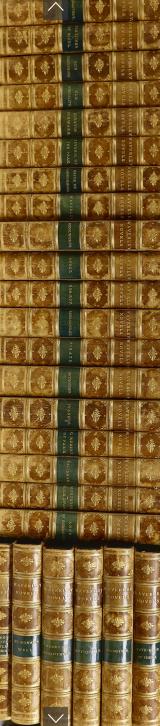
A Stunningly Bound Complete 25 Volume Set Of Sir Walter Scott’s Waverley Novels. Published in Edinburgh in 1871
These bound volumes would elegantly grace any bookcase, library or study. They are a truly truly beautiful collection.
Scott, Sir Walter - Waverley Novels; the Centenary
Edition, 25 vols. pictorial engraved titles, num. plates and some other illus.; contemp fine calf leather and marbled boards, gilt decorated panelled spines with green leather and tan leather Published in Edinburgh, 1871
The Waverley Novels are a long series of novels by Sir Walter Scott (1771–1832). For nearly a century, they were among the most popular and widely read novels in Europe.
Because Scott did not publicly acknowledge authorship until 1827, the series takes its name from Waverley, the first novel of the series, released in 1814. The later books bore the words "by the author of Waverley" on their title pages.
The Tales of my Landlord sub-series was not advertised as "by the author of Waverley" and thus is not always included as part of the Waverley Novels series.
Scott’s early Waverley books deal with several different phases of Scottish history and were noted for their characterizations of ordinary people and their use of regional Scottish dialect. These novels often concern the clash between heroic traditions of the past and practical visions of the future. Waverley, for example, treats the tensions between the Jacobites and the Hanoverians in the mid-18th century, while The Heart of Midlothian addresses the social conflict following the Porteous Riots of 1736 over the execution of a smuggler. Scott set his other novels in historical periods dating to the Middle Ages in locales such as England, France, Palestine, and the Orkney Islands.
Chronological order, by settingedit
1097: Count Robert of Paris
1187–94: The Betrothed, The Talisman, Ivanhoe (3)
1307: Castle Dangerous
1396: The Fair Maid of Perth
1468–77: Quentin Durward, Anne of Geierstein (2)
1547–75: The Monastery, The Siege of Malta, The Abbot, Kenilworth (4)
1616–18: The Fortunes of Nigel
1644–89: A Legend of Montrose, Woodstock, Peveril of the Peak, The Tale of Old Mortality, The Pirate (5)
1700–99: The Black Dwarf, The Bride of Lammermoor, Rob Roy, Heart of Midlothian, Waverley, Guy Mannering, Redgauntlet, The Antiquary (8)
19th century: St. Ronan's Well
They are beautiful bindings in super condition. We have only ever seen the Zaehnsdorf bindings as equal to or possibly better than these. read more
995.00 GBP
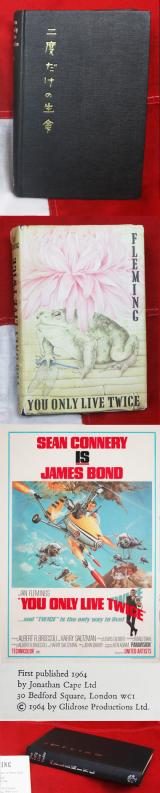
James Bond Ist Edition "You Only Live Twice" Ist Issue, Fleming, Ian Published by Jonathan Cape, London, 1964. Basis for the James Bond movie with Sean Connery & Karin Dor As Bond-Girl Helga Brandt.
Jonathan Cape, London, 1964. the 2nd Bond book. Black Cloth with Japanese kanji . Condition: Fine. Dust Jacket Condition:Good. First Edition. A first edition/first Impression. Throughout a jolly nice copy. "When Ernst Stavro Blofeld blasted into eternity the girl whom James Bond had married only hours before, the heart, the zest for life, went out of Bond" (from the dust-jacket). Basis for the James Bond movie with Sean Connery and Karin Dor as Bond-Girl Helga Brandt. This film is the first Bond movie to deviate from the source material. Other than the Japanese setting, and several characters, the two stories are very different. A first edition/first Impression (stating "first Published 1964" versus the second state "March 1964")
You Only Live Twice
Cinema poster showing Sean Connery as James Bond fly his monocoptor over the villains lair.
British cinema poster for You Only Live Twice.
The movie was Directed by Lewis Gilbert
Produced by Albert R. Broccoli
Harry Saltzman
Distributed by United Artists
Release date
12 June 1967 (London, premiere)
You Only Live Twice is a 1967 British spy film and the fifth in the James Bond series produced by Eon Productions, starring Sean Connery as the fictional MI6 agent James Bond. The film's screenplay was written by Roald Dahl, and loosely based on Ian Fleming's 1964 novel of the same name. It is the first James Bond film to discard most of Fleming's plot, using only a few characters and locations from the book as the background for an entirely new story.
In the film, Bond is dispatched to Japan after American and Soviet manned spacecraft disappear mysteriously in orbit. With each nation blaming the other amidst the Cold War, Bond travels secretly to a remote Japanese island to find the perpetrators and comes face to face with Ernst Stavro Blofeld, the head of SPECTRE. The film reveals the appearance of Blofeld, who was previously a partially unseen character. SPECTRE is working for the government of an unnamed Asian power, implied to be the People's Republic of China, to provoke war between the superpowers.
During the filming in Japan, it was announced that Sean Connery would retire from the role of Bond, but after a hiatus, he returned in 1971's Diamonds Are Forever and later 1983's non-Eon Bond film Never Say Never Again. You Only Live Twice is the first Bond film to be directed by Lewis Gilbert, who later directed the 1977 film The Spy Who Loved Me and the 1979 film Moonraker, both starring Roger Moore.
You Only Live Twice was a great success, receiving positive reviews and grossing over $111 million in worldwide box office. read more
1460.00 GBP
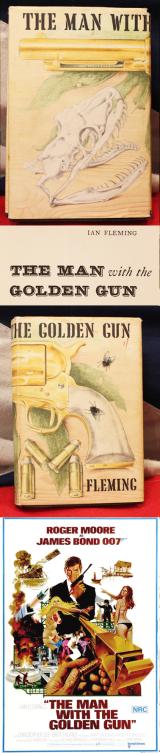
1st Edition James Bond, Man with the Golden Gun, by Ian Fleming. Bond Sent to the Caribbean To Find & Kill Francisco Scaramanga, The Titular "Man With the Golden Gun".
London: Jonathan Cape 1965. 1st Edition 1st Issue. Flemings 12th outing for Commander Bond. With original dust jacket priced at 18 shillings. Cover artist Richard Chopping (Jonathan Cape ed.). The Man with the Golden Gun is the twelfth novel (and thirteenth book) of Ian Fleming's James Bond series. It was first published by Jonathan Cape in the UK on 1 April 1965, eight months after the author's death. The novel was not as detailed or polished as the others in the series, leading to poor but polite reviews. Despite that, the book was a best-seller.
The story centres on the fictional British Secret Service operative James Bond, who had been posted missing, presumed dead, after his last mission in Japan. Bond returns to England via the Soviet Union, where he had been brainwashed to attempt to assassinate his superior, M. After being "cured" by the MI6 doctors, Bond is sent to the Caribbean to find and kill Francisco Scaramanga, the titular "Man with the Golden Gun".
The first draft and part of the editing process was completed before Fleming's death and the manuscript had passed through the hands of his copy editor, William Plomer, but it was not as polished as other Bond stories. Much of the detail contained in the previous novels was missing, as this was often added by Fleming in the second draft. Publishers Jonathan Cape passed the manuscript to Kingsley Amis for his thoughts and advice on the story, although his suggestions were not subsequently used.
The novel was serialised in 1965, firstly in the Daily Express and then in Playboy; in 1966 a daily comic strip adaptation was also published in the Daily Express. In 1974 the book was loosely adapted as the ninth film in the Eon Productions James Bond series, with Roger Moore playing Bond and Fleming's cousin, Christopher Lee, as Scaramanga.
The Man with the Golden Gun film was filmed in 1974 the ninth film entry in the James Bond series and the second to star Roger Moore as the fictional MI6 agent James Bond. A loose adaptation of Ian Fleming's novel of the same name, the film has Bond sent after the Solex Agitator, a device that can harness the power of the sun, while facing the assassin Francisco Scaramanga, the "Man with the Golden Gun". The action culminates in a duel between them that settles the fate of the Solex.
The Man with the Golden Gun was the fourth and final film in the series directed by Guy Hamilton. The script was written by Richard Maibaum and Tom Mankiewicz. The film was set in the face of the 1973 energy crisis, a dominant theme in the script. Britain had still not yet fully overcome the crisis when the film was released in December 1974. The film also reflects the then popular martial arts film craze, with several kung fu scenes and a predominantly Asian location, being set and shot in Thailand, Hong Kong, and Macau. Part of the film is also set in Beirut, Lebanon, but it was not shot there. Ian Fleming wrote The Man with the Golden Gun at his Goldeneye estate in Jamaica in January and February 1964, completing it by the beginning of March. His health affected him badly during the writing process and he dropped from his usual rate of two thousand words a morning to a little over an hour's worth of work a day.
As with his previous novels, Fleming used events from his past as elements in his novel. Whilst at Kitzbühel in the 1930s, Fleming's car, a Standard Tourer, had been struck by a train at a level crossing and he had been dragged fifty yards down the track. From that time on he had associated trains with death, which led to their use as a plot device not just in The Man with the Golden Gun, but also in Diamonds Are Forever and From Russia, with Love. To show just how much all things original Bond are appreciated in the world of collectors the Walther pistol used by Connery in the poster of From Russia With Love, in 1963, and also drawn in the man With The Golden Gun poster as shown here an air pistol, .177 (4.5mm) Walther 'LP MOD.53' Air Pistol, Serial No. 054159, was sold by Christies in 2010 with an estimate of £15,000 to £20,000 for an incredible £277,000. We dropped out of the bidding at £22,000 Incredible in that it was never used in any film, was an air pistol not a real automatic, and only used in promotional posters. It was 'said' to have been used by accident in fact as they couldn't find a correct Walther PPK on the day of the photoshoot. read more
1295.00 GBP