


A Most Incredible and Intriguing European Art Deco Bronze Table Lamp, Decorated With the Subject of a Prisoner in an Ancient Chinese 'Cangue' Torture Device Beneath a Lamp
A seated figure with the torture block of a Chinese 'cangue' . Likely designed from small portable carved wooden figures purchased and brought back to Europe by travellers to the Treaty Port of Ningbo in China, sometime in the early 20th century. The European fascination with all things oriental, from the exotic east, has influenced western art considerably for centuries, and it is frequently known as Chinoiserie Art, although the depiction of Chinese torture implements was somewhat niche, but they were especially popular, and depicted in decorative art, paintings, prints and sculpture. But this is the first time we have seen an old rendition of one in the form of a beautiful bronze table lamp. This very nice quality and fascinating piece of object d'art in bronze and enamel painted glass, is one of those incredible creations. This kind of tortuous affair using the cangue was usually unique to the far east from the ancient period up to relatively modern times. In fact the legendary Genghis Khan himself was imprisoned in such a terrible device when he was captured by another mongol leader as a youth before he grew into becoming the world greatest conqueror.
the bronze is signed at the reverse base, the front lamp base bears Chinese script, as does the cangue panel around the prisoners neck, which often details the prisoner's crimes, and the French bronze founder's label is on the underneath.
Although there are many different forms, a typical cangue would consist of a large, heavy flat board with a hole in the centre large enough for a person's neck. The board consisted of two pieces. These pieces were closed around a prisoner's neck, and then fastened shut along the edges by locks or hinges. The opening in the centre was large enough for the prisoner to breathe and eat, but not large enough for a head to slip through. The prisoner was confined in the cangue for a period of time as a punishment. The size and especially weight were varied as a measure of severity of the punishment. The Great Ming Legal Code (大明律) published in 1397 specified that a cangue should be made from seasoned wood and weigh 25, 20 or 15 jīn (roughly 20–33 lb or 9–15 kg) depending on the nature of the crime involved. Often the cangue was large enough that the prisoner required assistance to eat or drink, as his hands could not reach his own mouth, or even lie down. The word "cangue" is French, from the Portuguese "canga," which means yoke, the carrying tool has also been used to the same effect, with the hands tied to each arm of the yoke. Frequently translated as pillory, it was similar to that European punishment except that the movement of the prisoner's hands was not as rigorously restricted and that the board of the cangue was not fixed to a base and had to be carried around by the prisoner. the condition overall is very good, the lamp has four hand painted enamel glass panels but the interior somewhat concealed one has been long past repaired in the mid section 13.5 inches high x 7 inches deep, x 3.2 inches wide. If one wishes to use it for illumination once more It will need safely rewiring to approved standards, what remains of any past wiring should not be used under any circumstances. read more
545.00 GBP

Roman Ist Century AD Hippocampus Intaglio Engraved Bronze 'Status' Ring. Around 2000 Years Old. From The Time Of the Divine Augustus, The First Emperor of Rome
Henig type Xb bronze Roman ring around 1900 -2000 years old. In copper bronze with great, natural age patination
In the Iliad, Homer describes Poseidon, god of horses, earthquakes, and the sea, driving a chariot drawn by brazen-hoofed horses over the sea's surface, and Apollonius of Rhodes, describes the horse of Poseidon emerging from the sea and galloping across the Libyan sands.8 This compares to the specifically "two-hoofed" hippocampi of Gaius Valerius Flaccus in his Argonautica: "Orion when grasping his father’s reins heaves the sea with the snorting of his two-hooved horses." In Hellenistic and Roman imagery, however, Poseidon (or Roman Neptune) often drives a sea-chariot drawn by hippocampi. Thus, hippocampi sport with this god in both ancient depictions and much more modern ones, such as in the waters of the 18th-century Trevi Fountain in Rome surveyed by Neptune from his niche above.
The engraved intaglio seal ring was important for displaying the Roman's status. For example Tiberius, who was after all left-handed according to Suetonius, thus displays a ring in his bronze portrait as the Pontifex Maximus: The complete Roman Empire had around a 60 million population and a census more perfect than many parts of the world (to collect taxes, of course) but identification was still quite difficult and aggravated even more because there were a maximum of 17 men names and the women received the name of the family in feminine and a number (Prima for First, Secunda for Second…). A lot of people had the same exact name.
So the Roman proved the citizenship by inscribing themselves (or the slaves when they freed them) in the census, usually accompanied with two witnesses. Roman inscribed in the census were citizens and used an iron or bronze ring to prove it. With Augustus, those that could prove a wealth of more than 400,000 sesterces were part of a privileged class called Equites (knights) that came from the original nobles that could afford a horse. The Equites were middle-high class and wore a bronze or gold ring to prove it, with the famous Angusticlavia (a tunic with an expensive red-purple twin line). Senators (those with a wealth of more than 1,000,000 sesterces) also used the gold ring and the Laticlave, a broad band of purple in the tunic.
So the rings were very important to tell from a glimpse of eye if a traveller was a citizen, an equites or a senator, or legionary. People sealed and signed letters with the rings and its falsification could bring death.
The fugitive slaves didn’t have rings but iron collars with texts like “If found, return me to X” which also helped to recognise them. The domesticus slaves (the ones that lived in houses) didn’t wore the collar but sometimes were marked. A ring discovered 50 years ago is now believed to possibly be the ring of Pontius Pilate himself, and it was the same copper-bronze form ring as is this one.
Every single item from The Lanes Armoury is accompanied by our unique Certificate of Authenticity. Part of our continued dedication to maintain the standards forged by us over the past 100 years of our family’s trading read more
395.00 GBP
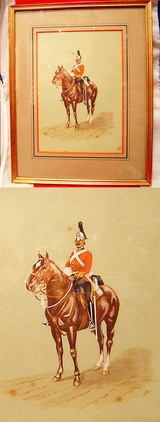
A Superb, Original Watercolour of a Victorian 1st Royal Dragoons NCO by H.R. Coombe
A most attractive portrait of a mounted Sergeant of Dragoons in full dress probably late Victorian. One of the non commissioned officers of one of the great historical regiments of the British Army. 14 x 19 framed picture 8.75 x 12.5 inches The regiment also fought at the Battle of Beaumont in April 1794 and the Battle of Willems in May 1794 during the Flanders Campaign. It served under Viscount Wellesley, as the rearguard during the retreat to the Lines of Torres Vedras in September 1810, and charged the enemy at the Battle of Fuentes de Onoro in May 1811 during the Peninsular War. The regiment also took part in the charge of the Union Brigade under the command of Major-General William Ponsonby at the Battle of Waterloo in June 1815 during the Hundred Days Campaign. Captain Alexander Kennedy Clark, an officer in the regiment, captured the French Imperial Eagle of the 105th Line Infantry Regiment during the battle.
In 1816 a detachment of the regiment was involved with suppressing the Littleport riots.
Rough Rider Robert Droash of the 1st Royal Dragoons after serving in the Crimean War in 1856
The regiment, under the command of Lieutenant-Colonel John Yorke, also took part in the charge of the heavy brigade at the Battle of Balaclava in October 1854 during the Crimean War. Having been re-titled the 1st (Royal) Dragoons in 1877, the regiment also saw action at the Battle of Abu Klea in January 1885 during the Mahdist War. In January 1900, during the Second Boer War, the regiment was part of a force that set out to discover the western flank of the Boer lines. It was able to ambush a column of about 200 Boers near Acton Homes and successfully trapped about 40 of them. Following the end of the war, 623 officers and men of the regiment left South Africa on the SS Kildonan Castle, which arrived at Southampton in October 1902.
The regiment, which had been serving at Potchefstroom in South Africa when the First World War started, returned to the UK and than landed at Ostend as part of the 6th Cavalry Brigade in the 3rd Cavalry Division in October 1914 for service on the Western Front.[9] It took part in the First Battle of Ypres in October 1914, the Second Battle of Ypres in April 1915, the Battle of Loos in September 1915 and the advance to the Hindenburg Line in 1917 read more
475.00 GBP
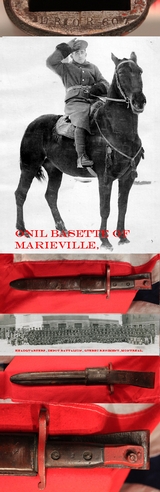
A Most Desirable & Rare Canadian WW1 Historical Regimental Ross Bayonet of The 1st Depot Battalion, 1st Quebec Regt. One Of The Great Heroic Regiments Of Canada From The Close of the Great War.
A veritable museum grade collectors piece. With superb regimental markings from the small number of conscripts and heroes of the ill fated, 1st Depot Batt. The Quebec Regt. Who suffered a terrible percentage of casualties at the Western Front.
A fairly uncommon bayonet to find, even unmarked of regimental details these days, but, very rare indeed to find with good regimental markings, especially by such a small detachment of conscripts from a regiment of such noble history. A draft of Military Service Act, 1917 conscripts from the 1st Depot Battalion, Quebec Regiment, Montreal sailed on the S.S. Scandinavian March 25, 1918 arriving in England April 3, 1918. The total size of this draft at present is unknown probably about 500 soldiers. What is known is that 140 of this draft were channelled through the 23rd Reserve Battalion into the 14th (Royal Montreal) Battalion. Of this draft of 140 soldiers,100 were casualties with 22 deaths all within the last 100 days of the war! Photo in the gallery of Headquarters, Depot Battalion, Quebec Regiment, Montreal, March 27, 1918, Lt.-Col. L.J. Daly-Gingras, D.S.O., O.C. A photo in the gallery of a mounted soldier, Onil Basette of Marieville, 1st Depot Battalion, 1st Quebec Regiment, taken in 1918. The bayonet metal is unusually painted red . Details of their noble and heroic service in just those 100 days are including in the following engagements; The Advance in Picardy (8 August 3 September, 1918) Amiens 8-11 August 1918
The Breaking of the Hindenburg Line (26 August ? 12 October, 1918) Arras, 1918 26 August 3 September 1918
Scarpe, 1918 26-30 August 1918
Drocourt-Queant Line 2-3 September 1918
Hindenburg Line, Battles of the 12 September 9 October 1918
Canal du Nord 27 September 2 October 1918
Picardy (17 October 11 November) Pursuit to Mons 11 November 1918 read more
365.00 GBP

A Simply Stunning Ancient Roman Museum Grade Fine Gold Seal Ring with Intaglio Portrait Engraved Garnet Gem Stone 2nd to 3rd Century A.D. Likely a Depiction of an Emperor Such As Hadrian, Marcus Aurelius, Lucius Verus, or Even A Parthian Vassal King.
A museum grade, around 1900 year old pure gold ancient Roman intaglio carved garnet gemstone seal ring.
Worn by such a noble as the rank of Imperial Legate { Legatus Augusti pro praetore}. The commander of two or more legions, who also served as the governor of an eastern province in which the legions he commanded were stationed. He was of Senatorial rank and was appointed by the Emperor for a term of 3 or 4 years.
The carved gem’s seal is depicting a profile hand carving, possibly of an Emperor such as Verus, or vassal King of Parthia. Possibly as a celebration of Verus’s ‘Triumph’ from the Parthian War. Classified by the seminal classification of ancient ring forms, by Dr. Martin Henig, as Ancient Roman, Henig type II
The Roman triumph was one of ancient Rome’s most important civic and sacred institutions. These spectacular processions were celebrations of Rome’s military victories, the courage of its soldiers, and the favour of the gods. They were also one of the highest honors a Roman man could achieve: designated a triumphator, he was awarded a grand procession through the imperial capital. The lavish parade of prisoners and captured treasures was sure to guarantee the eternal fame of the conquering general. Over time, the triumph became an important tool in the manipulation of Roman politics.
Made and worn by the highest ranking Roman, such as a Legate, possibly even a member of the Imperial household at the time from Emperors Marcus Aurelias, Lucius Verus, & Commodus, and just into the early following century.
Rings were one of the most popular pieces of jewellery in Roman culture. Under the Republic the wearing of gold rings was exclusively reserved to certain classes of persons or for specific occasions. In the late 3rd century BC only senators and knights equo publico had this privilege. Towards the end of the Republic, gold rings were also bestowed on civilians. Under the Roman Empire gold rings, although still regarded as a privilege and awarded as a military distinction
During the era of dual Emperors Marcus Aurelius, and Lucius Verus, 161 to 180 ad, the last part of his reign was dramatically represented in the blockbuster film 'Gladiator', starring Richard Harris as the Emperor Marcus Aurelias. He acceded to the throne of Emperor alongside his adoptive brother, who reigned under the name Lucius Verus. Under his rule the Roman Empire witnessed heavy military conflict. In the East, the Romans fought successfully with a revitalised Parthian Empire and the rebel Kingdom of Armenia. Marcus defeated the Marcomanni, Quadi, and Sarmatian Iazyges in the Marcomannic Wars; however, these and other Germanic peoples began to represent a troubling reality for the Empire. Ultimately, the Romans were victorious in the Parthian War of 161-167 CE. After the sacking of Ctesiphon and Seleucia, Lucius Verus took the title Parthicus Maximus. As a feature of his imperial titulature, the epithet conveyed his military might and power. But the question remains: to what extent can the Roman victory over the Parthian Empire be attributed to Verus?
Indeed, much of the successes the Romans enjoyed in this eastern war surely belong to the supremely able retinue of generals and administrators who were with Verus at the time. Regardless, upon his return from the campaign, Verus was awarded a triumph, the traditional celebration of Roman military conquest that had been used since the Republican era. This was to be the high point of Verus’ imperial story, however. In 169 CE, as he was journeying back from the Danubian frontier — where he had been fighting in the Marcomannic wars with Marcus Aurelius — Verus suddenly fell ill and died. It is highly probable, according to historians, that Verus was a victim of the pestilence that his soldiers had carried back to the empire with them from the Parthian War.
Commodus. the successor and son of Emperor Antoninus Pius,, was the Roman emperor who ruled from 177 to 192. He served jointly with his father Marcus Aurelius from 177 until the latter's death in 180, and thereafter he reigned alone until his assassination. His reign is commonly thought of as marking the end of a golden period of peace in the history of the Roman Empire, known as the Pax Romana.
Commodus became the youngest emperor and consul up to that point, at the age of 16. Throughout his reign, Commodus entrusted the management of affairs to his palace chamberlain and praetorian prefects, named Saoterus, Perennis and Cleander.
Commodus's assassination in 192, by a wrestler in the bath, marked the end of the Nerva–Antonine dynasty. He was succeeded by Pertinax, the first emperor in the tumultuous Year of the Five Emperors.
Jewellery in the Roman Republic
The core ideologies of the Roman Republic, centred around moderation and restraint, meant that elaborate jewellery was relatively unpopular until the transformation to imperial rule. The law of the Twelve Tables in the 5th century BC, limited the amount of gold which might have been buried with the dead. The Lex Oppia, 3rd century BC, fixed at half of an ounce the amount of gold which a Roman lady might have worn. During the Roman Empire, however, jewellery became a public display of wealth and power for the elite.
Rings of the higher ranks were often embellished with intaglios, cameos and precious gemstones. Mythology and Roman history were used as a repertoire of decorative themes. Roman rings featuring carved gemstones, such as carnelian, garnet or chalcedony, were often engraved with the depiction of deities, allegories and zoomorphic creatures.
1 inch across, UK size H1/2, {measured on the round inside the oval} 9.6 grams, approx 22 carat gold 91.16% Gold, 6.66% silver, 1.93% copper, which is a typical consistency of ancient Roman gold determined by x-ray flourescence analysis with Oxford Instruments in 2017
As with all our items it comes complete with our certificate of authenticity. read more
8950.00 GBP

A Good, Antique, Edo Period Iron Plate 17th Century Saotome Tembo Katana Tsuba, From The Tembo School of Tsubako.
A well hammered rough surface forged iron plate Saotome Tembo tsuba.
The first master of the Saotome school was Nobuyasu of Shimotsuke. Nobuyasu moved to Odawara in Sagami were the Saotome school itself was founded. Some of the early Saotome makers were Nobuyasu, Iyenori, Iyetsugu, Iyetada and Iyesada although there is some disagreement on the lineage of the school. There were many other generations working well into the late Edo period. The Saotome School gave rise to the Tembo School of tsubako.
Tempo {Tembo} school and the yakite finish (heat treatment) is typical, as is the excellent iron. Typical wildness of the hot-stamping, and it is very finely constructed. The patina is amazingly soft and velvety, kozuka and kogai ana, on each side, numerous deep stamps, kozuka and kogai hitsu ana (suhama) copper ume infills. 74 mm read more
495.00 GBP
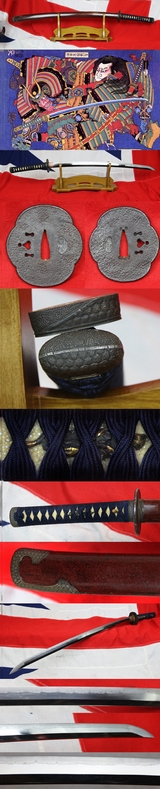
A Very Good & Beautiful Shinto Long Katana Signed Chikanobu. Very Good, Unique Matsushiro Sinano Sinchu & Silver Line Koshirae. Gold and Shakudo Dragon Clutching The Pearl Of Wisdom Menuki. Circa 1680.
All original Edo period mounts and lacquer saya. Fine iron tsuba. With a very beautiful choji hamon to the blade is an absolute beauty, and fully polished.
Long kissaki. Dark blue silk tsukaito over traditional giant rayskin with gold and bronze menuki of dragons. Fully matching suite of sinchu and contrasting silver line mounts to the tsuka and saya, of the Matsushiro Sinano school. A well hammered rough surface...smooth rim though, Saotome Tembo tsuba with kakine kokuin stamps, udenuki-ana, lead ume, uchikaeshi mimi rim, boars eye piercing.
The first master of the Saotome school was Nobuyasu of Shimotsuke. Nobuyasu moved to Odawara in Sagami were the Saotome school itself was founded. Some of the early Saotome makers were Nobuyasu, Iyenori, Iyetsugu, Iyetada and Iyesada although there is some disagreement on the lineage of the school. There were many other generations working well into the late Edo period. The Saotome School gave rise to the Tembo School of tsubako.
The Tembo School (also spelled Tempo, Tenpo or Tenbo) also worked well into the Edo Period. They are most noted for the use of kokuin (hot stamps) on their plates,
This unique original mounting is called “Matsushiro” koshirae which was specially made in Matsuro-han in Shinano (Nagano) province in the edo period.
The samurai were roughly the equivalent of feudal knights. Employed by the shogun or daimyo, they were members of hereditary warrior class that followed a strict "code" that defined their clothes, armour and behavior on the battlefield. But unlike most medieval knights, samurai warriors could read and they were well versed in Japanese art, literature and poetry.
Samurai endured for almost 700 years, from 1185 to 1867. Samurai families were considered the elite. They made up only about six percent of the population and included daimyo and the loyal soldiers who fought under them. Samurai means ?one who serves."
Samurai were expected to be both fierce warriors and lovers of art, a dichotomy summed up by the Japanese concepts of to stop the spear exanding into bushido (the way of life of the warrior) and bun (the artistic, intellectual and spiritual side of the samurai}. Originally conceived as away of dignifying raw military power, the two concepts were synthesized in feudal Japan and later became a key feature of Japanese culture and morality.The quintessential samurai was Miyamoto Musashi, a legendary early Edo-period swordsman who reportedly killed 60 men before his 30th birthday and was also a painting master. Members of a hierarchal class or caste, samurai were the sons of samurai and they were taught from an early age to unquestionably obey their mother, father and daimyo. When they grew older they were trained by Zen Buddhist masters in meditation and the Zen concepts of impermanence and harmony with nature. The were also taught about painting, calligraphy, nature poetry, mythological literature, flower arranging, and the tea ceremony.
As part of their military training, samurai were taught to sleep with their right arm underneath them so if they were attacked in the middle of the night and their the left arm was cut off the could still fight with their right arm. Samurai that tossed and turned at night were cured of the habit by having two knives placed on either side of their pillow.
Samurai have been describes as "the most strictly trained human instruments of war to have existed." They were expected to be proficient in the martial arts of aikido and kendo as well as swordsmanship and archery---the traditional methods of samurai warfare---which were viewed not so much as skills but as art forms that flowed from natural forces that harmonized with nature.
An individual didn't become a full-fledged samurai until he wandered around the countryside as begging pilgrim for a couple of years to learn humility. When this was completed they achieved samurai status and receives a salary from his daimyo paid from taxes (usually rice) raised from the local populace. Swords in Japan have long been symbols of power and honour and seen as works of art. Often times swordsmiths were more famous than the people who used them.
likely details on the Chikanori nobu. Slight name change here, he was then actually signing Chikanobu as he did on this blade, appears in kanji reference notes as nori, nobu is next to nori, and thus often confused . He also used to be known as Shigechika
Chikanobu, previously known as Shigechika, studied under 1st generation Aizu Kanetomo, circa 1660.
Chikanobu received the name nobu from Kanetomo as an honour to therefore thus change his name.
Kanetomo also used to be known as another name once, Kanenobu and thus passed the nobu name to Shigechika as an honour, who thus changed his name to Chikanobu read more
7950.00 GBP

A Superb 'Tower of London' Made Front Line Regimental British Light Dragoon & Hussars Flintlock Pistol Circa 1802 Napoleonic Wars, Peninsular War and Waterloo Service use
Excellent walnut stock with original patina to all parts steel brass and walnut. All fine brass fittings and captive ramrod. In original flintlock, made byThe Tower of London Armoury. GR Crown Tower stamped lock plate. With numerous ordnance inspectors stamps throughout.
This is the pattern of pistol for use by British Light Dragoon & Hussars Cavalry regiments, and called the New Land Pattern, used initially from around 1802, during the Peninsular War, the War of 1812, and the Hundred Days War, culminating at Waterloo.
It is simply a superb Napoleonic wars original collector's item and good condition example. Certainly with usual signs of combat service use but with excellent natural age patina. Excellent perfect crisp action.
Introduced in the 1796 and in production by 1802, the New Land Pattern Cavalry Pistol provided one model of pistol for all of Britain's light cavalry and horse artillery. Another new element was its swivel all steel ramrod, which greatly improved the process of loading the pistol on horseback and ensuring no loss of ramrod due to miss-handling or dropping..
The regiments that used this very pistol under The Duke of Wellington's command were;
Hussars
7th (Queen's Own) Regiment of (Light) Dragoons (Hussars) — white facings, silver lace and buttons, blue and white sash
15th (King's) Regiment of (Light) Dragoons (Hussars) — red facings, silver lace and buttons, red and yellow sash
18th Regiment of (Light) Dragoons (Hussars) — white facings, silver lace and buttons, blue and white sash, grey dolmans
Light Dragoons
8th (King's Royal Irish) Regiment of (Light) Dragoons — red facings, silver lace and buttons, blue and red belt, grey dolmans
9th Regiment of (Light) Dragoons — red facings, gold lace and buttons, blue and yellow belt
10th (Prince of Wales's Own Royal) Regiment of (Light) Dragoons — red facings, silver lace and buttons, red and yellow sash
11th Regiment of (Light) Dragoons — buff facings, silver lace and buttons, blue and buff belt
12th (Prince of Wales's) Regiment of (Light) Dragoons — yellow facings, silver lace and buttons, blue and yellow belt
13th Regiment of (Light) Dragoons — buff facings, gold lace and buttons, blue and buff belt
14th (Duchess of York's Own) Regiment of (Light) Dragoons — orange facings, silver lace and buttons, blue and orange belts
16th (Queen's) Regiment of (Light) Dragoons — red facings, silver lace and buttons, blue and red belt
17th Regiment of (Light) Dragoons — white facings, silver lace and buttons, blue and white belt
19th Regiment of (Light) Dragoons — yellow facings, gold lace and buttons, blue and yellow belt
20th Regiment of (Light) Dragoons — orange facings, gold lace and buttons, blue and orange belt
21st Regiment of (Light) Dragoons — pink facings (black from 1814), gold lace and buttons, blue and pink belt
22nd Regiment of (Light) Dragoons — pink facings, gold lace and buttons, blue and pink belt, grey dolmans
23rd Regiment of (Light) Dragoons — red facings (maybe yellow), silver lace and buttons, blue and red belt
24th Regiment of (Light) Dragoons — grey facings, gold lace and buttons, blue and grey belt
25th Regiment of (Light) Dragoons — grey facings, silver lace and buttons, blue and grey belt, grey dolmans
The division between 'heavy' and light was very marked during Wellington's time: 'heavy' cavalry were huge men on big horses, 'light' cavalry were more agile troopers on smaller mounts who could harass as well as shock.
During the Napoleonic Wars, French cavalry was un-excelled. Later, as casualties and the passage of years took their toll, Napoleon found it difficult to maintain the same high standards of cavalry performance. At the same time, the British and their allies steadily improved on their cavalry, mainly by devoting more attention to its organization and training as well as by copying many of the French tactics, organization and methods. During the Peninsular War, Wellington paid little heed to the employment of cavalry in operations, using it mainly for covering retreats and chasing routed French forces. But by the time of Waterloo it was the English cavalry that smashed the final attack of Napoleon's Old Guard.
We show superb Napoleonic Light Dragoons illustration prints in the gallery by David Higham, that were gifted to us by a grateful client.
These can be bought at the link below, and they are extremely comfortably priced.
https://www.printsforartssake.com/products/7th-queens-own-british-regiment-of-light-dragoons-waterloo-1815.
This is a complimentary recommendation, for which we make no financial gain
Every single item from The Lanes Armoury is accompanied by our unique Certificate of Authenticity. Part of our continued dedication to maintain the standards forged by us over the past 100 years of our family’s trading, as Britain’s oldest established, and favourite, armoury and gallery read more
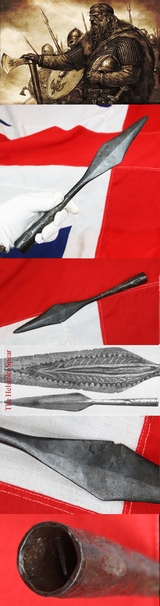
A Superb, Original, Long Viking Spear Head 1000 to 1100 Years Old, In Superb Excavated Condition. A True Museum Piece
Overall in superb and well preserved condition. Only deeper pitting on the socket, and small impact damage to one outer edge of the diamond form blade. Remarkably the socket still has it remaining rivet for fixing to the wooden haft at the base on the inside. This almost certainly may be a traditional Viking pattern welded blade, in the traditional 'Wolf's Teeth' form, but the surface is too intact to tell, however its shape is very similar to the most famous recovered 'Wolf's Teeth' Viking spear head in Helsinki Museum see gallery. According to the older parts of the Gulating Law, dating back to before the year 900 AD covering Western Norway, a free man was required to own a sword or ax, spear and shield. It was said that Olaf Tryggvason, King of Norway from 995-1000 AD, could throw two spears at the same time. In chapter 55 of Laxdæla saga, Helgi had a spear with a blade one ell long (about 50cm, or 20in). He thrust the blade through Bolli's shield, and through Bolli. In chapter 8 of Króka-Refs saga, Refur made a spear for himself which could be used for cutting, thrusting, or hewing. Refur split Þorgils in two down to his shoulders with the spear. The spearheads were made of iron, and, like sword blades, were made using pattern welding techniques (described in the article on swords) during the early part of the Viking era . They could be decorated with inlays of precious metals or with scribed geometric patterns
After forming the head, the smith flattened and drew out material to form the socket . This material was formed around a mandrel and usually was welded to form a solid socket. In some cases, the overlapping portions were left unwelded. Spear heads were fixed to wooden shafts using a rivet. The sockets on the surviving spear heads suggest that the shafts were typically round, with a diameter of 2-3cm (about one inch).
However, there is little evidence that tells us the length of the shaft. The archaeological evidence is negligible, and the sagas are, for the most part, silent. Chapter 6 of Gísla saga tells of a spear so long-shafted that a man's outstretched arm could touch the rivet. The language used suggests that such a long shaft was uncommon.
Perhaps the best guess we can make is that the combined length of shaft and head of Viking age spears was 2 to 3m (7-10ft) long, although one can make arguments for the use of spears having both longer and shorter shafts. A strong, straight-grained wood such as ash was used. Many people think of the spear as a throwing weapon. One of the Norse myths tells the story of the first battle in the world, in which Oðin, the highest of the gods, threw a spear over the heads of the opposing combatants as a prelude to the fight. The sagas say that spears were also thrown in this manner when men, rather than gods, fought. At the battle at Geirvör described in chapter 44 of Eyrbyggja saga, the saga author says that Steinþórr threw a spear over the heads of Snorri goði and his men for good luck, according to the old custom. More commonly, the spear was used as a thrusting weapon. The sagas tell us thrusting was the most common attack in melees and one-on-one fighting, and this capability was used to advantage in mass battles. In a mass battle, men lined up, shoulder to shoulder, with shields overlapping. After all the preliminaries, which included rock throwing, name calling, the trading of insults, and shouting a war cry (æpa heróp), the two lines advanced towards each other. When the lines met, the battle was begun. Behind the wall of shields, each line was well protected. Once a line was broken, and one side could pass through the line of the other side, the battle broke down into armed melees between small groups of men.
Before either line broke, while the two lines were going at each other hammer and tongs, the spear offered some real advantages. A fighter in the second rank could use his spear to reach over the heads of his comrades in the first rank and attack the opposing line. Konungs skuggsjá (King’s Mirror), a 13th century Norwegian manual for men of the king, says that in the battle line, a spear is more effective than two swords. In regards to surviving iron artefacts of the past two millennia, if Western ancient edged weapons were either lost, discarded or buried in the ground, and if the ground soil were made up of the right chemical composition, then some may survive exceptionally well. As with all our items it comes complete with our certificate of authenticity 13.5 inches long 350 grams weight. read more
1550.00 GBP

Very Rare, Possibly the Oldest Surviving Example in Existence, From The 18th Century, King George IIIrd 'Bow Street Runner's' Thief-Taker's or Beadle's Quarterstaff With Royal Crest From the Century Before the Founding of The Earliest British Police
Bearing the hand painted decoration of a large gilt and coloured crown, and a gilt GR monogram for the monarch, King George IIIrd, a district crest of a quartered circle, and monogram B.B. above the date 1783. This might well be the parish of Bromley-by Bow, now in Tower Hamlets Borough in London, where Bow was located, but this has to be conjecture as we have never seen one as old as this before, in, or out, of a museum collection. The warrant officer's tipstaff is recorded in writing as far back as the 14th century, but no example exists. The parish of Bromley-by-Bow has historic pedigree, appearing in the correspondence of Oliver Cromwell.
As far as we know this may be the oldest surviving law enforcement officer's, staff or trucheon, dated, with the royal crest, certainly in Britain, possibly the world. Incredibly dated from the time of the American Revolutionary War, aka the American War of Independence, when America was a British colony. We can't recall ever seeing even an 18th century crested staff or trucheon in over 50 years. A few years ago one dated 1804 was found, and made a trade magazine headline, as possibly the oldest ever truncheon, and this was made and in service over twenty years before then.
The Bow Street Runners were the law enforcement officers of the Bow Street Magistrates' Court in the City of Westminster. They have been called London's first professional police force. The force originally numbered six men and was founded in 1749 by magistrate Henry Fielding, who was also well known as an author. His assistant, brother, and successor as magistrate, John Fielding, moulded the constables into a professional and effective force. Bow Street Runners was the public's nickname for the officers although the officers did not use the term themselves and considered it derogatory. The group was disbanded in 1839 and its personnel merged with the Metropolitan Police, which had been formed ten years earlier but the London metropolitan detective bureau trace their origins back from there.
Magistrate Henry Fielding decided to regulate, regularise, formalise and legalise the thief-takers' activity due to high rates of corruption and mistaken or malicious arrests, therefore creating the Bow Street Runners. His Runners were not dissimilar to the thief-takers, but differed from them in their formal attachment to the Bow Street magistrates' office and in being paid by the magistrate with funds from central government. They worked out of Fielding's office and court at No. 4 Bow Street, and did not patrol but served writs and arrested offenders on the authority of the magistrates, travelling nationwide to apprehend criminals.
It has a some surface paint wear caused by service use in its working life. Based on the old English quarterstaff a beadle or Bow Street Runner's walking stave that was originally used in the days before a force had been designed for the British service. It was a means of identifying the bearer as to his rank, status and authority as a police constable, yet still a most effective weapon of defence and restraint when required, but they continued in use after uniforms were fully standard, but only for a brief period. Very few of these most unusual original police service artifacts survive today. Stick fighting was prevalent throughout historical European martial arts and indeed worldwide. The oldest systematic descriptions of stick-fighting methods in Europe date to the 15th century. The oldest surviving English work giving technical information on staff combat dates from the 15th century - it is a brief listing of "strokes of the 2-hand staff", which shares terminology with the preceding "strokes of the 2-hand sword" in the same manuscript. George Silver (1599) explains techniques of short staff combat, and states that the use of other polearms and the two-handed sword are based on the same method. Later authors on the subject included Joseph Swetnam, Zachary Wylde, and Donald McBane. Silver, Swetnam, and Wylde all agreed that the staff was among the best, if not the very best, of all hand weapons.
During the 16th century quarterstaves were favoured as weapons by the London Masters of Defence. Richard Peeke, in 1625, and Zachary Wylde, in 1711, refer to the quarterstaff as a national English weapon. By the 18th century the weapon became popularly associated with gladiatorial prize playing. A modified version of quarterstaff fencing, employing bamboo or ash staves and protective equipment adapted from fencing, boxing and cricket was revived as a sport in some London fencing schools and at the Aldershot Military Training School during the later 19th century. Works on this style were published by Thomas McCarthy and by Allanson-Winn and Phillips-Wolley. A superb photo in the gallery of an early 19th century city Beadle with his near identical quarter staff.
68 inches long, in very good condition. The very top and bottom 1/2 inch has traces of old extinct worm.
Ref; picture in the gallery https://collections.britishart.yale.edu/catalog/tms:2605.
Free for all, public domain
UK mainland regular delivery only due to length, export delivery by request read more